Svenska Dokumentmallar
Evidence Collection for Future Security – Application, Risk of Evidence, & Excel | Word/PDF
Evidence Collection for Future Security – Application, Risk of Evidence, & Excel | Word/PDF
- File format
- DOCX, PDF, XLSX
- Document language
- Swedish documents and English User Guide
- Number of files
- 7
Digital download. No physical product is shipped.
Couldn't load pickup availability
About this template
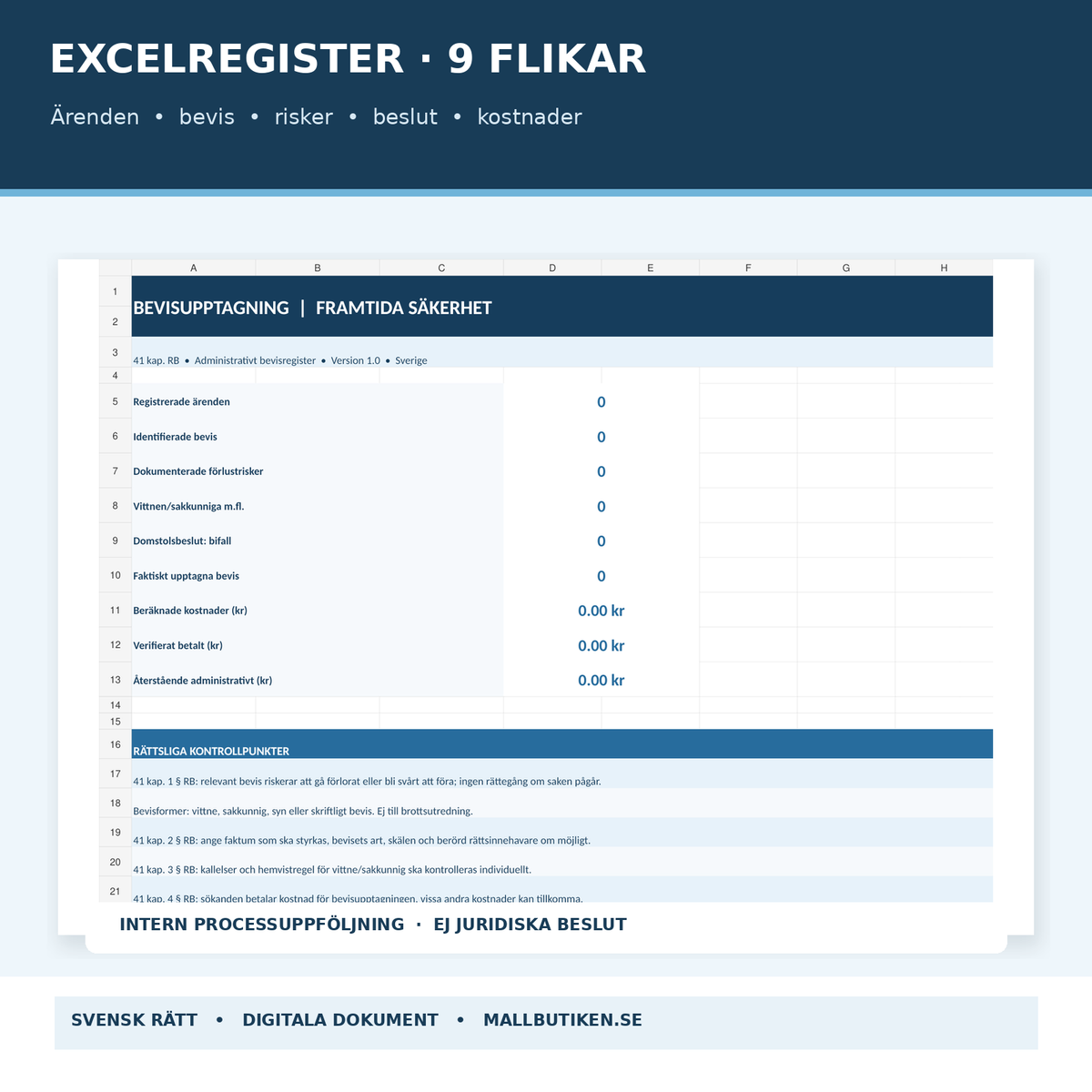
Pre-trial evidence collection – application, evidence risk and witness documentation. A complete template package for those who need to prepare an application to secure concrete evidence that might otherwise be lost or become difficult to present in future civil proceedings. The package contains editable Word documents, corresponding searchable PDF files, and an Excel register with nine tabs.
Important limitation: The rules in Chapter 41 of the Swedish Code of Judicial Procedure apply when no court proceedings are underway regarding the circumstances in question. The procedure may not be used for the purpose of investigating crimes. It is not a general investigative procedure and does not grant a general right to obtain the opposing party's documents or IT systems. Only the court may review and decide on the collection of evidence.
What is pre-trial evidence collection?
According to Chapter 41, Section 1 of the Swedish Code of Judicial Procedure, evidence may be collected in advance when there is a risk that evidence regarding circumstances of importance to someone's rights will otherwise be lost or become difficult to present. Permissible forms of evidence under the provision include witnesses, expert testimony, inspections, and written evidence. The applicant must be able to state a concrete future evidentiary issue and explain why the collection is necessary.
01. Package Contents
15 digital customer files: 7 editable Word files (.docx), 7 corresponding searchable PDF files (.pdf), and 1 Excel workbook (.xlsx) with nine tabs. The package contains five Swedish operational working documents, a Swedish user guide, and an English-language user guide. The PDF files are not interactive official forms. Delivery is provided as a ZIP file.
02. What the Files Contain
Draft application to the district court, evidence and risk log, documentation for witness and expert testimony or inspection, specification of written documents, special cost and decision log, and two guides. The Excel register contains only actual cases, identified evidence, risk data, persons, costs, and verified decisions.
Document List – All Files
| Document | What It Is Used For | Format |
|---|---|---|
| 01. Application for Pre-Trial Evidence Collection | Draft application stating the right, evidentiary issue, form of evidence, risk of loss, and affected rights | DOCX + PDF |
| 02. Risk of Loss of Evidence | Fact-based risk analysis and specific evidentiary issue for each piece of evidence | DOCX + PDF |
| 03. Witness, Expert Testimony, and Inspection | Identification of persons and objects, location, questions, and practical collection | DOCX + PDF |
| 04. Written Evidence and Evidentiary Objects | Documents, metadata, provenance, availability, and protected information | DOCX + PDF |
| 05. Costs and Court Decisions | Applicant's cost liability, actual decisions, and follow-up | DOCX + PDF |
| 06. Swedish User Guide | Step-by-step workflow and legal requirements | DOCX + PDF |
| 07. User Guide EN | English reference guide for the Swedish documents | DOCX + PDF |
| 08. Evidence Register in Excel | Nine tabs with administrative overview, status management, and cost formulas | XLSX |
Excel Register – Nine Tabs
Overview, Cases, Evidence, Risks, Persons, Collection, Costs, Events, and Read Me. The Overview shows only the number of actually registered cases, evidence, and events, as well as reconciliations of entered costs. The cost formula subtracts verified paid amounts from preliminary cost items; the result is an administrative difference, not a legally determined compensation amount.
Excel does not decide whether an application should be accepted, whether evidence is relevant, whether a person must appear in court, which cost is reasonable, or what information may legally be used.
How to Use the Template Package
- First, check that no court proceedings are already underway regarding the circumstances to which the evidence relates. Different procedural rules apply to evidence in ongoing cases.
- Identify a concrete circumstance that is of importance to someone's rights, and describe why it may become relevant in future civil proceedings.
- Select the form of evidence: witness, expert testimony, inspection, or written document. State exactly which evidentiary issue is to be proven.
- Document the actual risk that the evidence will be lost or become very difficult to present later. Use verifiable circumstances and dates.
- State the nature of the evidence, the reasons for early collection, and, if possible, the persons whose rights may otherwise depend on the measure, pursuant to Chapter 41, Section 2.
- Check questions regarding the court's jurisdiction, possible summons, and the location of witnesses and experts pursuant to Chapter 41, Section 3.
- Make a separate cost assessment pursuant to Chapter 41, Section 4. The applicant generally pays the costs of the collection of evidence; special compensation may be available.
- Send a completed, individually reviewed application to the correct district court and follow its instructions. Register only actual decisions and completed collections of evidence in Excel.
Legal Requirements
Chapter 41, Section 1 – Risk of Loss of Evidence
The relevant legal circumstance must be concrete, and the evidence must be at risk of being lost or becoming difficult to present in the future. The procedure is intended to secure evidence, not to discover whether a claim may exist or to conduct a criminal investigation.
Chapter 41, Section 2 – What the Application Must Contain
Describe the circumstance to be proven, the nature of the evidence, and the concrete reasons for the collection of evidence. If possible, state the person or persons whose rights may otherwise depend on the measure. A general request to obtain all material is not a sufficiently specified statement.
Chapter 41, Section 3 – Procedure, Location, and Summons
The rules for the collection of evidence outside of a main hearing apply in relevant parts. Witnesses and experts are not required to appear at any court other than where they are domiciled. Questions regarding the presence and summons of affected persons must be examined in each individual case.
Chapter 41, Section 4 – Cost Liability
The applicant shall bear the costs of the collection of evidence. If another affected person has been summoned and appeared, the applicant may also need to compensate for necessary travel and accommodation costs and reasonable loss of time, according to the court's assessment. It is therefore important to document both preliminary and actual costs.
Frequently Asked Questions
Can I Use the Template if the Dispute Is Already Before the District Court?
Not for an application under Chapter 41 if the circumstances in question are already the subject of court proceedings. In that case, the rules for the collection of evidence within the existing case must be considered.
Can I Secure Witness Testimony Before the Court Hearing?
Yes, if the conditions in Chapter 41, Sections 1–4 are met. A relevant concrete evidentiary issue and a real risk that the evidence will otherwise be lost or become difficult to present are required.
Can I Obtain Access to All of the Opposing Party's Documents?
No. Pre-trial evidence collection is not a general information or discovery procedure. A documentary piece of evidence must be assessed according to its own legal basis and applicable limitations.
Who Pays for the Collection of Evidence?
As a general rule, the applicant pursuant to Chapter 41, Section 4 of the Swedish Code of Judicial Procedure. Depending on the summons and actual appearance, special compensation for affected persons may be available.
Can I Use the Documents for a Criminal Investigation?
No. Chapter 41, Section 1 expressly prohibits evidence from being collected under this chapter for the purpose of investigating crimes.
Is the Evidence Automatically Admissible in a Later Dispute?
No. Pre-trial collection of evidence does not decide a future dispute or replace the court's later assessment of relevance, evidentiary value, or applicable procedural rules.
Related Document Templates
See Business Agreements – Templates for related business and procedural templates. The package complements documents for orders for production, complaints, statements of defense, and other evidence, but does not replace them.
Legal Sources, Version, and Review
Legal basis: Swedish Code of Judicial Procedure (1942:740), especially Chapter 41, Sections 1–4, as well as referenced provisions on evidence in Chapters 35–40. Version v1.0, Sweden, dated November 1, 2026. AI-assisted legal source review and document review have been performed. No external independent legal review or official approval is claimed.