Svenska Dokumentmallar
Tire Hotel – Complaints About Missing Tires, Storage Damage, and Compensation | Word/PDF/Excel
Tire Hotel – Complaints About Missing Tires, Storage Damage, and Compensation | Word/PDF/Excel
- File format
- DOCX, PDF, XLSX
- Document language
- 5 Swedish work instructions 1 Swedish user guide and 1 English User Guide; the work instructions are only in Swedish
- Number of files
- 7
Digital download. No physical product is shipped.
Couldn't load pickup availability
About this template
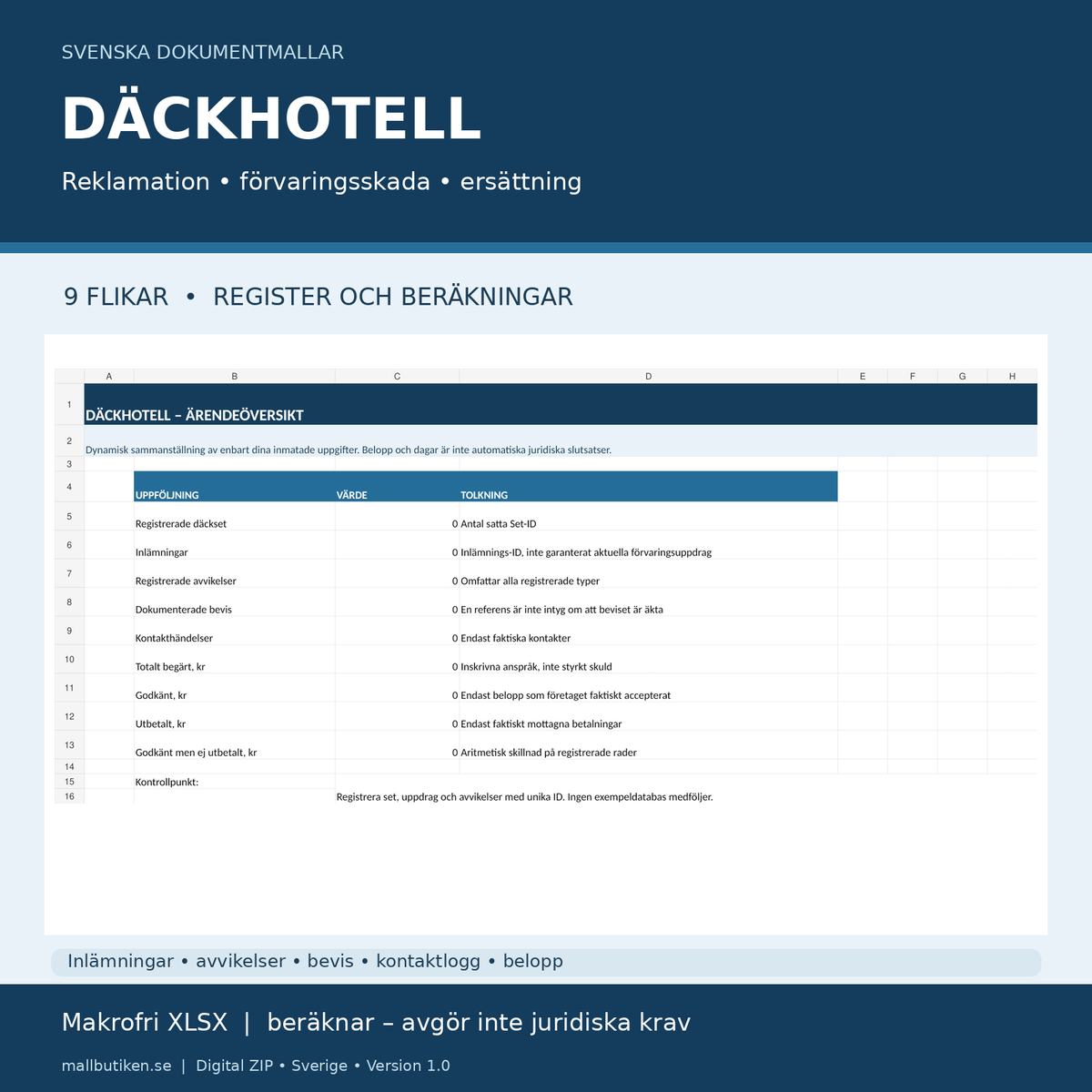
Are your tires missing after being left at a tire hotel, have you received the wrong wheels back, or discovered storage damage? This document package helps you as a consumer make a formal complaint about defects in tire storage, request an investigation or return, object to incorrect charges, and specify a documented claim for compensation. The package contains five different Swedish customer letters, two guides, and an Excel register with nine tabs.
Quick answer: Keep the drop-off receipt and storage agreement, note the tire dimensions and markings, document the condition, and describe the actual discrepancy. Contact the tire hotel in writing. The storage of loose items is covered by the Consumer Services Act (1985:716), Section 1, third point, with its own rules for defects in storage (Section 15). A loss or damage does not automatically lead to a specific compensation amount.
01 · Package contents
Five Swedish complaint letters, one Swedish user guide, and an English User Guide in Word (.docx) and searchable PDF (.pdf). Also, a macro-free Excel workbook (.xlsx) with nine tabs. 7 DOCX + 7 PDF + 1 XLSX = 15 customer files in a digital ZIP. The PDF versions are printable but are not interactive fillable forms.
02 · What the files contain
Written investigation for missing wheels, complaint about storage damage, request for return after delay, specified invoice objection, and substantiated compensation claims. Excel keeps track of tire sets, drop-offs, contract terms, discrepancies, images, contacts, and amounts, without automatically determining liability or the right to compensation.
Which letter should you use?
1. The tire hotel cannot find your wheels: Choose letter 01 and identify the dropped-off set with the receipt, label, dimensions, and any photos. Request a written investigation before determining the compensation value. If a different set is offered, you do not automatically have to assume it corresponds to your wheels.
2. Tires or rims are damaged after storage: Choose letter 02. Describe the condition before and after as accurately as possible, what damage has been discovered, and what images or statements you have. Have an expert inspect damaged or suspected unsafe tires before they are used.
3. The tire hotel cannot return the wheels on the agreed day: Use letter 03 to document the delay and request a concrete return time. Record any necessary, substantiated additional costs separately.
4. You have received an incorrect tire hotel invoice: Use letter 04 if the storage fee, tire change, wash, or other additional service has been charged differently than agreed. Object to a specified incorrect part and handle undisputed amounts separately.
5. You need to specify a financial claim: Use letter 05 after you have documented the age, condition, relevant value, actual additional costs, and any insurance compensation of the tires. **The new purchase price is not automatically the compensation value for used tires.**
Complete file list
| Document | Use | Language | Format |
|---|---|---|---|
| 01. Missing or swapped wheels at a tire hotel | Investigation, identification, and written request for the correct wheels to be returned. | Swedish | DOCX + PDF |
| 02. Damaged tires or rims after storage | Complaint about concrete observed damage and request for damage investigation. | Swedish | DOCX + PDF |
| 03. Delayed return of tires | Requirement for return time and documentation of delay or obstacles. | Swedish | DOCX + PDF |
| 04. Incorrect tire hotel fee | Objection to a defined invoice item, unagreed addition, and invoice documentation. | Swedish | DOCX + PDF |
| 05. Specified compensation claim | Separate claims for substantiated tire value, actual consequential costs, and storage price deductions. | Swedish | DOCX + PDF |
| 06. Swedish user guide | Choose the right letter 01–05, fill in only information you can substantiate. Remove the separate instruction page and all unused bracket pairs. | Swedish | DOCX + PDF |
| 07. English User Guide | English instructions for the Swedish letters. The letters are not translated. | English | DOCX + PDF |
| 08. Excel – case and value register | Nine tabs for storage assignments, tire ID, discrepancies, contact, and amounts. | Swedish | XLSX |
Excel: nine tabs for your tire hotel case
START · Tire set · Drop-offs · Discrepancies · Evidence · Contacts · Amounts · Overview · READ ME. Each set and discrepancy can be identified with an ID to collect the information. Record the actual drop-off and pick-up dates, agreed services, tire brand, size, markings, and rims. If the dimensions, DOT, or condition are unknown, the field can be left blank instead of guessing.
Tested and macro-free: In the date columns, Excel calculates calendar days between the agreed and actual dates; a test with November 1 and 5 gave four days. In the amount register, 170 SEK plus 55 SEK gives a claimed amount of 225 SEK, and 110 SEK approved minus 50 SEK actually paid gives an arithmetic difference of 60 SEK. The sums do not determine legal liability, due date, or damages. The customer register is delivered without test data and without macros.
What does the Consumer Services Act say about tire hotels?
1. Storage is covered by the Act. Section 1, third point covers the storage of loose items when a trader performs the service for a consumer. If the customer has purchased another service, e.g., new tires, additional contractual and legal issues may arise.
2. Special rule on defects in storage. According to Section 15, storage shall be assessed according to the special requirements of professional competence, safety, and what has been agreed. This provision applies instead of some of the general rules on defects in work. Some discrepancies may be defects even in the event of an accident, but the assessment must be made in the individual case.
3. Complaint deadline. According to Section 17, you must complain within a reasonable time after the defect was discovered or should have been discovered. Complaints within two months from discovery are always on time. The normal absolute deadline is three years after the assignment has been completed, with the exceptions of the Act. In case of delay, other provisions, including Section 26, may be relevant.
4. Price reduction for storage has its own calculation rule. Section 22, second paragraph states that the price reduction for storage specifically shall always correspond to the significance of the defect for the consumer. It is not a standard amount that automatically corresponds to what new wheels cost. Any damages or compensation for property must be assessed separately.
5. Damage to the customer's property. Sections 31–32 contain provisions on damages in case of defects, delays, and damages when the object of the service is in the company's possession. What the consumer can show and what the company can do regarding this affects the assessment of liability. This package does not establish the burden of proof or value in any individual case.
6. Payment and invoicing. Agreed prices are the starting point. When the price is not determined, Section 36 on reasonable price may become relevant; Section 40 regulates specified billing under certain conditions. A retention of payment according to Section 19 may only concern what is needed as security for a concrete claim due to a defect. The entire invoice can therefore not automatically be left unpaid.
Safety when tires have been stored
The Swedish Transport Agency specifies tire rules and recommends cool, dry, and dark storage. On Swedish roads, among other things, tread depth and marking requirements apply for summer and winter tires. For light passenger cars, winter tires generally apply from December 1 to March 31 when there are winter road conditions; The Swedish Transport Agency's winter tire page explains the requirements and exceptions. No template can assess whether a real damaged set of tires is roadworthy. Suspected damaged tires must be inspected by an expert before use.
How to use the letters in six steps
- Identify the company and storage agreement. Keep the drop-off receipt, any label, and any booked return date.
- Describe the wheels with quantity, brand, dimensions, season, any rim model, markings, and documented previous condition.
- Choose the right letter 01–05 and fill in only information you can substantiate. Remove the separate instruction page and all unused bracket pairs.
- Attach only actual evidence, for example photos from the drop-off, emails, receipts, and necessary expert statements.
- Send the letter in writing and note the date of complaint, actual response, any investigation, and return in Excel.
- If the dispute is not resolved, check ARN's motor area and whether your type of tire hotel dispute is reviewable. The normal value limit there is 1,500 SEK and the one-year rule is counted from the first complaint to the company.
Common questions about complaining about tire hotels
What do I do when the tire hotel has lost my winter tires?
Request a written investigation and state exactly which wheels you dropped off. Substantiate the identity with a receipt, markings, images, and agreement. A later financial claim must be based on a relevant assessment of value and circumstances.
Does the company have to pay for new tires if my old ones disappear?
Not automatically. Any liability and compensation value needs to be examined based on the law, agreement, age, condition, value, and actual loss. Document 05 helps you report the basis.
Which law applies to storage at a tire hotel?
The Consumer Services Act normally applies to professional storage of loose items for consumers according to Section 1, third point. Especially Sections 15 and 22 are important for defects and price reductions in storage specifically.
Can I get a price reduction if the storage did not work?
It can become relevant when the storage service is defective and legal conditions are met. According to Section 22, second paragraph, such a price reduction shall correspond to the significance of the defect, not automatically to the purchase price of wheels.
How quickly do I have to complain about storage damage?
The complaint must be made within a reasonable time after you noticed or should have noticed the defect. A complaint within two months after discovery is always on time according to Section 17. Document as soon as possible and check the other deadlines of the Act.
Can I continue driving if the tires have cracks or damage?
No document template can determine road safety. Ask an expert tire shop to assess suspected damage and avoid driving on tires that may be unsafe.
Can I object to an extra tire hotel fee?
Yes, if you have a factual basis to object to a specific item. Request a specification and handle any undisputed amounts separately. Price and the scope of the agreement must be checked.
Are the complaint letters in English and the PDFs fillable?
No. Five work letters and a Swedish guide are in Swedish. The separate English User Guide provides instructions but not translated letters. The PDFs are searchable and printable, not interactive fillable forms. Edit in Word.
Related templates – choose the right document
For ongoing service history for the car itself, including tires and costs, there is The car's service journal and maintenance register. For general vehicle administration, there is Vehicle register and service planning. For a consumer dispute that goes to external review, there is ARN application – consumer dispute and evidence. These products are not duplicates of a special complaint package for storage.
Legal sources and review status
Riksdagen: Consumer Services Act (1985:716) · Swedish Transport Agency: Tires · Swedish Transport Agency: Winter tires · ARN: Motor.
Document version 1.0 · Sweden · AI-assisted legal source review 2026-11-07. No independent legal review or authority certification has been performed. Customers are responsible for accurate information and assessment of their situation. No guarantees on outcome. Digital ZIP delivery is linked only after separate file linking and possible publication; this product remains DRAFT.