About this template
Photo release and image consent form 2026/2027 – Word, PDF, and Excel
Do you need a photo release template, image consent form, or documentation for image publishing? This package helps companies, associations, and organizations document when images and videos are to be used in advertising, on websites, and in other specified channels. You receive editable forms for consent, GDPR consent when appropriate, image publishing of children, withdrawal of consent, and a separate publication decision.
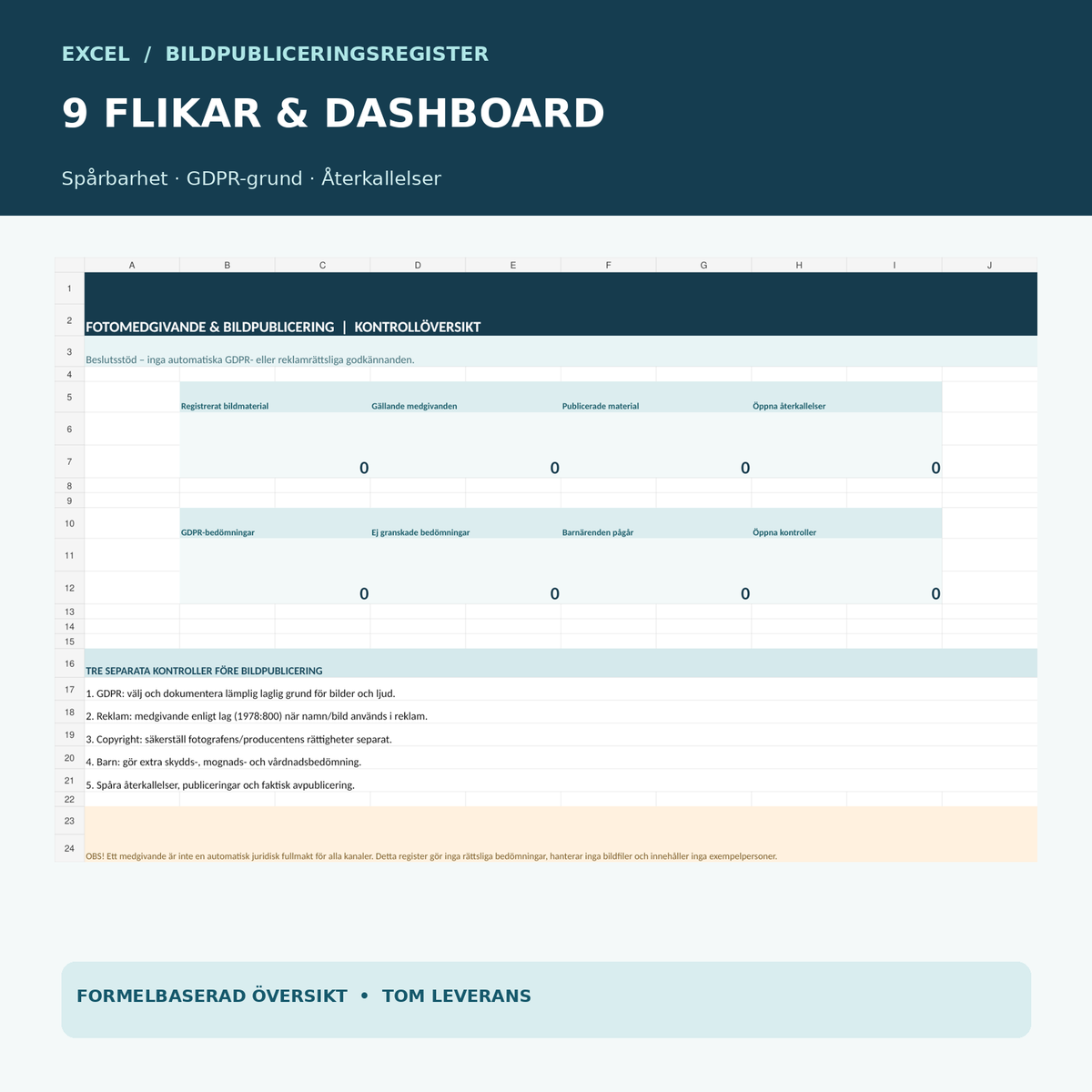
An Excel register with nine tabs is also included to keep track of material IDs, publication channels, existing consents, withdrawals, and responsible reviewers. All main templates are in Swedish and have corresponding searchable PDFs. A Swedish and English user guide is included.
An important legal distinction: The person depicted, the photographer, and the publisher have different rights. GDPR grounds for processing personal data, consent for names and images in advertising, and copyright to the photo must be checked separately. A general signed paper does not automatically resolve all three issues.
01. Package contents
- 7 editable Word documents (DOCX) – five main Swedish templates, one Swedish user guide, and an English User Guide.
- 7 corresponding searchable PDF files – for reading, printing, and documentation.
- 1 Excel workbook (XLSX) – nine tabs, a formula-based dashboard, and clear status fields.
- 15 files in total and eight unique documents or tools, delivered in a ZIP file that can be downloaded immediately. No physical delivery.
Each Word file has two framed information boxes – one regarding the purpose of the document and one regarding verification before use. They are intended as internal guidance and can be removed from external material. Version 1.0 – 2026/2027.
02. What the files contain – document by document
| File | Content and use | Format |
|---|---|---|
| 01. Consent for name and image in advertising | Specific consent for a company to use a person’s name or image in clearly defined marketing in accordance with the Act (1978:800). | DOCX + PDF |
| 02. GDPR consent for image and film | Separate active, informed, and revocable GDPR consent when this legal ground is correct and appropriate, with separate purposes and channels. | DOCX + PDF |
| 03. Children and guardians – image publishing | Form for maturity assessment, best interests of the child, guardian authorization, exposure, protection needs, and special approval. | DOCX + PDF |
| 04. Withdrawal and changed image use | Documenting GDPR withdrawal, objection, or deletion requests with processing, material ID, and actual unpublishing control. | DOCX + PDF |
| 05. Publication decision and image rights | Traceable checklist that distinguishes between GDPR grounds, advertising law consent, and the photographer's copyright/license. | DOCX + PDF |
| 06. Swedish user guide | Ten workflow steps, clear delimitations, examples, legal sources, children, employment, copyright, and Excel instructions. | DOCX + PDF |
| 07. English User Guide | English user guidance, including the difference between GDPR, advertising release, and copyright; does not include full English main templates. | DOCX + PDF |
| 08. Excel register for consents and publishing | Nine tabs for materials, consents, publications, withdrawals, GDPR assessments, children, controls, and dashboard. | XLSX |
Language: Five main Swedish forms. English User Guide explains the use in English; no separate English main forms are included.
Excel register for photo consent, image publishing, and withdrawals
The workbook contains Overview, Image Material, Consents, Publications, Withdrawals, Legal Ground, Children & Guardians, Controls, and Read Me. You can use a common material ID to link an image to a publication decision, applicable consents, and any subsequent requests for unpublishing.
The dashboard shows eight formula-based key figures: registered image material, current consents, published material, open withdrawals, GDPR assessments, unreviewed assessments, ongoing cases involving children, and open controls. Empty registers show zero as an administrative starting point. Excel is not an image archive or an automated legal compliance check.
The formulas have been tested with temporary registrations; I have specifically verified that actual entered material and assessment IDs are counted. Test data is not included in the delivery. Do not register images containing protected persons or unnecessary sensitive personal data in the spreadsheet itself.
How to use the photo consent – ten steps
- Describe the material. State the exact photo, recording, material ID, producers, time period, and intended channels.
- Determine the purpose. Is the image to be used for general information about the business, editorial context, an advertisement, or other marketing?
- Choose and document GDPR grounds. Consent is one of several possible legal grounds. Assess the purpose and prerequisites first.
- Check advertising law consent. If a company uses a person's name or image in marketing, check the Act on Name and Image in Advertising and document the specific consent.
- Check copyright. The depicted person does not automatically own the photographer's image. Ensure the correct license and permitted alterations.
- Assess children and protection needs. Take into account the best interests of the child, maturity, guardian authorization, and any protected identity.
- Inform the person concerned. Specify the organization, purpose, legal ground, recipients, storage, and contact for rights-related matters.
- Document active choices. No pre-ticked boxes; separate purposes and channels when GDPR consent is used.
- Review and publish. Register decision ID, date, URL/channel, actual license, and person responsible for control in Excel.
- Handle changes and withdrawals. Review requests, stop or modify processing when regulations require, and document the measures taken.
GDPR and the Act on Name and Image in Advertising – what applies?
Is consent always a requirement to publish images?
No, not according to GDPR in all situations. The IMY (Swedish Authority for Privacy Protection) explains that publishing identifiable persons requires an applicable legal ground. A private company may, in some cases, use a balancing of interests after a real and documented assessment. For example, regarding employee photos, the power imbalance in the employment relationship means that GDPR consent is often not appropriate. Consideration must always be given to transparency, purpose, data minimization, and the rights of the data subject.
When is special consent for names and images in advertising required?
The Act (1978:800) on Name and Image in Advertising, § 1, states that a trader may not use another person’s name or image in marketing without their consent. This requirement under advertising law is not the same as using GDPR consent as the legal ground for all handling of the image. Therefore, select the advertising form when it concerns actual advertising use and document the GDPR issue separately.
What is required for valid GDPR consent?
The IMY emphasizes that GDPR consent must be voluntary, specific, informed, and unambiguous. It must be an active choice, with no pre-ticked boxes. Different purposes generally require separate choices. Consent must be as easy to withdraw as it was to give, and the organization must be able to demonstrate what information was provided and when.
Who may consent to images of children?
Children's personal data is considered particularly worthy of protection. Authorized guardians and the child’s own ability to understand should be checked based on the specific context, and the best interests of the child must be assessed. The IMY's age limit of 13 for certain information society services is not a general age limit for all photography or image publishing. In cases of shared custody, risky exposure, or protected identity, special control is required.
What happens when GDPR consent is withdrawn?
Withdrawal does not retroactively affect processing that was lawful before the withdrawal. However, the organization must assess continued processing and any necessary deletion or unpublishing measures. An already distributed printed publication or a third-party copy may require special practical and legal handling. The form therefore does not promise automatic total withdrawal of everything already published.
Is the photographer's permission also needed?
Yes, depending on who holds the rights. Getting a depicted person's consent is not the same as having a sufficient license for the photograph or film. The license, permitted channels, editing, and any secondary use should be documented in the publication control.
The package consists of independently developed, general forms and registers. It does not imply that any specific GDPR consent is valid, that all image publishing requires consent, that a marketing campaign is permitted, or that all copyright permissions are secured. No external legal review or official authority certification is claimed. Check actual use and regulations in each case. Source review: October 18, 2026. The designation 2027 does not guarantee future legal status.
Related Template Store products
- Privacy policy and cookie policy – GDPR – for information on personal data management and publication purposes.
- GDPR register extract and data subject rights – when persons wish to exercise their GDPR rights.
- Marketing agreements and agency assignments – supplementary agreements on ads, usage rights, and delivery.
Frequently asked questions about consent forms and image publishing
Is there a consent form for images in Word?
Yes. The package contains editable Word forms for names and images in advertising, separate GDPR consent, and guardian involvement, with a PDF for each document.
Can a company post photos of employees without consent?
It depends on the purpose and legal ground. The IMY states that a balancing of interests may be possible for certain information purposes, but GDPR consent is often inappropriate in the dependency relationship between employer and employee. Advertising law requirements must be reviewed separately.
Does one signature apply to all future images?
No, not automatically. Document specific material, purposes, channels, and scope. Significantly new usage may require a new assessment or new consent.
Is a consent form for children included?
Yes, with checks regarding guardians, the child's will, exposure, and special risks. It is not a universal permission to publish all images of children.
Can I withdraw my consent to image publishing?
GDPR consent can always be withdrawn for future processing based on that consent. Other rights, already distributed material, and other legal grounds must be assessed separately.
Are GDPR consent and an advertising release the same document?
No. Advertising law and GDPR regulate different issues. The package therefore has separate main templates and a checklist that checks both.
Is an Excel register for photo consents included?
Yes. The Excel file contains nine tabs and eight dashboard key figures. It is an administrative register, not an image archive or a legal decision-making program.
Does the Excel file contain any fictional personal data?
No. All registers are empty upon delivery. Temporary quality tests have not been saved.
Is an English photo release included?
No. Five main templates are in Swedish. A separate English user guide is included.
Official sources
- IMY – Publishing images, films, and audio on the internet
- IMY – Consent as a legal ground
- Swedish Code of Statutes – Act (1978:800) on Name and Image in Advertising
- IMY – Children's personal data and guardians
Svenska Dokumentmallar · Version 1.0 – 2026/2027 · Legal source review 2026-10-18 · DOCX, searchable PDF, XLSX · 15 files in digital ZIP.