Svenska Dokumentmallar
Course Evaluation & Training Feedback – Course Organizer | Word/PDF/Excel
Course Evaluation & Training Feedback – Course Organizer | Word/PDF/Excel
- File format
- DOCX, PDF, XLSX
- Document language
- 6 Swedish documents including a Swedish guide + 1 English User Guide
- Number of files
- 7
Digital download. No physical product is shipped.
Couldn't load pickup availability
About this template
Course Evaluation & Training Feedback is a package of editable Word templates, searchable PDF files, and an Excel tool for course organizers and non-profit organizations that want to evaluate completed training. Follow up on relevance, pedagogical clarity, course materials, pace, and participants' perceived learning with a consistent, documented workflow.
Important before use: Course feedback is not an examination, and a self-reported grade does not show that the participant has actually achieved the course's learning objectives. A voluntary survey without a name field is not automatically anonymous: free text, logins, IP addresses, and small groups may contain personal data. The organizer is responsible for the concrete GDPR assessment.
When are these course evaluation templates suitable?
After a training course, course series, workshop, or internal organizational training when the organizer needs to collect voluntary participant responses, evaluate the training design, and document suggestions for improvement. The package is intended for course quality, not for attendance records, course certificates, individual grading, personnel assessment, or legal training accreditation.
01. Package contents
Five independent working documents, a Swedish user guide and an English User Guide, all as editable Word files and corresponding searchable, printable PDFs. An Excel tool with nine tabs is also included. 7 DOCX + 7 PDF + 1 XLSX = 15 customer files in total. Word and PDF are two format versions of the same seven documents.
02. What the files contain
Plan for course objectives and questions, voluntary participant survey, instructor self-evaluation, results report with the number of responses per question, improvement and feedback plan, Swedish guide, English User Guide, and Excel for recording courses, grades, follow-ups, decisions, and privacy checks.
Documents and file list
| Document | Function | Language | Format |
|---|---|---|---|
| Course evaluation plan & learning objectives | Prepare course ID, objectives, and follow-up questions | Swedish | DOCX + PDF |
| Participant survey & course feedback | Voluntary 1–5 questions and controlled free text | Swedish | DOCX + PDF |
| Instructor self-evaluation | Objective observations on design, materials, and schedule | Swedish | DOCX + PDF |
| Training report & results | Summarize number of responses, grades, and methodological limitations | Swedish | DOCX + PDF |
| Improvement plan & feedback | Suggestions, actual decisions, implementation, and verification | Swedish | DOCX + PDF |
| Swedish user guide | Step-by-step usage, Excel instructions, and privacy | Swedish | DOCX + PDF |
| English User Guide | Usage guide for the Swedish templates | English | DOCX + PDF |
| Excel – course evaluation tool | 9 tabs with survey responses, averages, objectives, and actions | Swedish | XLSX |
Excel tool with nine tabs
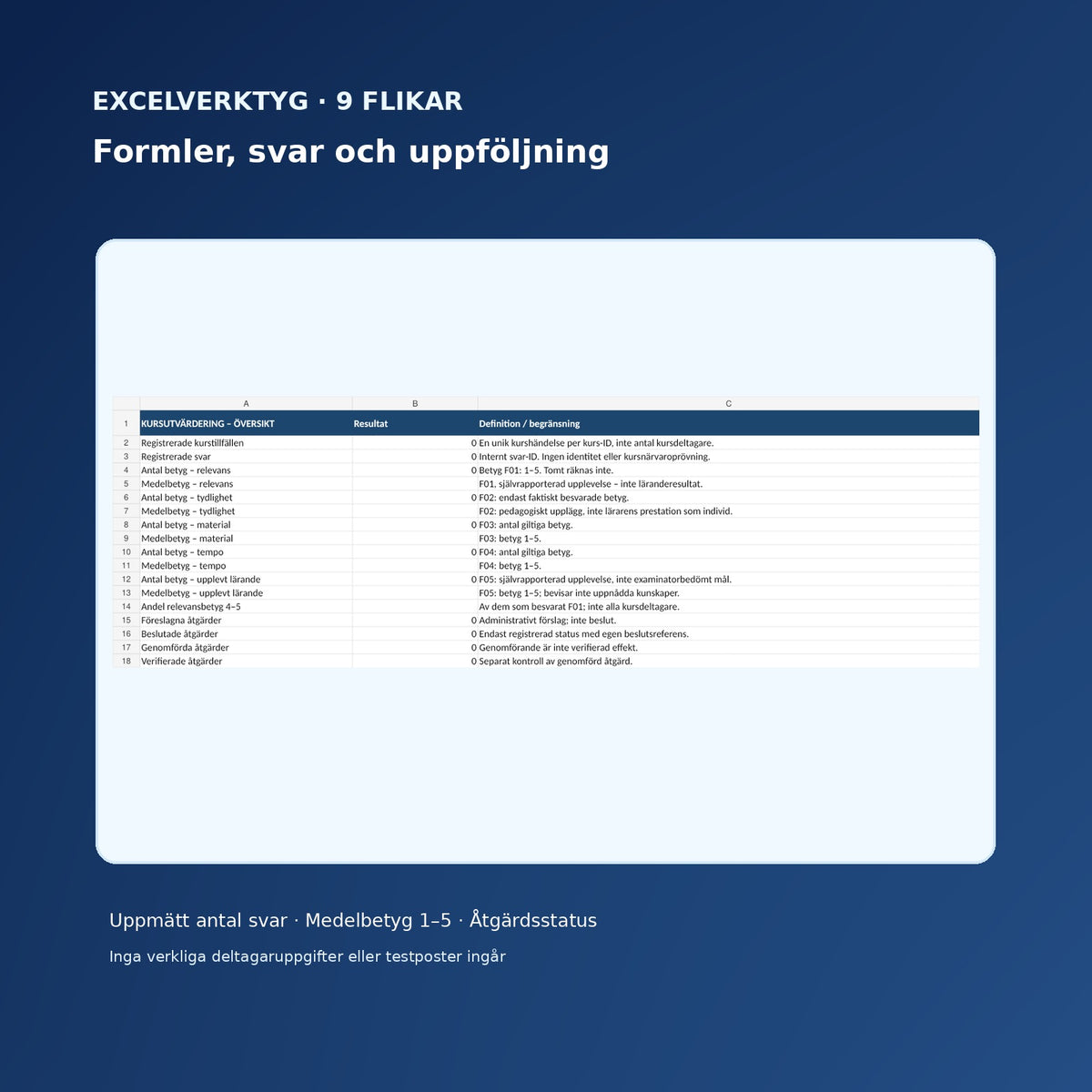
The workbook includes Overview, Courses, Question Bank, Responses, Learning Objectives, Actions, Decisions, Privacy, and Read Me. There are five standard questions (F01–F05) with a 1–5 response scale. Excel actually counts the number of answered grades per question, the average, the proportion of relevance grades 4–5, and the number of registered improvement actions per administrative status.
Empty responses are not treated as zero grades. The average for perceived learning does not measure verified knowledge. The tool does not determine whether the course meets regulatory requirements, whether the survey is anonymous, or whether GDPR is fulfilled. Test data has been removed from the customer version.
How the course organizer uses the package
- Determine the course's purpose, objectives, course ID, and what participants should provide feedback on.
- Check the survey system, technical logs, purpose, data minimization, and legal basis if personal data is processed.
- Prepare a voluntary participant survey and provide applicable information about the processing of personal data.
- Collect responses using the 1–5 scale. Review free text and small groups before results are used or shared.
- Record responses in Excel, check the number per question, and document dropouts and uncertainty.
- Keep participants' self-perceptions separate from the instructor's observations and any actual examination.
- Decide on improvements through the appropriate function and check completed actions separately.
Legal requirements and data protection
When course evaluation responses can be linked directly or indirectly to an identifiable person, the General Data Protection Regulation (EU) 2016/679 may apply. In that case, the organizer needs to assess, among other things, the specific purposes, legal basis, information, storage, and security. The Swedish Authority for Privacy Protection's guidance on personal data explains that even technical identifiers can be personal data.
Guaranteed anonymity does not follow from omitting names; the difference between anonymized and pseudonymized data is described in IMY's guidance on anonymization. For courses with minors, identifiable small groups, sensitive data, or unclear purposes, additional individual assessment must be made.
Frequently Asked Questions
What is a course evaluation used for?
To systematically collect feedback after a training course and identify improvements in pedagogy, materials, and design. It is not a certificate of the participant's performance.
Is the course survey anonymous?
Not automatically. The design does not ask for names, but the organizer must check free text, small groups, IP addresses, logins, and the actual collection method before any description of anonymity is used.
Can Excel calculate average grades?
Yes. For each of the five questions, the average of actually answered grades 1–5 and the number of responses is calculated. Empty cells do not result in a grade of zero.
Does a high grade for perceived learning mean the objective has been achieved?
No. F05 reports the participant's own perception, not a verified examination or formal knowledge assessment.
Are the PDF files interactively fillable?
No. They are searchable and printable, while the Word versions are used for editing and filling in.
Are the templates in English?
The five working documents and the Swedish guide are in Swedish. English User Guide is an English-language instruction for the Swedish documents, not a separate adaptation to foreign law.
Related products
- Course Certificates & Training Register – for attendance, certificates, and training administration rather than quality feedback.
- Registration Form & Participant Administration – for registration before an activity.
Sources and product version
GDPR (EU) 2016/679 · IMY: personal data · IMY: anonymization.
Product version 1.0 · AI-assisted legal source review 2026-11-02 · Sweden. No documented external legal review or regulatory certification. The final ZIP file is later manually linked to Shopify Digital Products before manual publication.