Svenska Dokumentmallar
Legionella Control & Hot Water Log – Temperature Monitoring, VVC & Excel | Word/PDF
Legionella Control & Hot Water Log – Temperature Monitoring, VVC & Excel | Word/PDF
- File format
- DOCX, PDF, XLSX
- Document language
- Five Swedish work templates Swedish guide and English User Guide
- Number of files
- 7
Digital download. No physical product is shipped.
Couldn't load pickup availability
About this template
Legionella Control & Hot Water Log – Temperature Measurement, Hot Water Circulation, and Self-Monitoring is a digital document package in Word, PDF, and Excel for housing cooperatives, property owners, landlords, operations managers, and other business operators who need to document preventive controls of hot water systems.
The package covers control points, actually measured temperatures, risk assessment, deviations, and follow-up. A temperature log is not a Legionella culture, a laboratory test, or proof that the water system is free of Legionella bacteria. Always consult experts when circumstances require technical and medical assessment.
01. Package Contents
15 customer files in a ZIP: five Swedish work templates, one Swedish user guide and one English User Guide, all seven as editable Word (.docx) and searchable PDF files, plus an Excel workbook (.xlsx) with nine tabs. Total 7 DOCX + 7 PDF + 1 XLSX. The PDF files are intended for reading and printing, not as electronically fillable forms.
02. What the Files Contain
Registers of heaters, hot water circulation, and tap points; a temperature measurement log with documented method; risk assessment and self-monitoring; deviations and corrective action orders; and follow-up. Excel includes control flags for missing local reference, measurements outside the specified temperature reference, acute risks without recorded protection, and outstanding deviations. The formulas do not make technical, medical, or legal decisions.
Document Templates for Legionella Control – File Overview
| File | What You Get | Format |
|---|---|---|
| 01. Control Point Register | Property, hot water circulation, heaters, tap points, method, and responsibility. | DOCX + PDF |
| 02. Temperature Measurement Log | Measurement point, actual °C value, reference, deviation, and measurement conditions. | DOCX + PDF |
| 03. Risk Assessment & Self-Monitoring | Documented risk, stagnation, temperature, exposure, and follow-up. | DOCX + PDF |
| 04. Deviation & Corrective Action Order | Escalation, protection, expert engagement, and action plan. | DOCX + PDF |
| 05. Follow-up & Conclusion | Verification, possible sampling, remaining risk, and decision. | DOCX + PDF |
| 06. User Guide – Swedish | Workflow, five control scenarios, risk limitations, and sources. | DOCX + PDF |
| 07. English User Guide | English instructions for the Swedish work templates. | DOCX + PDF |
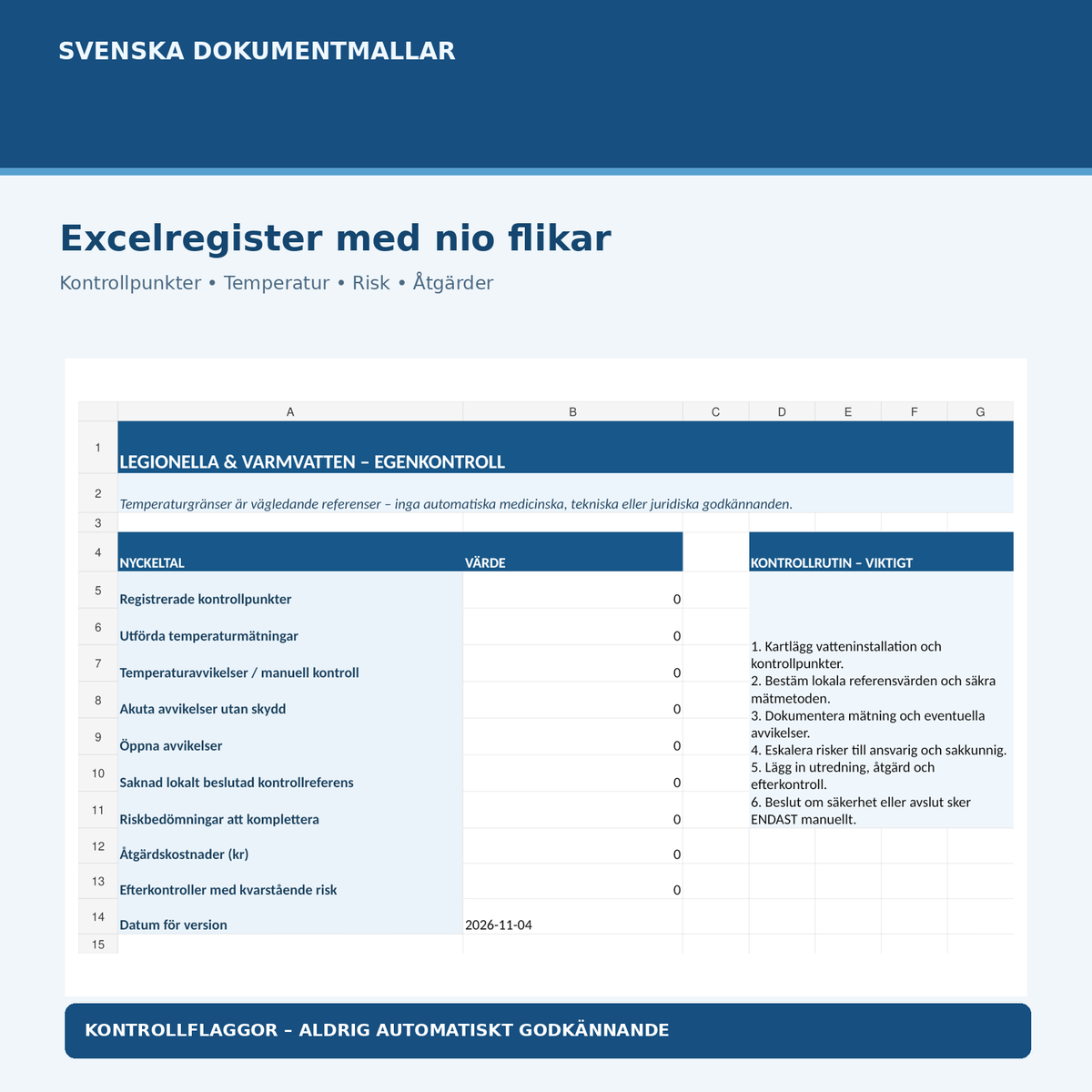
| 08. Excel Register, Nine Tabs | Administrative overview, control points, temperatures, risk, and actions. | XLSX |
Excel – Temperature Log with Nine Tabs
Overview, Control Points, Temperature Log, Risk Assessment, Deviations, Actions, Follow-up, Sampling, and Read Me. The workbook has 100 pre-filled data rows per register tab, status bars, control formulas, and summary measures. Locally determined minimum/maximum values for relevant measurement points can be entered. Deviating values are flagged for manual handling.
Excel cannot diagnose Legionella. It does not assess the presence of bacteria, the legal compliance of a specific building stock, the protection of sensitive users, or whether a technical intervention has had the intended effect. Risk scores are only an administrative prioritization aid.
Workflow – How the Property Owner Uses the Templates
- Inventory: map heaters, hot water circulation, mixers, and tap points, including rarely used points and any stagnant pipes.
- Determine the control plan: document locally applicable references, risk-assessed intervals, competence, and measurement method.
- Measure and document: record actual temperature, instrument, measurement conditions, and any deviations.
- Manage risk: escalate low temperatures, deviating water conditions, or scalding risks to the responsible person and, if necessary, an expert.
- Follow up: document actual actions, possible sampling results, and a separate decision on continued operation and control.
Legal Requirements and Temperature References
Prevent Legionella Without Increasing Scalding Risk
According to the Public Health Agency of Sweden's Legionella Guidance, preventive temperature references are normally at least 50 °C in hot water at the tap point and in hot water circulation and 60 °C in heaters or storage tanks where water may become stagnant. Boverket also highlights scalding risk and temperature regulation for particularly sensitive individuals. The references must be applied with the correct measurement point, installation type, and currently applicable building regulations; they do not constitute a universal diagnosis or an automatic boundary decision.
The Property Owner's Self-Monitoring
Chapter 9, Section 9 of the Environmental Code (1998:808) regulates protection against hazards to human health in homes and certain premises. The Public Health Agency states that the property owner or business operator should have routines for monitoring temperature, rarely used tap points, and actions in case of Legionella risk. The agency does not specify a general control interval in days or months that automatically applies to all properties. Intervals and the need for water sampling are determined by risk and the installation.
Scope for Sampling and Remediation
Sampling, laboratory analysis, and remediation measures require a specific assessment of purpose, method, competence, and safety. Increasing the temperature or carrying out chemical treatment without an adequate risk assessment can cause damage. The document package contains no method description for hazardous thermal or chemical remediation and is not medical guidance.
Frequently Asked Questions About Hot Water Logs and Legionella
Must Property Owners Monitor Hot Water Temperature?
Regular self-monitoring is a key preventive routine according to the Public Health Agency's guidance. Which measurement points and intervals are needed depend on the risks associated with the building and business.
Is 50 °C at the Tap Point Always Sufficient?
No. A measured temperature does not automatically show that the entire system is safe or free of Legionella. Other points, hot water circulation, stagnation, measurement method, and scalding risk must be assessed.
What Should the Temperature in a Hot Water Heater Be?
The Public Health Agency and Boverket normally describe at least 60 °C in heaters where water may stand still as an important preventive level. Technical design and appropriate protection must be assessed separately.
How Often Should Temperature Be Measured?
The Public Health Agency does not have a single general prescribed measurement interval for all properties. Establish a risk-based routine and document the basis for the decision.
Does Sampling or Legionella Testing Included?
No. The workbook can record a laboratory report, but no test or laboratory results are included.
Can Excel Approve a Hot Water Installation?
No. Excel only displays administrative control flags. The authorized responsible person and, if necessary, an expert must assess the actual risk and actions.
Are English Templates Included?
The five work templates are in Swedish. One English user guide is included, but not English legal versions of the work templates.
Related Products
For water costs and consumption monitoring, see Water Consumption & Water and Sewerage Cost Monitoring. For general property matters, use the store's separate product for fault reporting and case management. The Legionella control package is aimed at preventive temperature documentation and follows a different case workflow.
Version 1.0 · 2026-11-04 · Sweden · AI-assisted legal source check. No independent external legal, laboratory, or plumbing review. Digital ZIP delivery only after separate manual activation.