Svenska Dokumentmallar
Scissor Lifts & Aerial Work Platforms – Inspection Log, Service & Action Register | Word/PDF/Excel
Scissor Lifts & Aerial Work Platforms – Inspection Log, Service & Action Register | Word/PDF/Excel
- File format
- DOCX, PDF, XLSX
- Document language
- Swedish main templates Swedish guide and English User Guide
- Number of files
- 7
Digital download. No physical product is shipped.
Couldn't load pickup availability
About this template
Lift Tables & Stationary Scissor Lift Tables – Inspection Log, Service and Action Register is a comprehensive digital document package for Swedish workplaces with stationary lift tables for material handling. Collect equipment IDs, inspection programs, risk-free visual inspections, fault reports, service records and separately documented post-inspections in a continuous workflow. Editable Word files, searchable PDF versions and Excel with nine tabs are included.
Important: The product applies to stationary goods lift tables. Mobile scissor lifts for personnel lifting, vehicle tail lifts and vehicle lifts are not covered by this document package. A completed log is not an inspection certificate or a technical safety assessment.
01. Package Contents
15 customer files: 7 Word (DOCX), 7 corresponding searchable PDF (A4) and one Excel register (XLSX) with nine tabs. The seven documents consist of five Swedish work templates, a Swedish user guide and an English User Guide. The main templates and Excel are in Swedish; only user guide number 7 is in English. Digital ZIP delivery after manual file linking and publication.
02. What the Files Contain
Equipment register with classification fields, inspection and round logs, fault reporting with immediate protective measures, service ordering, report receipt as well as separate post-inspection and return-to-service decisions. Excel manually compiles registered entries. Ordered service is not performed service; performed service does not automatically mean the device is safe.
Who Needs a Lift Table Log?
Warehouses, logistics, industrial facilities and workshops that use stationary goods lift tables and need a structured inspection history. For the entire warehouse work environment, see warehouse and warehouse work risk assessment; for pallet racks, we refer to pallet rack and racking inspection. These complement each other but do not replace each other.
Document List
| Document | Function | Format |
|---|---|---|
| 01. Lift Table Register and Inspection Program | Installation ID, instructions, classification and responsibility | DOCX + PDF |
| 02. Round Log and Visual Inspection | Risk-free visual observations and reporting of deviations | DOCX + PDF |
| 03. Fault Reporting and Protective Measures | Actually observed fault, risks and protective measures taken | DOCX + PDF |
| 04. Service Ordering and Report Receipt | Order, actually performed service and report reference | DOCX + PDF |
| 05. Post-Inspection and Return-to-Service Decision | Verification, remaining points and separate manual decision | DOCX + PDF |
| 06. Swedish User Guide | Step-by-step workflow, legal sources and limitations | DOCX + PDF |
| 07. English User Guide | English instructions for the Swedish documents | DOCX + PDF |
| 08. Excel – Operation and Inspection Register | Nine tabs, status lists and 15 administrative summaries | XLSX |
Excel with Nine Tabs
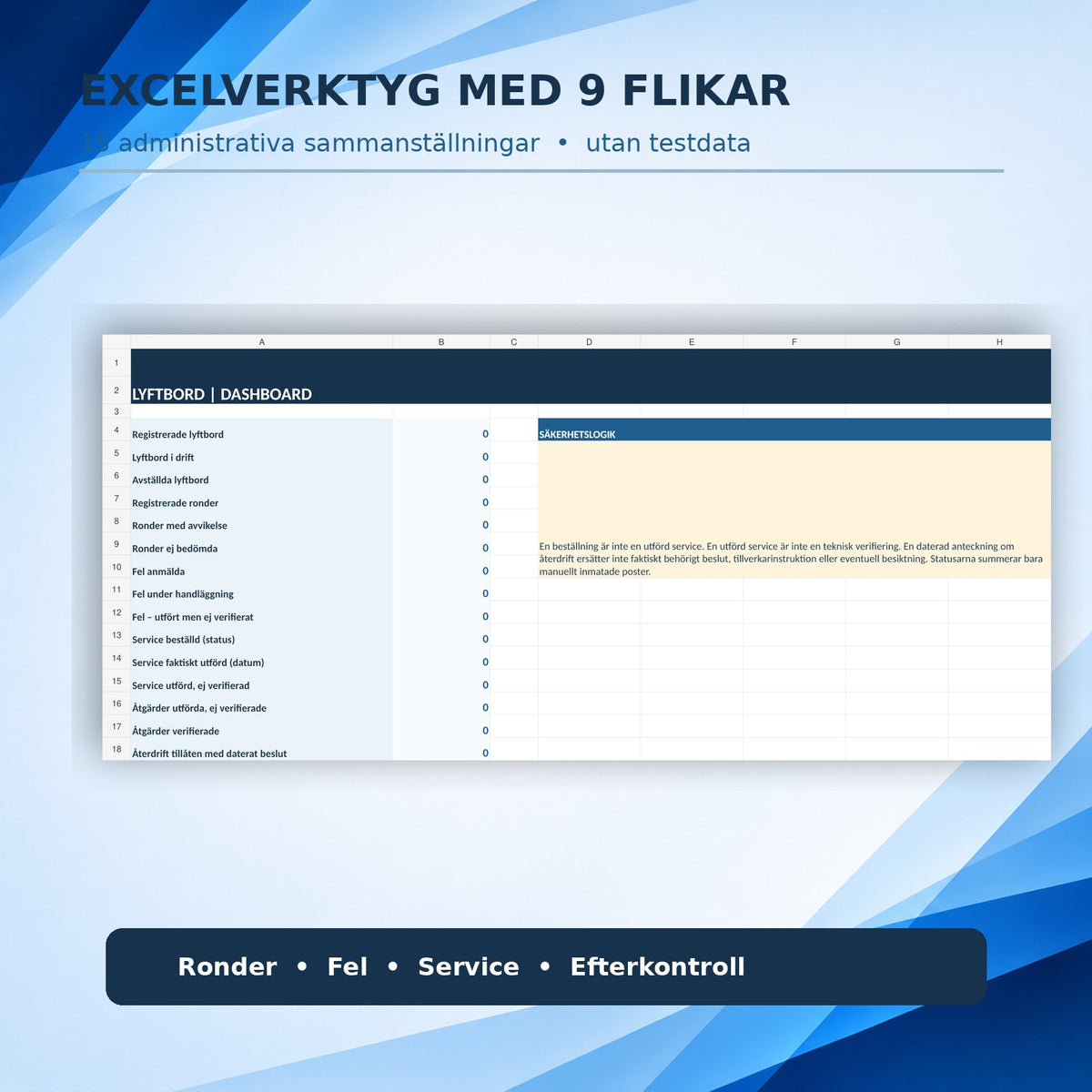
The Excel tool has Start, Lift Tables, Rounds, Fault Cases, Service, Actions, Post-Inspection, Dashboard and Read Me. Six operational registers have 300 prepared data rows each. The dashboard has 15 calculated key figures for registered lift tables, decommissioned units, rounds, faults, ordered service, actually performed service and separately dated return-to-service decisions.
Excel tests include registered deviation, decommissioned equipment, ordered service without a performance date, later entered performance date and return-to-service decisions that must be dated. All test items have been removed. No macros, automatic alarms, load tests, safety sensors or remote control are included.
How to Use the Document Package
- Obtain the manufacturer's instructions, previous certificates and correct model/serial number information.
- Identify the lift table's actual use and assess special rules – for example, if it is a level-equalizing device at a loading dock.
- Establish a local inspection program with reference to the correct documentation. The template does not contain any universal inspection interval.
- Only perform risk-free observations for which the personnel have sufficient competence; otherwise, note Not assessed.
- Record faults and protective measures taken. Save the actual performance report and document the actual service date.
- Let the competent function review the documentation and decide on continued use; document this separately.
Which Rules and Standards Are Relevant?
The Swedish Work Environment Authority's AFS 2023:11 contains requirements for the safe use of work equipment and special inspection rules in Chapter 13 and Annex 12 for the devices covered. Classification is crucial. Among other things, it contains a special category for machine-driven devices at loading docks that equalize the level difference between vehicles and loading docks. It is not correct to assume a single inspection interval for all lift tables.
SS-EN 1570-1:2024 is a current standard for certain lift tables according to SIS. The full text of the standard has not been reviewed, and no design requirements or test values from it are stated here. See also the Work Environment Act. Assess which regulation applies to the actual machine and operation.
Frequently Asked Questions
Is this lift table log mandatory by law?
Not this specific form. The employer may need to document inspections, risks and maintenance according to applicable requirements. How this is done depends on the machine type and the workplace's conditions.
Are all stationary lift tables subject to inspection every two years?
No, such a general statement is misleading. Special inspection rules depend on the type of device used and the context. Check AFS 2023:11, Annex 12, and the documentation for the actual equipment.
Can I use the template for a mobile scissor lift or a personnel lift?
No. The product covers stationary goods lift tables. Personnel lifts and mobile scissor lifts require specially adapted documents and legal assessment.
Is documented service enough to put the lift table back into operation?
No. In addition to actual service, further expert inspection and possible statutory inspection measures may be required. Return-to-service must be decided separately with the correct documentation.
Are the PDF files fillable?
The PDF versions are searchable and printable. The Word files are editable. We do not promise interactive fillable PDF forms.
Is everything translated into English?
No. The English User Guide explains how the Swedish work templates are used. The Excel register and work templates are in Swedish and designed for Swedish conditions.
Related Templates, Sources and Version
See Warehouse and Inventory – Templates, Risk Assessment for Warehouses as well as Pallet Rack Inspection. Official sources are linked above and in the guides.
Product version 1.0. AI-assisted legal source check performed November 5, 2026. No external legal review or technical third-party certification has been carried out. The product and ZIP refer to digital download with subsequent manual file linking.