Svenska Dokumentmallar
Response to Notice of Claim FT – Denial, Objections & Excel | Word/PDF
Response to Notice of Claim FT – Denial, Objections & Excel | Word/PDF
- File format
- DOCX, PDF, XLSX
- Document language
- Swedish templates and English User Guide
- Number of files
- 7
Digital download. No physical product is shipped.
Couldn't load pickup availability
About this template
Answer to a summons – simplified pecuniary claim is a professional document package for anyone who has been sued in a Swedish pecuniary claim and needs to prepare a clear response to the district court. The package helps the defendant state what is admitted or contested, set out the grounds for the objections, and state the evidence and the facts to be proved. It contains editable Word templates, searchable PDF files, and an Excel register for administrative tracking.
Difference from a statement of claim: A statement of claim is the claimant's initiating document. An answer to a summons is the defendant's response to a claim that has already been brought. This package is for an answer to a summons, not a counter-claim, appeal, or new statement of claim.
When is the package relevant?
Primarily for businesses and other defendants who have received a summons in a dispositive pecuniary claim, especially smaller claims where the court handles the case as a simplified pecuniary claim. Always follow the actual summons, the court's directions, and the deadline for response. No general deadlines, fictitious case numbers, or legal admissions are pre-filled.
01. Package contents
15 ready-made client files: 7 editable Word documents (.docx), 7 corresponding searchable PDF documents (.pdf), and 1 Excel workbook (.xlsx) with nine tabs. Six operational/instructional Swedish Word documents and one English user guide. The PDF files are not interactive official forms.
02. What the files contain
The answer to the summons itself, a claim-by-claim matrix, factual objections and legal grounds, a list of evidence with the facts to be proved, procedural control, two user guides, and a structured Excel register. You will receive guidance on distinguishing express admissions from denials and keeping track of what has actually been sent to the court.
File by file – document list
| File | Use | Format |
|---|---|---|
| 01. Answer to a summons – simplified pecuniary claim | Main draft with court, case number, position, denial, grounds, and evidence. | DOCX + PDF |
| 02. Position on each claim | Admitted, denied, or partially admitted – separately for principal, interest, and costs. | DOCX + PDF |
| 03. Objections and grounds | The claimant's allegations, the defendant's own factual information, and documentary support. | DOCX + PDF |
| 04. Evidence and facts to be proved | Each piece of evidence, date, exhibit, specific fact to be proved, and control questions. | DOCX + PDF |
| 05. Procedural obstacles and forum control | Competent district court, arbitration clause, competent representative, and procedural issues. | DOCX + PDF |
| 06. User guide SV | Workflow from summons to completed answer to the summons in accordance with the court's directions. | DOCX + PDF |
| 07. User Guide EN | English guidance explaining the Swedish documents and limitations. | DOCX + PDF |
| 08. Answer to a summons register FT | Excel with Dashboard and eight other tabs for claims, evidence, deadlines, and procedural log. | XLSX |
Excel with nine tabs
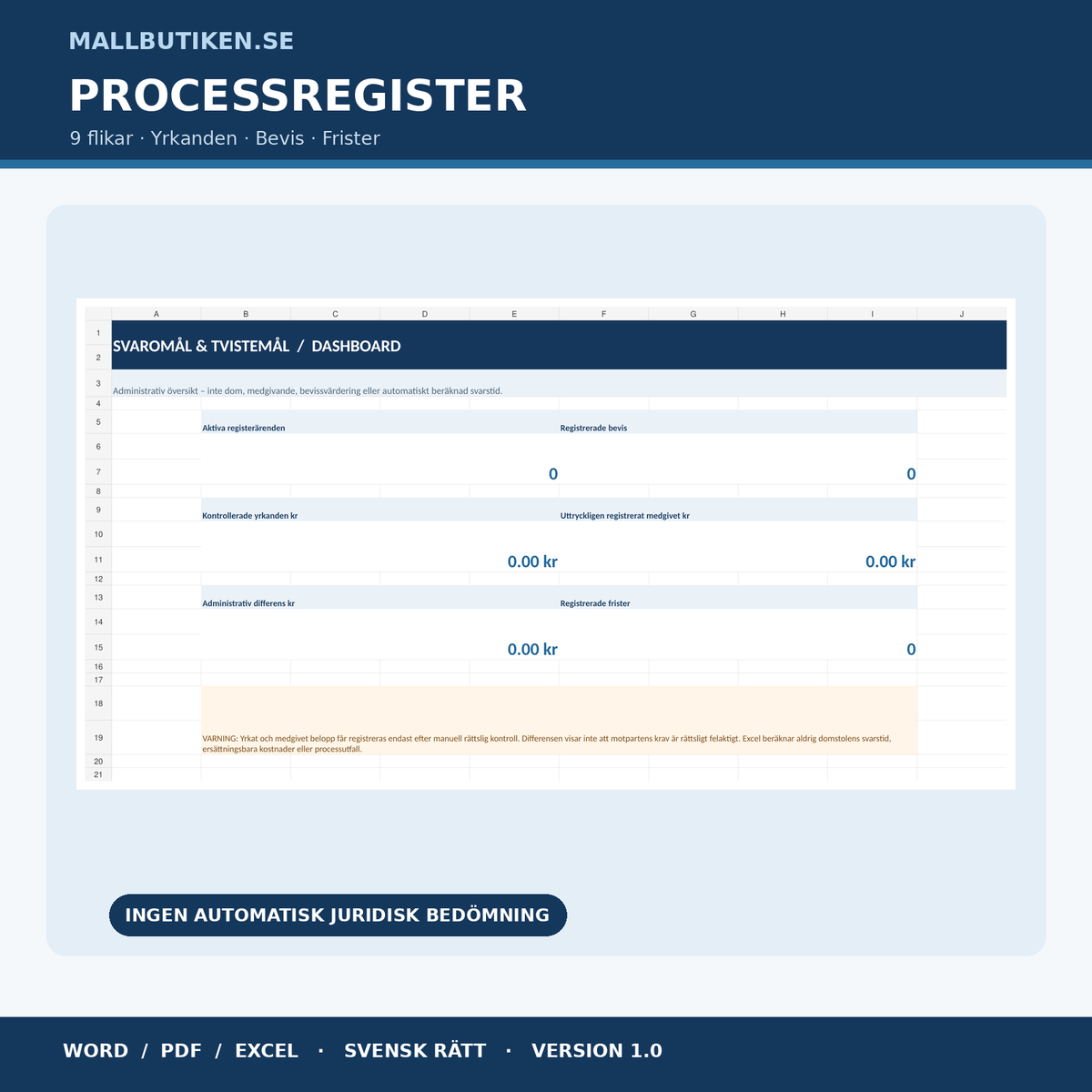
Dashboard, Cases, Claims, Objections, Evidence, Events, Deadlines, Costs, and Read Me. The dashboard shows registered cases and evidence, as well as a purely administrative amount difference only when the user has manually marked the information as checked. Such a difference is not a legal admission or a court decision. The workbook does not calculate response times, the court's outcome, or recoverable legal costs.
Workflow – how to write an answer to a summons
- Read the entire summons and the court's directions. Note the case number, actual deadline for response, and how the response should be sent.
- Separate the claimant's claims for principal, interest, legal costs, and any other items.
- Expressly state for each claim whether it is admitted, denied, or admitted only to a specified extent.
- Address the claimant's factual allegations and state the circumstances that form the basis of the objections.
- List the evidence relied upon, what each piece of evidence is intended to prove, and which exhibits are submitted.
- Check for any procedural obstacles, forum issues, and the authority of the signatory or representative.
- Review and send the completed answer to the correct district court within its actual deadline. Save the submission confirmation.
Legal basis: Chapter 42, Section 7 of the Code of Judicial Procedure
The Code of Judicial Procedure (1942:740) states in Chapter 42, Section 7 that an answer to a summons shall, among other things, contain the objections regarding procedural obstacles that the defendant wishes to make, to what extent the claimant's claim is admitted or denied, the grounds for the denial, and the evidence relied upon and what it is intended to prove. Written evidence relied upon should be submitted at the same time as the answer to the summons.
According to The Swedish Courts' guidance on pecuniary claims, failure to respond to a summons in time may carry a risk of default judgment in applicable situations. The court's specific decisions and directions always take precedence over general advice in a template. A limited right to compensation for legal costs may apply under Chapter 18, Section 8 a of the Code of Judicial Procedure for simplified pecuniary claims.
Frequently Asked Questions
How do you contest a summons?
You submit an answer to the summons within the time specified by the court. It must state which claims are contested or admitted, what factual grounds are relied upon, and what evidence is intended to prove them. A general "I contest" may be insufficient.
What happens if I do not respond to the district court?
In certain dispositive pecuniary claims, the district court may issue a default judgment if the defendant does not comply with its directions. Therefore, read the exact conditions and deadline of the directions immediately.
Can you contest only part of the claim?
Yes, but the part that is actually admitted must be clearly stated, and the part that is contested must be substantiated. An amount that only appears in an internal Excel register does not automatically constitute a legal position.
Can the template be used for a regular pecuniary claim?
The structure is based on Chapter 42, Section 7 of the Code of Judicial Procedure, but the work is primarily designed for smaller dispositive pecuniary claims. Larger, more complex, or non-dispositive cases may require completely different considerations and procedural documents.
Can I claim back all legal costs?
Not automatically. In simplified pecuniary claims, there are limitations on recoverable legal costs under Chapter 18, Section 8 a. Each cost item and the actual circumstances of the proceedings must be reviewed.
Does Excel calculate the response deadline or the probability of winning?
No. The court's actual response date must be entered manually. No formula determines the court's jurisdiction, legal admissions, evidentiary value, or outcome.
Related document templates
See Business Agreements – Templates for agreements and related procedural templates. The product complements Mallbutikens template for Statement of Claim in a Simplified Pecuniary Claim, where the user instead prepares the initiating document as the claimant.
Legal sources and version information
Legal sources: The Code of Judicial Procedure, Swedish Parliament and The Swedish Courts – How a Pecuniary Claim is Handled. Version 1.0, 31 October 2026. Jurisdiction: Sweden. AI-assisted source review has been performed, but no external independent legal review or official approval is claimed. The user is responsible for checking the law, agreements, circumstances, court decisions, and exhibits in the actual case.