
Assignment, delegation or authorization in a non-profit organization – choose the right document
Who has the authority to make decisions in a non-profit organization? Compare conflict of interest declarations, delegation of authority, decisions on signing authority, powers of attorney, and internal control plans. A practical decision-making guide with legal boundaries.

A delegation policy distributes tasks and internal decision-making authority. A decision on signing authority describes who may represent the organization externally. A power of attorney gives a limited agent the right to act on behalf of the organization. A declaration of conflict of interest helps the board identify and document a potential conflict of interest. An internal control plan is then used to monitor that decisions, authorities, and control procedures are working.
These documents do not replace one another. Start by checking the organization's bylaws, membership and board decisions and what the relevant action actually applies to. The Swedish Tax Agency's legal guidance on the administration of non-profit organizations describes the duties of the general meeting and the board, as well as the powers of representatives.
Quick guide: five situations and the right document
| Situation | Suitable document support | What it does not automatically do |
|---|---|---|
| An official or working group is to make limited internal decisions and report to the board. | Delegation policy and decision-making authority | Does not in itself grant the right to sign on behalf of the organization or log in to bank accounts. |
| The board needs to document who may sign on behalf of the organization and provide supporting documentation to the bank. | Decision on signing authority and bank authorization | Does not automatically mean that the bank has approved or activated the authorization. |
| A person is to represent the organization in a specific agreement or matter. | Power of attorney for non-profit organization | Does not replace a proper decision or the recipient's specific form requirements. |
| A board member has a personal interest in an upcoming decision. | Declaration of conflict of interest and management of conflicts of interest | Does not automatically establish legal conflict of interest or the validity of the decision. |
| The organization needs to repeatedly check mandates, risks, and financial procedures. | Internal control plan and risk register | Does not constitute an audit or approval by an authority. |
1. Start with the bylaws – who may make decisions?
In a non-profit organization, the membership meeting is normally the organization's decision-making body, and the board is responsible for day-to-day administration within the framework set by the bylaws and the membership meeting. Unlike limited companies, there is no single comprehensive law that determines every step in the decision-making process for all non-profit organizations. Bylaws, organizational decisions, general legal principles, and applicable special rules can therefore be of great importance. See the Swedish Tax Agency's guidance on the organization's bylaws.
Check in particular who may make decisions on major expenditures, loan agreements, personnel, grant funds, signing, delegation, and the management of conflicts of interest. If a matter needs to be decided at the annual meeting, the board cannot make it its own simply by writing a delegation policy.
2. Delegation policy – internal distribution of tasks
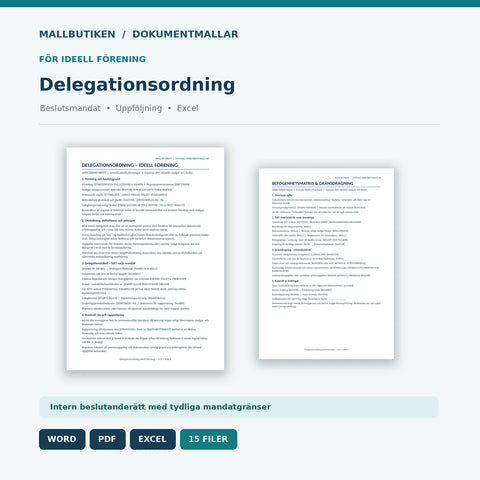
A delegation policy may state that, for example, the treasurer may approve ongoing costs up to an internally established amount or that an activity manager may book venues within an approved budget. Describe the task, the amount or subject limits, the recipient, the decision date, reporting, and who may revoke the mandate.
3. Signing authority and bank authorization – external representation
For signing authority, the organization needs to check the bylaws and valid decisions, and document whether the organization is represented jointly or individually. The Swedish Companies Registration Office describes signing authority in non-profit organizations engaged in commercial activities in particular; that information should not automatically be treated as detailed special rules for all types of organizations.
The Swedish Tax Agency points out that an organization number certificate normally does not show who the board members or authorized signatories are. When contacting the bank, the organization may therefore need to show current minutes and authorization decisions. The bank may also require its own forms, identification, and checks. A completed document does not activate any bank authorization.
4. Power of attorney – the right for a person to act in a matter
A power of attorney can be used when an authorized representative wants to allow a named person to perform specific legal acts on behalf of the organization. Sections 10–11 of the Contracts Act (1915:218) set out the basic rules on power of attorney, authority, and competence. The difference between what the agent may do externally and what internal instructions the agent has received can be crucial in a dispute.
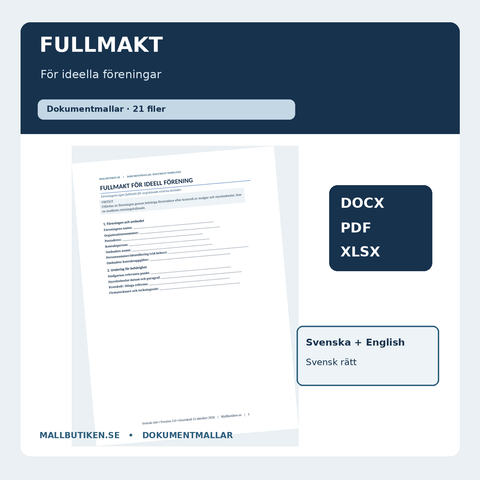
A practical power of attorney should therefore clarify the grantor, the agent, the matter, express limitations, validity, and who may revoke the power of attorney. First, check that those issuing it are authorized to represent the organization. A member's power of attorney to vote at a membership meeting is a different situation from the organization's power of attorney to an agent.
5. Conflict of interest – document before the decision
If a board member, for example, has a financial interest in a supplier that wants to sell services to the organization, the matter should be raised before the board considers the case. Check the organization's bylaws, conflict of interest policy, grant conditions, and any special legal rules. Rules on conflicts of interest in the Companies Act or the Act on Economic Associations should not automatically be described as directly applicable to every non-profit organization.
- Objectively describe the relationship or personal interest and the matter it concerns.
- Let the organization assess how the matter should be handled according to its rules and any legal requirements.
- Record the assessment, who participated, and how the decision was made, without registering unnecessary personal data.
- If the authorized decision-making body or decision-making capacity is affected, follow the bylaws and seek help if needed.
- Follow up on any actions in the regular control work.
Writing "no conflict of interest exists" in a register is not a guarantee that the assessment is correct; it must be based on actual circumstances.
Three illustrative situations
A treasurer is to purchase equipment
The board has decided that the treasurer may propose purchases up to a certain amount. The treasurer may then need a clear internal delegation to do so, but the organization's authorized signatory may still need to sign the agreement with the supplier. If the treasurer is also a shareholder in the supplier, the conflict of interest must be handled separately.
A volunteer is to pick up material from a supplier
A practical instruction or a limited power of attorney may be sufficient, depending on the supplier's requirements and what the person is to do. A general delegation policy from the board does not automatically grant the external right to enter into new agreements that the supplier may require.
The organization changes its board and bank contact
Document the relevant general meeting decisions, the new authorized representatives, and any decisions on signing authority. Revoke or change old powers of attorney and bank authorizations according to applicable rules and the bank's procedures. An up-to-date internal control plan can collect control points without being the authorization document itself.
6. Internal control – catch deficiencies before they become problems
A simple internal control plan can distribute who reviews authorization lists, agreements, financial approval limits, and outstanding conflict of interest matters. State the control interval, responsible person, action, and follow-up date. There is no universal legal requirement for this exact template for all non-profit organizations; the need and any obligations follow from the concrete operations, bylaws, grant conditions, and applicable rules.
Research on governance in non-profit organizations covers, among other things, board work, ethical procedures, and accountability. A systematic review by Alregab (2026) compiled 55 reviewed studies from 2015–2025 and simultaneously identified geographical and methodological limitations. It does not prove that a certain document template improves the organization's results and is not a source of Swedish association law. Read the research review.
Checklist for the board's next meeting
- Check current bylaws and who may make each decision.
- Distinguish between preparation, internal decision, approval, signing, and bank authorization.
- Document external powers of attorney separately and keep revocations up to date.
- Assess possible conflicts of interest before the matter is decided.
- Ensure that decisions, minutes extracts, and authorization documentation match.
- Use an internal control plan to follow up on procedures and deviations.
- Check the bank's and the recipient's own requirements before using a template package.
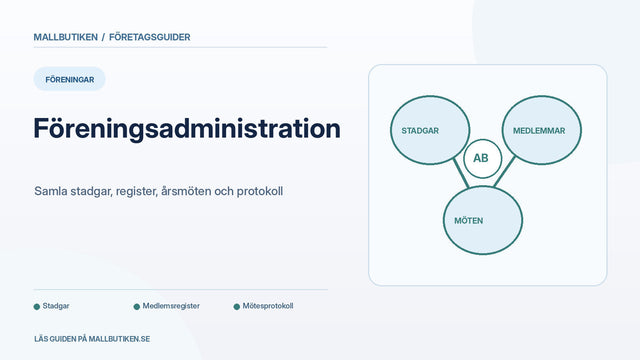
If you need a broader overview of bylaws, membership registers, and annual meetings, Mallbutiken also has a guide to organizational administration.
Official sources
- Swedish Tax Agency – Administering a non-profit organization, legal guidance.
- Swedish Tax Agency – Starting a non-profit organization and the organization's bylaws.
- Swedish Tax Agency – Non-profit organization, organization number, and minutes.
- Swedish Companies Registration Office – Signing authority in non-profit organizations engaged in commercial activities.
- Swedish Parliament – Contracts Act (1915:218), Chapter 2.
Templates in this article

Explore the topic
 Business guides – contracts, HR, AI & compliance
Association Administration 2026 – statutes, membership register, annual meeting and minutes
Pillar guide for association administration: bylaws, member registry and GDPR, annual meeting, board minutes, authorized signatories, finances, and...


