
Transport authorization for shipping and cargo – authority, receipt and checklist 2026/2027
Power of attorney for transport and freight: when is it needed, what can the agent do, and how does it differ from a waybill, shipping agreement, and customs power of attorney? Practical checklist under Swedish law.

A transport power of attorney gives a specific person the right to carry out specified transport matters on behalf of someone else, for example, to book freight, hand over goods, or acknowledge receipt of a shipment. The power of attorney should define who is authorized to do what, for which goods, for how long, and within what cost limits. It does not replace transport agreements, bills of lading, or the carrier's requirement for identification.
This guide helps individuals and businesses determine when a courier needs a specific transport power of attorney and how the assignment can be documented without unintentionally granting the right to sell goods, order expensive additional services, or act as a customs agent. It is aimed at practical authorization checks and therefore differs from a general guide on powers of attorney.
When do you need a transport power of attorney?
A transport power of attorney is particularly useful when the person who owns or controls the goods cannot be present at a booking, handover, or delivery. This may apply to a company sending equipment between warehouses, an employee picking up goods on behalf of the employer, or an individual who wants a relative to pick up a specific shipment.
There is no general requirement for a document specifically named "transport power of attorney" for every shipment. What matters is what authorization the recipient needs to be able to check and what procedures the freight company applies. Freight companies and pickup points may require their own form, identification, code, or other documentation even if a general power of attorney exists.
Example: a company hires an employee
A Swedish limited company is to send two labeled pallets to a customer. The warehouse manager may book a specified road transport, sign the delivery receipt, and report visible damage. The power of attorney specifies a cost cap of 4,000 kronor, the last day of validity, and that the courier may not sell the goods or agree to a final settlement of a damage claim. The amount is only an illustrative example.
Transport power of attorney, bill of lading, freight agreement, or customs power of attorney?
The documents serve different purposes. The fact that they are used in the same transport chain does not make them interchangeable.
| Document | Main purpose | Control question |
|---|---|---|
| Transport power of attorney | Show that a courier may act on behalf of the principal in specified matters. | Who has authorization and how far does it extend? |
| Transport agreement or freight order | Regulate the transport itself, the service, the price, and the terms for the parties. | What has been agreed with the carrier? |
| Bill of lading and receipt | Document transport details, receipt, and other relevant circumstances. | What goods were received and what was noted? |
| Customs agent power of attorney | Give a registered customs agent the right to represent the declarant in customs matters. | Is the agency direct or indirect, and are the Swedish Customs requirements met? |
According to the Road Transport Act (1974:610), special rules apply to certain paid road freight transports within Sweden. The Act has express exemptions, including for letter delivery and household goods. It covers, among other things, bills of lading, the receipt of goods, and the carrier's liability. It does not give a general transport power of attorney any special status as a substitute for freight documents.
Is a bill of lading always required? A bill of lading is not mandatory for every domestic road transport. According to Section 7 of the Road Transport Act (1974:610), a bill of lading shall be drawn up if the sender or carrier requests it, provided that its use does not cause unreasonable inconvenience to the other party or conflict with established practice for the type of transport. According to Section 8 a, the bill of lading may be drawn up electronically if the parties agree, but the Act then imposes special requirements for an advanced electronic signature or stamp. A transport power of attorney is a separate authorization document and does not replace the requirements that apply to a bill of lading.
In customs matters, Swedish Customs states that the courier must have a power of attorney and be registered. Direct and indirect agency involve different roles. Therefore, do not use a regular power of attorney for package pickup as if it automatically granted customs agency authorization.
What should be stated in the power of attorney to avoid disputes?
1. Identify the grantor and the courier
State full names or company details, contact information, and, if necessary, an internal document reference. For a limited company, the person signing on behalf of the company should have controlled authority to issue the power of attorney. A job title is not always sufficient to show signing authority.
2. Specify the transport and the goods
State the tracking number or order reference, number of packages, type of goods, any markings, sender, recipient, and relevant addresses. Avoid providing unnecessary personal information or details that are not needed to identify the assignment.
3. Write positive authorizations and clear prohibitions
It should state whether the courier may book transport, choose the carrier, pay freight, receive notifications, acknowledge receipt of goods, and report visible discrepancies. It is advisable to limit the amount, time, and opportunity to hire someone else. Explicitly prohibit sale, transfer, credit, or concessions unless these are included.
The difference between authorization and authority can have legal significance. According to the Contracts Act (1915:218), especially Sections 10–11, the principal's liability depends, among other things, on the limits of the power of attorney, internal instructions, and what the third party knew or should have known. Therefore, important limitations should be made clear even to the person who is to rely on the power of attorney.
4. State validity and revocation
Determine the start date, end date, or an objective termination condition, for example that an identified package has been delivered. If the power of attorney is revoked, special measures may be required toward the third party depending on how it was issued. Sections 12–18 of the Contracts Act deal with different forms of revocation. Keep documentation of which recipients have been notified.
Checklist before, during, and after transport
Before transport
- Check who owns or has the right to control the goods and who can issue the power of attorney.
- Ask the carrier what identity and document requirements apply to the specific service.
- Identify the shipment, packages, addresses, cost cap, and time frame.
- Select only the authorizations the courier needs. State any prohibitions and exceptions.
- Sign and deliver the document to the correct recipient in good time.
At handover or delivery
- Compare the packages, markings, and visible condition against the documentation.
- Document discrepancies immediately and follow the carrier's instructions for reservations and complaints.
- Request and keep the receipt, bill of lading, or equivalent proof of transport when such is used.
- Pay or approve only those costs covered by the assignment.
After transport
- Reconcile the delivery date, costs, and any discrepancy report against the assignment.
- Inform the principal and keep relevant documentation according to the organization's document management.
- Terminate or revoke the remaining authorization when the assignment is no longer needed.
In the event of visible damage, it is important to distinguish between noting a condition and finally deciding the issue of liability. A courier who is only to acknowledge receipt should not, without specific mandate, approve a final settlement of compensation.
Five common mistakes with transport powers of attorney
- Too broad wording: "Handle all transport and financial matters" can create unnecessary uncertainty about the limits.
- Wrong recipient: The carrier requires their own form or identification but only receives a general letter.
- No cost limit: The courier may appear authorized to accept expensive additional services.
- Unclear revocation: An internal note is made without the affected third parties being notified in a relevant manner.
- Confusion with customs or traffic permits: A transport power of attorney does not replace regulated authorizations. The Swedish Transport Agency describes when professional freight transport is covered by permit regulations.
Common questions about transport powers of attorney
Does a transport power of attorney need to be witnessed?
There is no general legal requirement for two witnesses for every ordinary transport power of attorney according to the Contracts Act. However, a certain recipient may impose special requirements to accept the document. Always check the specific case.
Can I let a relative pick up a package?
Often this is possible, but the carrier's terms and identification procedures determine what documentation is accepted. A privately drawn up power of attorney does not guarantee delivery.
Can a transport power of attorney be used for customs clearance?
Not automatically. Swedish Customs has special requirements for customs agents, including a power of attorney and registration. This needs to be assessed separately.
Can the courier sign a bill of lading?
It depends on the intended role and action as well as the scope of the power of attorney. A right to acknowledge receipt of goods does not automatically imply the right to change freight agreements or approve unlimited costs.
What if the goods are damaged?
Document the damage and check the carrier's complaint procedure and applicable transport terms. A power of attorney to receive goods should not be interpreted as the right to waive compensation claims without express mandate.
Relevant document templates and supplementary guides
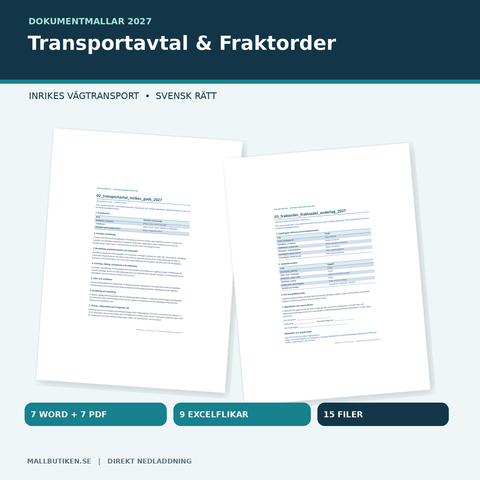
To define the courier's assignment, you can use Transport Power of Attorney – Swedish and English Word/PDF Template. If you also need to agree on the transport service itself, Transport Agreements and Freight Orders are available. In case of deviation, Transport Damage Report and Freight Complaint may be a separate documentation aid.
Also read the guide Which type of power of attorney do I need? for a broader comparison and Common questions about powers of attorney for validity and revocation.
Sources and source checking
Templates in this article

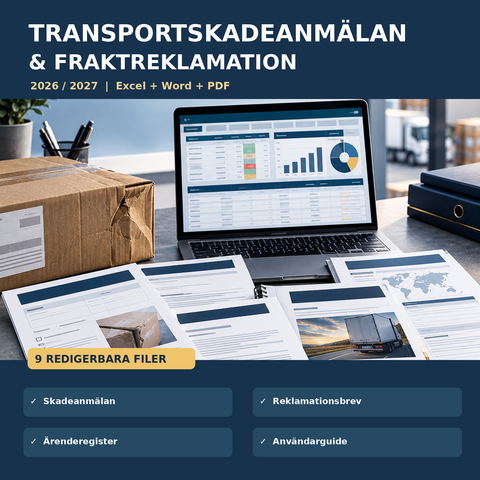
Transport Damage Report & Freight Claim 2026/2027 – Excel, Word & PDF
Word (DOCX) + PDF + Excel (XLSX)
79 SEK
View template: Transport Damage Report & Freight Claim 2026/2027 – Excel, Word & PDF

Explore the topic
 Powers of attorney – guides, rules & templates
What type of power of attorney do I need? Comparison and checklist
Compare specific powers of attorney, general powers of attorney, enduring powers of attorney, and business powers of attorney. See which type fits ...
 Powers of attorney – guides, rules & templates
Frequently asked questions about powers of attorney – validity, revocation, and use
Answers to frequently asked questions about powers of attorney: written requirements, witnesses, validity period, revocation, banks, e-signing, dea...


