
Systematic fire safety management – responsibilities, documentation, and fire safety inspections
Organize fire safety work from the distribution of responsibilities to checks and follow-up actions. With the distinction between legal requirements, general recommendations, and practical procedures.

Systematic fire safety work, SBA, involves organizing, inspecting, and following up on fire safety to ensure it remains effective over time. Start with the division of responsibilities, identify safety measures and risks, plan inspections, and follow up on deficiencies. The extent of the documentation should be adapted to the building and the operations.
This guide helps smaller businesses, property owners, or housing cooperatives (BRF) structure their work. A fire safety binder is a tool; the work must also be carried out on the premises and be known to those who use them.

The most important points in brief
- The law requires fire safety to a reasonable extent. The general recommendations describe a systematic way to maintain it.
- Property owners and users need to clarify which tasks each party is responsible for.
- Inspections must lead to actions and verification that the deficiency has been resolved.
- There is no generally prescribed SBA binder or inspection frequency that fits all buildings.
What are legal requirements and what are general recommendations?
According to Chapter 2, Section 2 of the Act on Protection against Accidents, owners or occupants must, to a reasonable extent, maintain equipment for extinguishing and rescue and take measures to prevent fire and limit damage. This is a statutory obligation. See the Act (2003:778) on Protection against Accidents.
SRVFS 2004:3 provides general recommendations on how fire safety can be managed systematically. The recommendations are not the same as binding regulations. The Swedish Civil Contingencies Agency (MSB) describes how the scope and documentation can be adapted to the object. See the agency's current guidance on responsibility and SBA.
SBA and SAM – what is the difference?
| Area | Main question | Examples of supporting documents |
|---|---|---|
| SBA | Is the fire safety of the building and operations working? | Division of responsibility, inspection plan, fire safety round, and action register. |
| SAM | How are work-related ill health and accidents prevented? | Risk assessments, routines, and action plans for the work environment. |
Joint inspection sessions can be effective, but the distinct tasks still need to be clear. Read the guide on systematic work environment management for the work environment process. The fact that SAM already has a guide does not mean that the division of responsibility and inspections for fire safety are covered.
Get started with fire safety work in seven steps
- Describe the object. Specify the building, operations, usage, contact persons, and which parts of the premises are included. Collect existing documentation so that you know the conditions you are working from.
- Clarify responsibilities. Review lease agreements and the distribution of tasks. Determine who performs inspections, orders maintenance, pays for measures, and follows up. Appoint a coordinator and a substitute.
- Identify safety measures and risks. Collect information about evacuation routes, fire cell boundaries, alarms, fire extinguishing equipment, and the operational risks. Seek expert help when internal competence is not sufficient.
- Determine inspection points. Connect each point to a location or installation. An inspection line needs to state what is to be checked, how, and by whom.
- Plan intervals. Use risk assessments, instructions, service requirements, and previous deviations. Document why an interval has been chosen and when it should be re-evaluated.
- Execute and manage deviations. Note results, measures, the person responsible, and the timeline. Deficiencies that require immediate protective measures must not wait for the next scheduled meeting.
- Follow up and update. Verify that measures work. Review routines in the event of, for example, remodeling, changes in operations, new tenants, or personnel changes.
What should a fire safety binder contain?
A physical binder and a digital folder can serve the same practical purpose. Organize the content so that a new person in charge can quickly find current documents and distinguish them from older versions.
| Section | What the reader should be able to find |
|---|---|
| Objects and contact routes | Which premises are covered and whom to contact. |
| Responsibility list | Owner, user, coordinator, and inspection manager. |
| Technical documentation | Current drawings, descriptions, and relevant instructions. |
| Inspection plan | Inspection point, method, interval, and responsible party. |
| Round protocols and deviations | Results, measures, timeline, and verification. |
| Information and training | How those involved learn about the routines. |
| Follow-up and changes | What has been revised, when, and by whom. |
Example: a deficiency in an evacuation route
During a round, it is discovered that a storage cart system has been placed in front of an evacuation door. The note "door blocked" is not sufficient as a conclusion. Document the location, when the observation was made, the immediate action taken, and who will ensure that the route is kept clear in the future.
From observation to followed-up action
Observation: Carts in front of door U3.
Immediate action: The obstacle is removed.
Preventive action: Determine a different storage location and inform relevant personnel.
Verification: Check that the storage arrangement works during subsequent inspections.
The example shows a documentation chain. It does not replace a fire-technical assessment of the door, evacuation route, or operations.
Checklist for a fire safety round
- Are the relevant evacuation routes clear and usable?
- Is signage and information available where needed?
- Is extinguishing equipment accessible and handled according to inspection and service instructions?
- Are there visible damages or changes that require expert inspection?
- Has the operation changed its use, storage, or furnishing?
- Have previous deviations actually been addressed and verified?
This is a selection of questions, not a complete inspection plan. Use the object's fire safety documentation and relevant instructions to determine the actual points.
Common mistakes
- A binder is created but no one performs the inspections. Documentation needs to be linked to people and actions.
- Responsibility is assumed to lie with the other party. Read the agreement and document the division of duties.
- The same interval is used everywhere. The need for inspection varies between different installations and risks.
- A deficiency is marked as complete when the order has been sent. Follow up to ensure the measure has been carried out and is functioning.
- Older drawings are used after changes. The routine needs to capture changed use and remodeling.
Frequently asked questions about SBA
Is a specific fire safety binder mandatory?
There is no general formal requirement for a binder specifically. Choose documentation that works for the object and makes the work clear and possible to follow up.
How often should a fire safety round be conducted?
There is no single SBA interval for all businesses. Determine the inspection plan based on risks, installations, and applicable instructions or requirements. A simplified monthly round is a possible way of working, not a general legal rule.
Who is responsible: the property owner or the tenant?
Owners and users need to distribute the tasks. An agreement clarifies the practical work, but a supervisory decision might need to be directed at the person who actually has the opportunity to fix the deficiency.
Should SBA documentation be sent to the municipality every year?
The previous requirement for a written report was removed in 2021. It is separate from the documentation needed for fire safety work, which may be requested during supervision.
Collect inspection plans, rounds, and actions
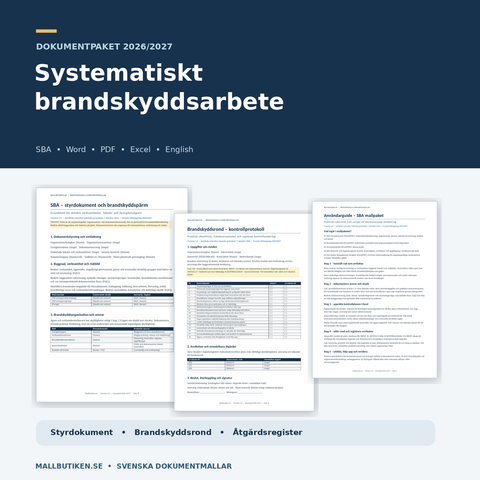
The template store's SBA package provides a basis for the fire safety binder, inspections, and follow-ups in Word, PDF, and Excel. Adapt the content to the building and supplement with the required technical documentation and expertise.
Related guides and supporting documents
- Systematic work environment management – process and follow-up
- First aid and crisis support in the workplace
- Continuity plan for the business
- Technical maintenance plan for housing cooperatives
- Templates for work environment and construction safety
Sources
- Swedish Parliament – Act on Protection against Accidents, Ch. 2, Sec. 2
- Swedish Civil Contingencies Agency – responsibility and systematic fire safety work
Last updated: . General information about fire safety and documentation. The guide does not replace object-specific fire safety engineering, expert risk assessment, or individual legal advice.
Templates in this article
Explore the topic
 Business guides – contracts, HR, AI & compliance
Systematic work environment management 2026 – SAM according to AFS 2023:1 step by step
Guide to systematic work environment management according to AFS 2023:1: policy, risk assessment, action plan, division of tasks, incidents, and an...
 Work environment & HR – guides, rules & templates
First aid and crisis support – workplace preparedness
Guide to first aid and crisis support according to AFS 2023:2: risk assessment, preparedness, alarm procedures, equipment, training, crisis support...
 Business guides – contracts, HR, AI & compliance
Continuity plan – what should it contain and how is it developed?
A business continuity plan describes how critical operations should continue or be restored in the event of disruptions. See what the plan should i...


