
Prepaid or Accrued? Year-End Accounting in Sweden
Prepaid expenses, accrued expenses, deferred revenue and accrued income explained under Swedish accounting rules. Practical examples, K2/K3 guidance, year-end review steps and template links.

Practical accounting guidance for companies, finance administrators and bookkeeping professionals · Swedish accounting law · Reviewed 24 October 2026 · Mallbutiken.se
Prepaid expense, accrued expense, deferred revenue or accrued income? The distinction depends on when a business pays, invoices, receives goods or services, and actually earns income or incurs an expense. At year-end, the substance and the applicable accounting framework matter more than the invoice date alone.
Accrual accounting assigns income and expenses to the financial period to which they relate. Chapter 2, Section 4 of the Swedish Annual Accounts Act (årsredovisningslagen) establishes the principle that income and expenses relating to the financial year are recognised regardless of payment date. The precise treatment depends on the company's applicable framework, including permissible simplifications. See the Annual Accounts Act (Swedish text) and guidance issued by the Swedish Accounting Standards Board (BFN).
Four common types of year-end accruals
| Type | Main question | Illustrative example |
|---|---|---|
| Prepaid expense Förutbetald kostnad | Has the business paid for a service or benefit relating partly or entirely to a later accounting period? | Insurance or a service subscription paid before the balance-sheet date but covering months in the next year. |
| Accrued expense Upplupen kostnad | Has an expense already arisen even though the supplier has not yet invoiced it or the supporting information is incomplete? | A consultancy assignment completed in December but invoiced in January. |
| Deferred revenue Förutbetald intäkt | Has the customer paid or been invoiced before the company has fulfilled the relevant performance obligation? | A customer pays in December for services to be delivered next year. |
| Accrued income Upplupen intäkt | Has the company performed work or earned income that has not yet been invoiced or received? | Work performed before the reporting date is invoiced afterwards, where the relevant recognition criteria are met. |
Classification is not mechanical. The contract, what has been delivered, materiality, the selected accounting framework and any exceptions must be considered. A partly completed service may call for a different assessment from a simple time-based subscription.
Example: a subscription spanning two financial years
Assume a Swedish company with a calendar-year financial year purchases a 12-month service for SEK 24,000 excluding any VAT, covering 1 October 2026 through 30 September 2027. If the applicable accounting rules require equal allocation across the service period, that is SEK 2,000 per month. Three months (SEK 6,000) relate to 2026 and nine months (SEK 18,000) to 2027.
If the supplier instead completes a service in December but invoices in January, an accrued expense may be appropriate. Verify that the service relates to the year being closed, and keep sufficient evidence. A late invoice by itself is not the deciding factor.
K2, K3 and annual closing accounts: which framework applies?
K2 is a Swedish accounting framework with specific simplifications for eligible smaller entities. It must be applied consistently as a whole. K3 has different recognition and measurement rules. Some businesses instead prepare annual closing accounts (årsbokslut) or simplified annual closing accounts (förenklat årsbokslut), with their own applicable requirements.
BFN has amended rules affecting financial years beginning after 31 December 2025 and issued further changes to its annual-closing-accounts guidance with separate effective dates. It is therefore unsafe to rely on an old threshold or assume every business can apply the same K2 simplification. Check the BFN guidance on changes to K2 and K3 from 2026, the current decided rules and effective dates and the framework actually applied by the entity.
Year-end accrual review: eight practical steps
- Define the closing date. Record the financial year, balance-sheet date and accounting framework.
- Gather supporting records. Collect contracts, invoices, evidence of completed services, the general ledger, receivables and payables, and previous accrual schedules.
- Identify the performance period. Determine which amount relates to the period before and after the closing date.
- Check simplifications and exceptions. Decide whether they are permitted for this transaction and document the reasoning.
- Calculate the allocation. Record amounts, dates, methodology, relevant VAT assumptions and judgments made.
- Reconcile the accounts. Make the accounting entries required by the applicable rules in the company's accounting system and verify the balance-sheet accounts.
- Plan the reversal or release. Specify when the accrual should affect future periods and check for double counting.
- Record review and approval. Identify the person who performed the check and any outstanding discrepancies.
Which document template should you use?
For recurring accruals and individual items
Accrual Register & Year-End Reconciliation (Word/PDF/Excel) is intended for documenting prepaid and accrued income and expenses, reviewing amounts and recording checks. The product description lists Word, PDF and Excel files, including English reference guidance. It is a documentation tool; it cannot automatically determine the correct legal or accounting treatment.
For the wider year-end closing process
Year-End Closing Checklist & Reconciliation Register (Excel/Word/PDF) is intended for managing closing tasks, account reconciliations, schedules and outstanding reviews across the entire process. It does not replace individual accrual assessments.
For a broader introduction, see the existing year-end closing guide for Swedish limited companies. The related English monthly reconciliation guide covers VAT, employer declarations, holiday pay liabilities and supplier invoices. The language of that related guide is stated explicitly rather than presented as an English translation.
Checklist: review before finalising the accounts
- Have you identified the correct financial year and current version of K2, K3 or the applicable annual-closing-accounts rules?
- Can the service period, delivery and recognition basis be explained from the agreement and supporting evidence?
- Are prepaid and accrued items separated from ordinary invoiced receivables and payables?
- Is VAT assessed separately when necessary?
- Can every calculation be traced to an invoice, contract or other supporting record?
- Have the reversal and next-period entries been planned to avoid duplication?
- Has a reviewer approved the figures and documented outstanding questions?
Frequently asked questions
Does a December invoice always belong in December?
No. The relevant goods, services, performance obligations and the company's accounting framework determine the period, subject to applicable simplification rules. The invoice date alone does not settle the question.
Does paying in advance make the whole amount a current-year expense?
Not necessarily. A payment for future services may need to be recognised as a prepaid expense, depending on the accounting framework and any valid simplification.
Does this guide decide how VAT should be declared?
No. Swedish VAT reporting has separate rules. Consult the Swedish Tax Agency's VAT reporting guidance for the applicable reporting period and method.
Are K2 and K3 interchangeable?
No. Eligibility and accounting requirements differ. The accounting framework must be determined for the specific entity and financial year before relying on a simplification.
Official sources and legal basis
- Swedish Annual Accounts Act (1995:1554), Chapter 2, Section 4.
- BFN — Swedish accounting guidance on K2, K3 and annual closing accounts.
- BFN — changes to K2 and K3 applicable from 2026.
- BFN — decided rules and effective dates.
- Swedish Tax Agency — bookkeeping and annual closing accounts.
Reviewed 24 October 2026. All numerical examples are illustrative. This English-language explanation concerns Swedish accounting legislation; the correct treatment depends on your company's circumstances. Templates do not constitute official approval or a substitute for professional assessment.
Templates in this article
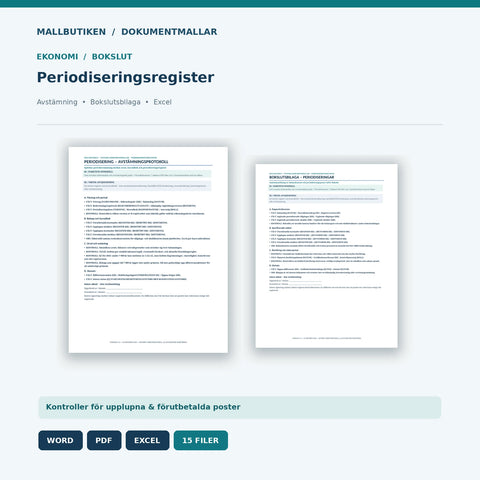
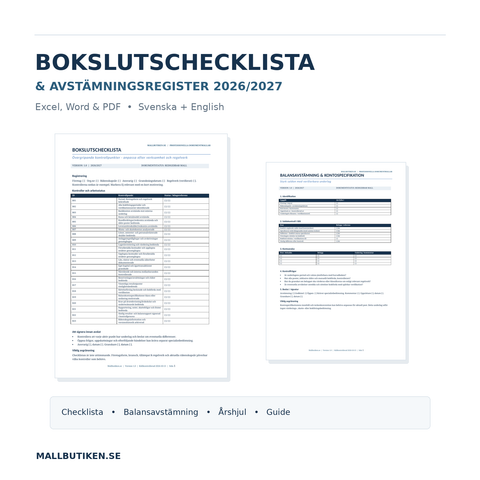
Year-End Closing Checklist & Reconciliation Register 2026/2027 – Balance Sheet Accounts, Year-End Schedules & Annual Cycle | Excel, Word & PDF
Excel (XLSX) + Word (DOCX) + PDF
79 SEK
View template: Year-End Closing Checklist & Reconciliation Register 2026/2027 – Balance Sheet Accounts, Year-End Schedules & Annual Cycle | Excel, Word & PDF
Explore the topic
 Annual reports – guides, rules & templates
Year-end closing for limited companies – step by step 2026
Year-end closing for limited companies step by step 2026: reconciliation, accruals, valuation, tax, K2/K3, capital deficiency, and the path forward...
 Business guides – contracts, HR, AI & compliance
Month-End Reconciliation Sweden – VAT, AGI, Holiday Pay & Suppliers
How should Swedish companies reconcile month-end VAT, employer declarations (AGI), holiday pay liabilities and supplier invoices? Compare four cont...


