
Month-End Reconciliation Sweden – VAT, AGI, Holiday Pay & Suppliers
How should Swedish companies reconcile month-end VAT, employer declarations (AGI), holiday pay liabilities and supplier invoices? Compare four controls, supporting records, deadlines and templates.

Guidance for Swedish small businesses, finance assistants, payroll administrators and accountants · Rules checked 24 October 2026
A useful month-end close reconciles the accounting areas actually relevant to the business: supplier invoices, VAT, paid wages and employer declarations (AGI), as well as accrued holiday pay liabilities. These controls need different records. A VAT reconciliation is not an AGI review, and holiday pay liabilities do not constitute a separate tax return.
A sound process is to identify the correct period and owner, compare source records, investigate discrepancies, correct information in the appropriate system, and only then approve the accounting or tax-filing support. A reconciliation template helps document this work but does not submit a return or establish its correct tax treatment.
Which reconciliation records do you need?
| Month-end question | Relevant document package | Compare these records |
|---|---|---|
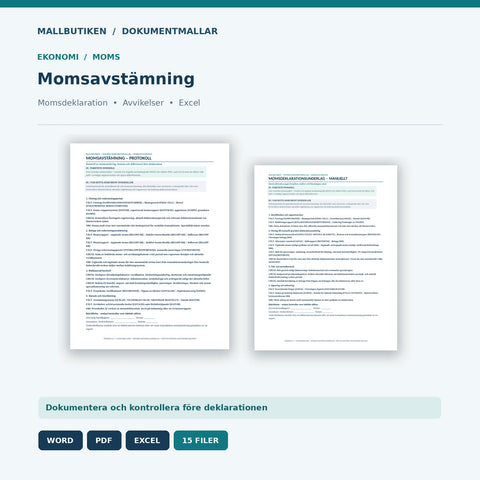
| Do VAT accounts agree with the VAT report? | VAT Reconciliation & Return Support | Posted VAT amounts, transactions, reporting period, VAT report and resolved discrepancies. |
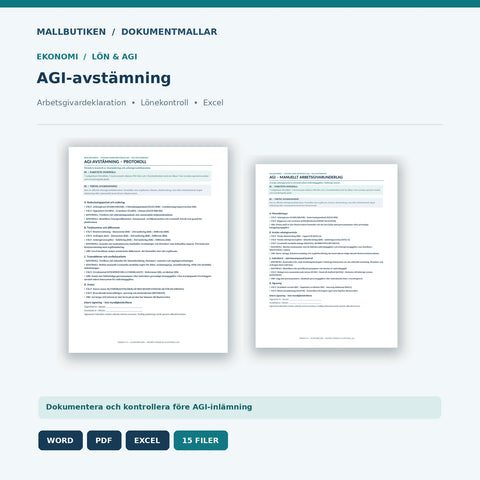
| Do payroll journals, employee figures and withheld tax agree? | AGI / Employer Declaration Reconciliation | Paid remuneration, payroll system, draft individual-level employer return, tax withholding, employer contributions and bookkeeping. |
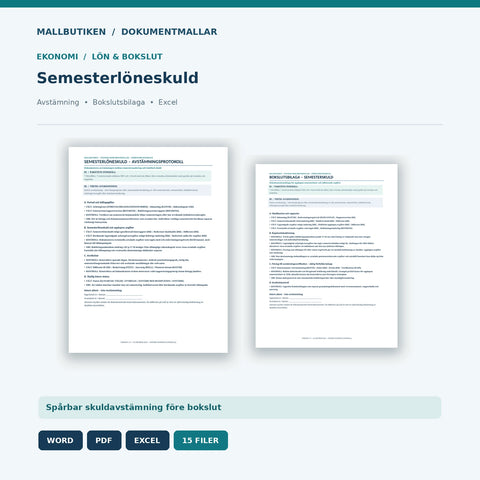
| Does the holiday pay liability agree with the payroll register? | Holiday Pay Liability Reconciliation | Individual holiday balances, payroll liability report and the accounting liability balance. |
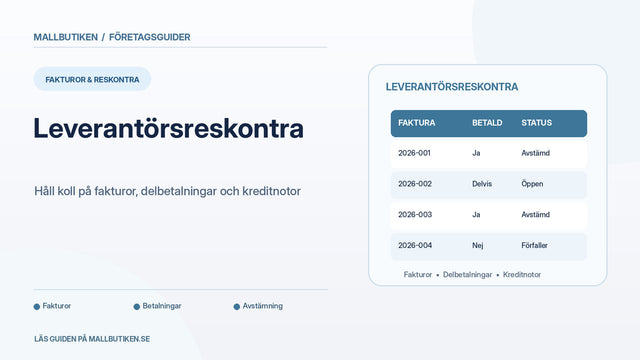
| Are outstanding supplier invoices and payments correct? | Accounts Payable Register & Payment Monitoring | Invoices, credit notes, instalments, due dates, general ledger and payment records. |
These are administrative documentation products described in the Shopify catalogue, not replacements for accounting/payroll software or tax filings. The products' status alone does not independently verify a customer's digital delivery.
1. Define reporting periods, accounting methods and responsibility
Make a control schedule showing the reporting period, assigned reviewer, report version, approval date and location of the exception register. If an external accountant prepares records while an authorised company representative files returns, specify that division of tasks in writing.
VAT may be reported monthly, quarterly or annually, depending on the Swedish business's registration and circumstances. Employer declarations are normally connected to calendar months. The company's bookkeeping method can also affect when VAT is recognised. A monthly internal bookkeeping review does not, by itself, impose monthly VAT filing. Check the Swedish Tax Agency's official VAT periods and reporting methods.
Internal approval and actual submission deadlines are different events. Always verify the company's precise reporting dates and current registration rather than relying on generic dates printed in a template.
2. Supplier invoices and payment reconciliation
Review invoices registered, paid, credited or still outstanding. Check credit notes and partial payments for double counting, and reconcile the total aged payables with the relevant general-ledger accounts. Investigate differences before recording completion.
This control supports cash-flow monitoring as well as correct period accounting. The VAT impact of a supplier invoice can depend on the transaction and the accounting method. See the related guide on accounts payable, partial payments and credit notes.
3. VAT reconciliation: ledger versus VAT report
Start with actual business transactions. Check whether the VAT report reconciles to posted amounts, whether transactions fall into the correct reporting period and whether exceptional transactions were handled appropriately. EU trade, certain construction services, advance payments and other special events may need additional review.
VAT reporting frequency and method depend on the company's actual registration and transactions. A document template cannot determine the correct period or input VAT deduction on its own. Consult the Swedish Tax Agency's VAT guidance.
4. AGI: reconcile remuneration paid, individual data and contributions
AGI stands for arbetsgivardeklaration på individnivå, the Swedish employer declaration at individual level. It concerns reportable remuneration, tax withheld and employer contributions. Compare payroll journals and amounts actually paid with individual employee/recipient information in the draft AGI and the company's accounting records.
The standard approach is to report salaries and taxable benefits in the relevant employer declaration after payment or provision of the benefit, subject to detailed rules. Check the company's actual filing date in the Tax Agency AGI guidance. Review differences per recipient without exposing employee details to unauthorised people.
5. Holiday pay liabilities are accounting items, not separate tax declarations
A holiday pay liability reflects accrued obligations for employee holiday pay and related entitlements that have not yet been settled. Compare payroll-system details and employee balances with liability amounts recorded in the ledger. Investigate differences and make any adjustments required by the applicable accounting framework.
An increase in a recorded holiday pay liability is not automatically a wage payment reportable in AGI in the same month. Holiday accruals, actual remuneration, settlement dates and related contributions require their own analysis based on the Swedish Annual Leave Act (1977:480), relevant collective agreements and the company's accounting standards. A spreadsheet assists with checking figures but does not itself calculate every legal payroll entitlement.
Eight steps for the recurring month-end close
- Confirm the control period. Identify the month each schedule covers and the actual tax-return periods.
- Collect records. Gather ledger extracts, accounts payable, bank statements, VAT report, payroll journal, draft AGI and any holiday pay liability report used by the business.
- Reconcile payables. Match invoices, credit notes, instalments and outstanding items to the ledger.
- Check VAT. Reconcile VAT accounts and reports; investigate transactions with unclear timing or treatment.
- Check payroll and AGI. Compare payments, individual recipient data, withheld tax and employer contributions.
- Check holiday pay liabilities. Reconcile payroll balances to accounting liabilities where appropriate for the company's closing procedures.
- Log exceptions. Capture the discrepancy, supporting record, person responsible, corrective action and next review date.
- Approve the correct version. Recheck corrections and obtain internal sign-off; authorised persons must separately review and submit any statutory return via the appropriate service.
The business's risk profile and size determine how detailed the process needs to be. BFN's bookkeeping guidance covers statutory record requirements; it does not require a particular commercial checklist.
Two illustrative month-end scenarios
A service company with employees and quarterly VAT
A business employs three people and files VAT quarterly. It may still reconcile supplier invoices and salary payments every month before preparing AGI, and monitor holiday pay accruals. VAT account movements may be reviewed monthly, but the statutory VAT return follows its registered quarterly period. A signed internal monthly schedule must not be described as a submitted VAT return.
An issue is found after AGI and VAT have already been filed
A supplier invoice was posted in the wrong period and an employee's reported remuneration is incorrect. First establish the facts and impact on bookkeeping, VAT and employer declarations. Then assess each potential correction independently under the relevant Tax Agency procedure. One corrected internal worksheet does not change both tax filings.
Why document reconciliations and discrepancies?
Olumoh (2025) studied relationships between accounting controls and perceived reporting quality in a sample of 140 participants at microfinance banks in Kwara, Nigeria. That setting is not Swedish SME bookkeeping, and the research does not establish that a particular commercial template reduces errors. It is cited only as limited background on the value of detecting and following up differences. Research reference.
Checklist before internal sign-off
- The period, data version and responsible reviewer are shown.
- Relevant supplier invoices, credit notes and payments reconcile to bookkeeping.
- The VAT report matches supporting records and the registered reporting period.
- Payroll and AGI figures agree for the relevant payment recipients.
- The holiday pay liability is reconciled where the business has such a balance.
- Exceptions are resolved or explicitly flagged as outstanding.
- Internal approval is not confused with the authority's submission receipt.
- Authorised people verify actual filing deadlines and declarations.
Official Swedish sources
- Swedish Tax Agency — VAT reporting periods
- Swedish Tax Agency — correcting a VAT return
- Swedish Tax Agency — employer declaration deadlines
- Swedish Tax Agency — correcting AGI
- BFN — Swedish bookkeeping guidance
- Annual Leave Act (1977:480)
Reviewed 24 October 2026. The examples are simplified. This English guide explains Swedish requirements only, not tax or payroll advice tailored to a particular organisation. Verify actual registrations, reporting periods, agreements and transactions.
Templates in this article
Explore the topic
 Business guides – contracts, HR, AI & compliance
Accounts payable – reconciliation, partial payments and credit notes
Here is how you track supplier invoices, link partial payments and credit notes, and reconcile outstanding liabilities against your bookkeeping.


