Volunteer at a non-profit organization – agreement, schedule and certificate
How does the organization document a volunteer assignment from start to finish? Compare the agreement, official schedule, timesheet, and volunteer certificate, along with a practical checklist and important boundaries.

Practical guidance for Swedish non-profit organizations · Fact-checked 24 October 2026 · Published by: Mallbutiken
A volunteer agreement describes what the volunteer work will entail, a staff schedule shows who does what and when, a timesheet documents hours worked, and a volunteer certificate confirms what the organization has verified after the fact. These documents serve different purposes and do not need to be used for every minor organizational activity.
The practical process is simple: describe the assignment before it starts, organize its execution, verify what actually happened, and issue certificates only after review. The information must match the organization's actual activities and should not give the impression that a volunteer assignment is always equivalent to employment.
Which document do you need?
| When? | Document | What needs to be verified? |
|---|---|---|
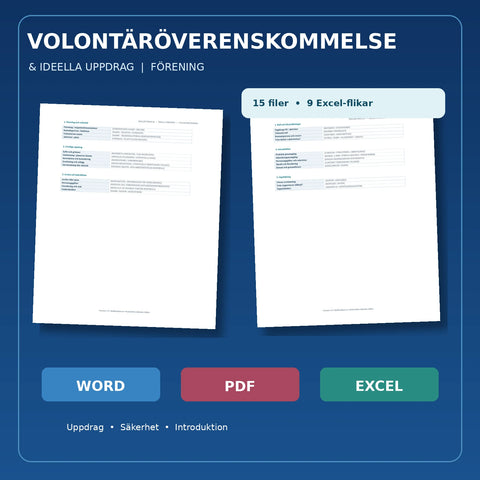
| Before the volunteer starts | Volunteer agreement and assignment description | Tasks, contact person, expectations, induction, safety, insurance matters, and completion. |
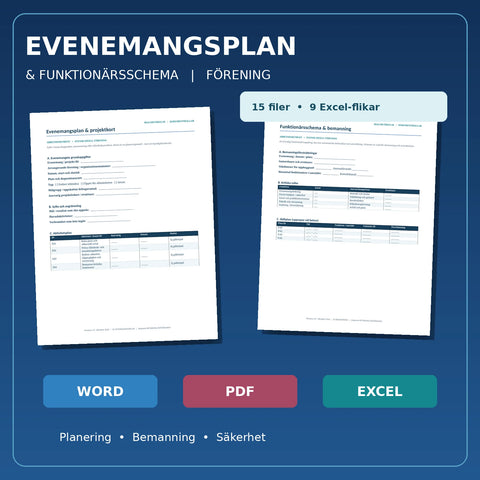
| For events or multiple work shifts | Event plan and staff schedule | Staffing, shifts, responsibilities, substitutes, risks, and how changes are communicated. |
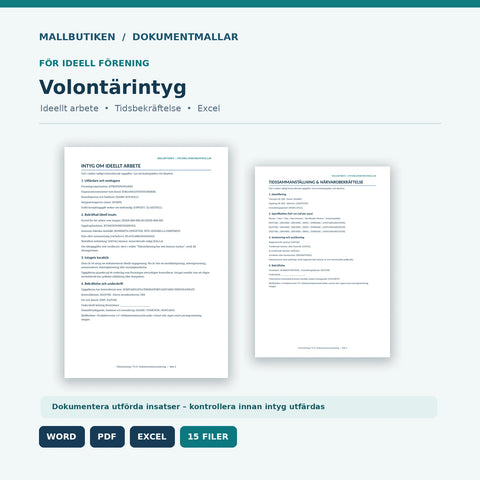
| During and after the assignment | Volunteer certificate and timesheet | Actual period, assignment, supporting documentation, verified hours, and authorized issuer. |
| For activities with registrations | Registration and participant administration | Who is participating, waiting list, practical information, and reasonable storage of personal data. |
| When an event involves particular safety risks | Safety plan and incident report | Risks, responsibilities, preparedness, permit requirements, reporting, and actions. |
All five products are administrative aids. They do not replace an assessment of the actual nature of the assignment, mandatory permits, or liability arrangements.
1. Before the assignment – write a clear agreement
A brief agreement is particularly useful when the assignment is recurring, involves trust or access to premises and information, or when several people need to know which volunteer is responsible for what. Document the following first:
- the organization's name, the volunteer's name, and a designated contact person,
- the assignment's content, approximate period, and practical instructions,
- what induction and equipment are required,
- who handles accidents, deviations, insurance matters, and emergency contact,
- how the assignment may be changed or terminated, and which permissions and items must be returned.
2. During the activity – staff it and monitor it safely
The staff schedule should show the task, time, location, assigned person, responsible contact, any induction requirements, and who can take over in case of absence. A schedule works best when changes can be confirmed so that two people do not believe the other has taken over a safety-critical shift.
For public events, the organization must also check whether permits or registration are required. The Swedish Police Authority's information on organizing events describes when special rules may apply. A volunteer staff member should not perform tasks that require special authorization without the proper conditions being met.
Example: an organization day with eight staff members
An organization assigns staff to the entrance, information desk, materials, refreshments, and final cleanup. The staff schedule specifies shifts and the responsible coordinator. Two volunteers help before and during the event. Their hours are reported afterward and reconciled against the tasks actually performed – not merely the planned schedule. If an incident occurs, it is handled according to the organization's safety procedures, not as a casual note in a widely distributed participant list.
3. After the assignment – distinguish planned time from verified time
A scheduled time is not the same as time actually worked. The organization should therefore have a simple verification process:
- The volunteer submits the actual period and the tasks performed.
- A responsible person compares the information with reasonably accessible supporting documentation, such as an attendance list or the coordinator's notes.
- Any discrepancies are corrected with the date and a clear explanation.
- The organization documents what has been verified, by whom, and when.
- Certificates are issued only based on documentation that the organization can substantiate.
Do not automatically use a maximum number of hours from a schedule as confirmation of actual work. If hours are not reliably documented, a truthful certificate stating the assignment and period may still be more appropriate than an uncertain hourly figure.
4. What should a volunteer certificate contain?
A certificate may state the organization's name, the volunteer's name, the nature of the work, the verified period, any verified scope, the date, contact details, and the name of the person issuing the certificate. Assessments of performance or personal qualities should only be included if they can actually be substantiated and are necessary.
A volunteer certificate is not an employer reference, a diploma, a formal professional qualification, or an official certificate. The recipient of the certificate determines how important the information is in their context. The certificate also does not mean that the organization guarantees a particular employment or insurance classification.
Remuneration and volunteer work – check the boundaries
If the organization pays wages, fees, benefits, or expense reimbursements, accounting and tax rules may apply. The Swedish Tax Agency's guidance on remuneration in non-profit organizations explains that organizations generally have the same obligations as other employers, with certain special exceptions, including in sports. The assessment should concern actual remuneration and real conditions, not the title of the template.
This guide therefore does not state any general tax-free amounts for "volunteers". Before remuneration is paid, the organization must check the type of remuneration, the recipient, the amount, and the applicable Swedish Tax Agency rules.
Personal data – collect less and protect it better
Contact details, assignments, schedules, and time reports are personal data when they can be linked to identifiable individuals. The organization must have a clear purpose and legal basis, provide relevant information, and limit access and storage. The Swedish Authority for Privacy Protection's (IMY) guidance on GDPR compliance for organizations describes, among other things, data minimization, correction, and security measures.
Do not routinely record personal identity numbers, private health information, or other sensitive personal details in schedules and certificates. Publishing photographs of volunteers requires a separate assessment; documenting work shifts does not in itself grant the right to publish images or distribute a complete register.
What does research say about induction and communication?
Trent, Allen, and Prange (2020) surveyed 171 volunteers from two non-profit organizations. The perceived opportunity to have their voice heard and satisfaction with communication were indirectly related to organizational commitment through the participants' experience of involvement. Education influenced the strength of these relationships. The study is based on observation and does not guarantee that a particular form will lead to higher commitment. See the study in the Journal of Community Psychology.
Another survey by Piatak and Carman (2023) found links between volunteers' experiences of education, inclusion, support, and continued commitment. The results should be seen as support for well-thought-out procedures, not as proof that a particular template guarantees volunteer retention. Read the study in the Journal of Public and Nonprofit Affairs.
Checklist for the organization's volunteer work
- Define the volunteer assignment and check whether another form of agreement may be needed.
- Appoint a contact person and write practical assignment instructions.
- Check the induction, safety procedures, and actual insurance terms.
- Plan staffing and document changes to work shifts.
- Check permit and special safety requirements before events.
- Record only the personal data needed for specific purposes.
- Reconcile the work performed against available supporting documentation.
- Issue an accurate, clearly defined certificate with an authorized issuer.
Official sources
- Swedish Tax Agency – non-profit organization.
- Swedish Tax Agency – paying remuneration in a non-profit organization.
- IMY – the organization's data protection work.
- IMY – processing personal data in organizations.
- Swedish Police Authority – organizing events.
Fact-checked 24 October 2026. Always check the current rules, agreements, and insurance terms for the organization's specific activities. This information does not replace individual advice.