Svenska Dokumentmallar
AMLR Football 2029 – KYC for Sponsors, Investors and Player Transfers | Word/PDF/Excel
AMLR Football 2029 – KYC for Sponsors, Investors and Player Transfers | Word/PDF/Excel
- File format
- DOCX, PDF, XLSX
- Document language
- Five Swedish business templates one Swedish user guide and one English User Guide in DOCX/PDF; Swedish Excel workbook with nine tabs.
- Number of files
- 7
Digital download. No physical product is shipped.
Couldn't load pickup availability
About this template
AMLR football 2029 – practical templates for KYC, sponsorship, investments, football agents and player transfers. The EU's new anti-money laundering regulation (EU) 2024/1624 means that certain professional football clubs will have specific obligations regarding risk assessment, customer due diligence, beneficial ownership, transaction monitoring and reporting. The requirements apply to club activities under Article 3.3(o) from 10 July 2029. This document package helps the club plan, document and prepare the chain of control.
Quick answer: The package contains 7 Word files, 7 searchable PDFs and 1 Excel workbook with nine tabs – a total of 15 digital customer files in a ZIP. Five Swedish working documents and one Swedish user guide are complemented by an English User Guide. This is a documentation aid, not an AML service that verifies persons or submits regulatory reports.
01. Package contents
Five operational templates: applicability assessment, KYC for sponsor/investor, player transfer/agent and payment trail, risk analysis/AML policy and incident/stop log. Guides: Swedish and English user guides. Excel: nine register tabs with formula support to identify missing documentation. Each document is available in editable Word and searchable PDF.
02. What the files contain
Ready-made control questions, fields for internal case IDs, contract references, license and division assessment, ownership structure and beneficial ownership, PEP/sanctions check, agent mandate, transfer payment, risk responsibility, escalation and human attestation. All personally identifiable KYC documentation must be stored separately in an access-controlled system. Excel never automatically approves a counterparty or transaction.
Which clubs and transactions are affected?
Article 2.52 defines what is meant by a professional football club in this context. According to Article 3.3(o), the clubs' AMLR obligations apply to four explicit transaction areas:
- Investors: capital injections and other relevant transactions where the club has an investor counterparty.
- Sponsors and advertisers: contractual and payment relationships where the purpose, owner and financing route may need to be reviewed.
- Football agents and other intermediaries: authority, mandate, remuneration and involved payment parties.
- Player transfers: counterparty clubs, agent agreements, remuneration flows and changes of recipient.
Football agents are covered separately by Article 3.3(n). The package focuses on the club's processes and is not a complete standalone agent manual. An amateur club does not automatically become reportable just because it operates football.
Does AMLR apply to all football clubs automatically?
No. Article 5 allows a Member State to decide on full or partial exemptions for certain professional clubs with documented low risk. For a club in the highest national division, revenue below 5 million euros during each of the two preceding calendar years is required, among other things, for the Member State to be able to use that option. Clubs in lower divisions can also be covered by decided exemptions under certain conditions. Exemptions are not automatic: a club cannot simply tick "under 5 million euros" and be exempt. Before a decision, an actual Swedish exemption decision and its scope must be checked.
When do the rules apply? AMLR generally applies from 10 July 2027, but specifically for the business operators under Article 3.3(n) and (o), football agents and professional football clubs, from 10 July 2029 according to Article 90. Older Swedish anti-money laundering legislation, GDPR, sanctions rules or other obligations may apply to certain activities earlier. The product is intended for preparation for 2029, not to claim that all new football requirements apply in 2026.
File by file – everything included
| No. | Document | Use | Language | Format |
|---|---|---|---|---|
| 01 | Applicability assessment | Definition of professional club, the four transactions and actual national exemptions. | Swedish | DOCX + PDF |
| 02 | KYC – sponsor and investor | Counterparty ID, beneficial owner, PEP, sanctions, financing and documented review. | Swedish | DOCX + PDF |
| 03 | Player transfer and agent | Contract chain, agent role, foreign counterparty and changed payment recipient. | Swedish | DOCX + PDF |
| 04 | Risk assessment and AML governance | Internal operational risk matrix, roles, board decisions and control routines. | Swedish | DOCX + PDF |
| 05 | Suspicion, stop and measures | Escalation, secure evidence reference, FIU review, correction and re-testing. | Swedish | DOCX + PDF |
| 06 | Swedish user guide | Step-by-step handling, legal limits and three fictional test scenarios. | Swedish | DOCX + PDF |
| 07 | English User Guide | English instructions and source guidance for the Swedish forms. | English | DOCX + PDF |
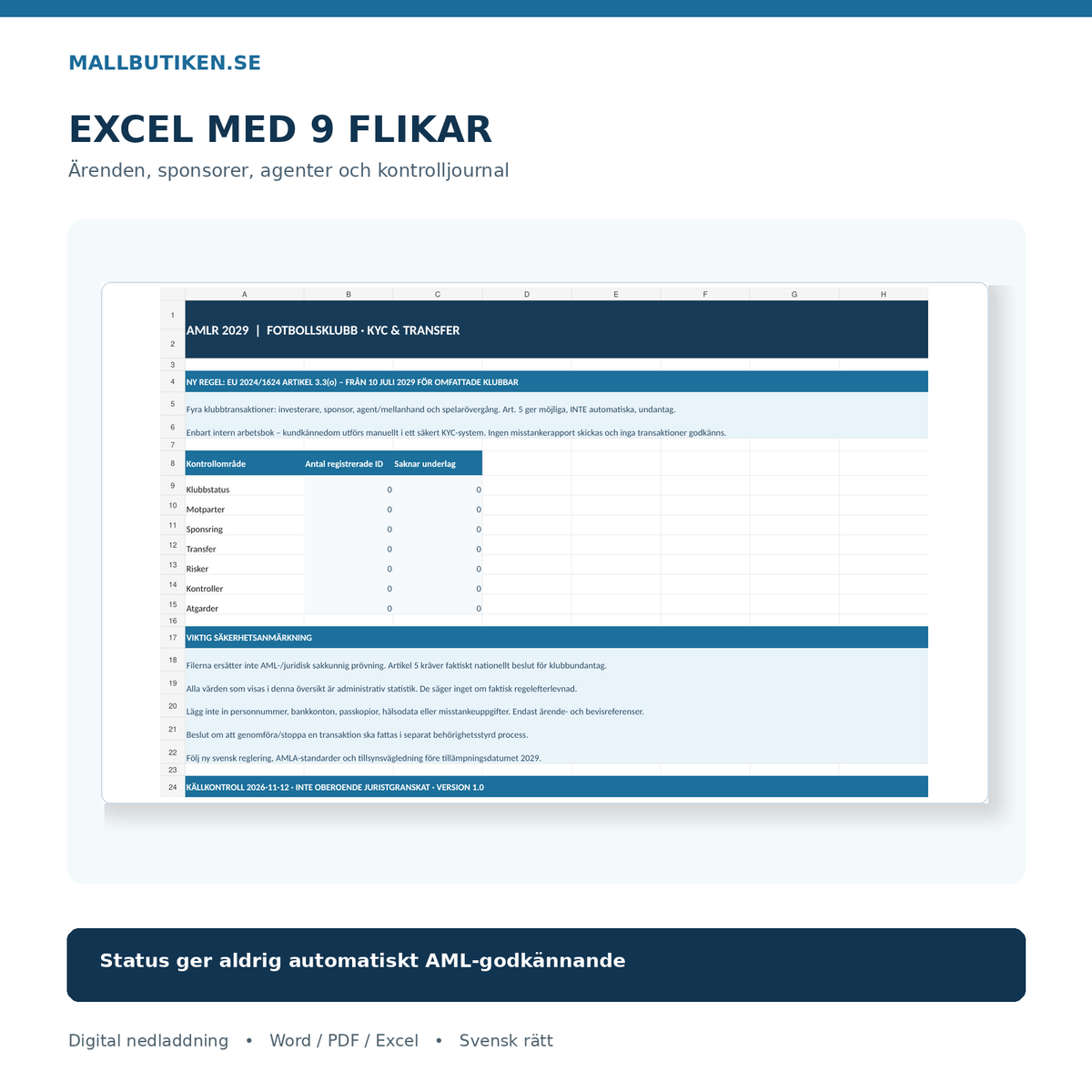
| 08 | KYC and transfer – Excel register | Nine tabs for club status, counterparties, sponsors, transfer, risks and follow-up. | Swedish | XLSX |
Excel: nine work tabs for football AML control
Start: overview and administrative control indicators. Club status: license, division, revenue references and any valid exemption decision. Counterparties: KYC and ownership references. Sponsorship: agreement, financing and responsibility. Transfer: transfer agreement, agent and payment chain. Risks: internal 1–3 classification for probability/consequence and action owner. Controls: KYC, PEP and sanctions. Measures: deviations and follow-up. Sources: official EU rules and applicability limits.
All registers are empty at the start. The formula statuses distinguish between "Missing documentation" and "Documentation registered – MANUAL REVIEW". A filled-in field does not prove identity verification, absence of money laundering risk or the right to carry out payment. The workbook contains no function to collect personal numbers, passports or bank accounts, and no actual suspicion report can be made via the file.
What is required in practice according to AMLR?
Article 9: internal policies, routines and controls must be documented and proportionate to the risk and scope of the activity. The board's role, control functions, training and risk updates become central. Articles 19–20: check when customer due diligence measures are required and identify/verify relevant customers, beneficial owners, the purpose of the relationship as well as sanctions/PEP where applicable. Article 21: if necessary customer due diligence measures cannot be fulfilled, the obligation to not carry out a transaction or to terminate the business relationship may arise. Article 69: suspected money laundering or terrorism financing must be reported in applicable cases to the competent financial intelligence unit, also when it concerns attempts. These questions are always assessed by competent persons; the Word and Excel files do not send reports.
Three football-specific use cases
- Unclear sponsor owner: the club is to receive a larger advance payment from a new sponsor company. Who owns the company? Where does the financing come from? Document control references and decisions on supplementation or stop.
- Change of payment account at transfer: just before a player transfer, the recipient for a transfer amount is changed. Document contract chain, mandate, payment risk and responsible review.
- Club in a lower division: management assumes the activity is exempt because it does not play in the top league. Check definition, risk and actual national exemption rules – do not assume that the exemption already applies.
How the club gets started
- Check the club's legal status and which of the four transaction types occur.
- Verify which applicability date and which Swedish decisions on exemptions actually apply.
- Create internal KYC/risk references for sponsors, investors, agents and transfers.
- Fill in documents 02–04 and link to correctly protected documentation.
- Establish escalation and stop path as well as division of responsibility in document 05.
- Register only process ID and documentation status in Excel; let competent functions make the actual assessment and attestation.
Frequently asked questions
When do the new AMLR requirements start to apply to football clubs?
10 July 2029 for the relevant football activities according to EU 2024/1624 Article 90. Other rules may apply earlier.
Must all clubs with sponsors have KYC registers?
No, not because of these rules alone. It depends on whether the club's activity is covered by the definition, transaction type, applicable rules and any actually decided national exemption.
Is a lower division club automatically exempt?
No. Article 5 gives Member States the opportunity to exempt certain clubs based on documented low risk. It is required that competent Swedish authorities have actually decided on exemptions, and the club's situation must be covered by the decision.
Can the club approve a player transfer by showing "documentation registered" in Excel?
No. The indicator only shows registered information, not approved KYC or legally secure payment. Human review and a competent decision are required.
Does the club need to send a suspicion report via this file?
No. Document 05 supports internal review and measures. Any suspicion reports are submitted through the competent official process, not via the document package.
Are all working templates in English?
No. Five working templates are in Swedish. You also get a Swedish user guide and a separate English User Guide. The seven documents are available as Word and PDF.
Are the PDF files interactively fillable?
No. They are searchable and printable; use the Word originals for filling in and customization.
Can I use the general AML/KYC template instead?
The general template can complement this product for a broader AML program. This package, however, is limited to the football club's specific transaction types and applicability issues according to EU 2024/1624.
Complementary products
For more comprehensive internal anti-money laundering routines, see AML/KYC & Anti-Money Laundering Compliance 2026/2027. That product has broader business controls; this package is specialized for football clubs, sponsorship agreements and player transfers.
Legal sources and quality
Regulation (EU) 2024/1624 – AMLR, especially Articles 2.52–53, 3.3(n)–(o), 5, 9, 19–21, 69 and 90; EUR-Lex summary; AMLA on the risks and exemptions in the football industry; GDPR. Document version 1.0, AI-assisted source review 12 November 2026. No independent legal review has been carried out. This is not an official form, registration with the authority or proof of compliance. National exemptions and new Swedish/EU technical rules must be re-checked before use. Digital ZIP delivered after separate Shopify publication and file linking.