Svenska Dokumentmallar
Used electronics 2026/2027 – certificate of functionality, export control and waste ban | Word/PDF/Excel
Used electronics 2026/2027 – certificate of functionality, export control and waste ban | Word/PDF/Excel
- File format
- DOCX, PDF, XLSX
- Document language
- Five Swedish work templates Swedish user guide and English User Guide; Excel in Swedish.
- Number of files
- 7
Digital download. No physical product is shipped.
Couldn't load pickup availability
About this template
Does your company export used computers, mobile phones, monitors, or other working electrical equipment from Sweden? It is not enough to label the shipment “used goods.” If waste electrical and electronic equipment (WEEE) is suspected, regulatory authorities may require actual functional test certificates for each unit, documented assessments of hazardous substances, transfer documents, declarations of responsibility, and protective packaging.
This specialized template package helps reuse companies, ITAD companies, exporting electronics dealers, and logistics managers document a shipment as actually consisting of used electrical and electronic equipment intended for direct reuse—and stop a shipment that lacks the necessary evidence. The legal basis is Chapter 8, Sections 7–9 of the Swedish Waste Ordinance (2020:614), Annex VI of the WEEE Directive 2012/19/EU, and the new Waste Shipment Regulation (EU) 2024/1157, Article 61. The rules on transboundary waste shipments were largely updated on 21 May 2026.
01. Package Contents
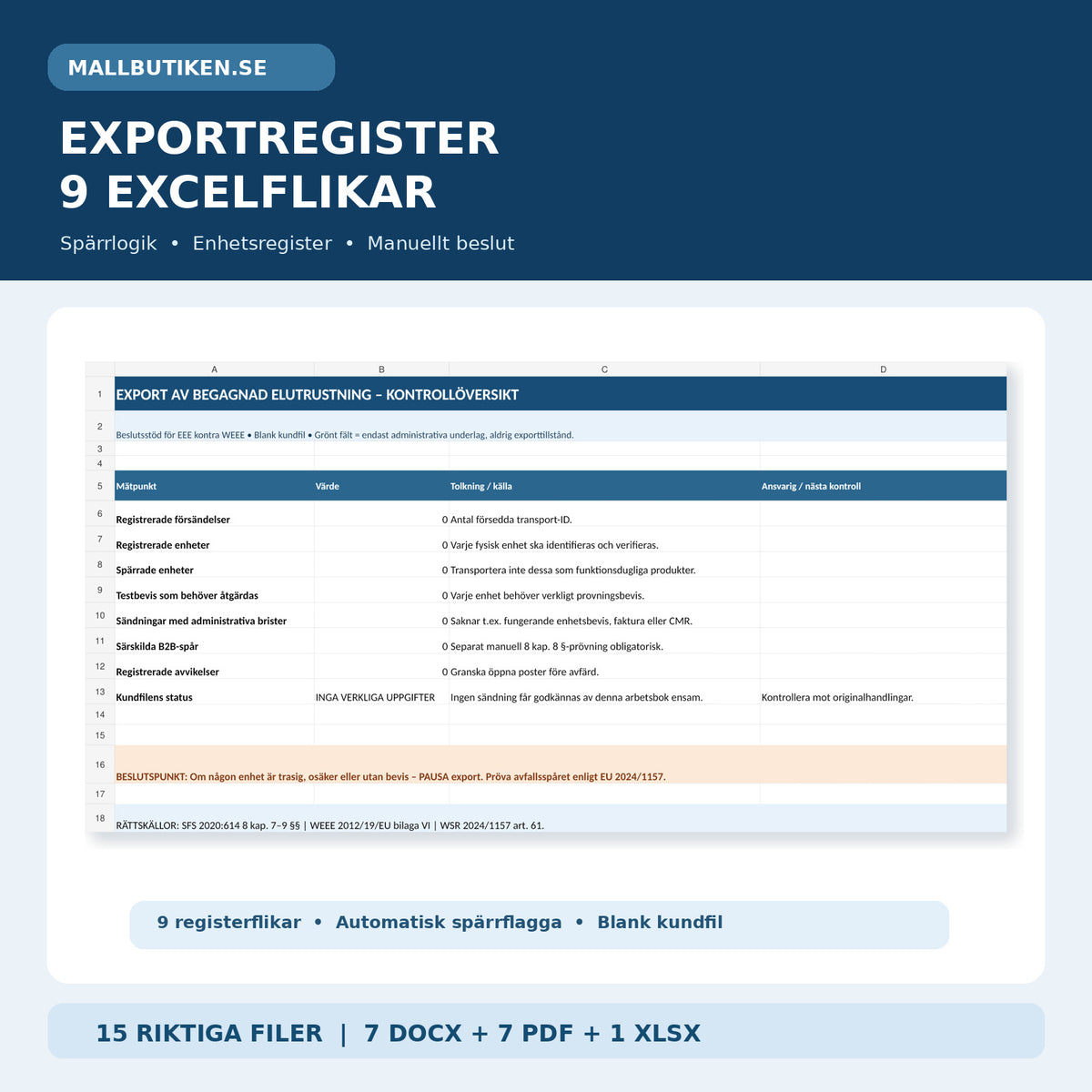
Five Swedish work templates—classification decision, individual functional test, transfer/declaration of responsibility, packaging and shipping control, and B2B repair assessment. Also included are a Swedish user guide and a separate English User Guide. Each document is available in editable DOCX and searchable PDF formats. An XLSX file with nine tabs complements these: a total of 7 Word + 7 PDF + 1 Excel = 15 files.
02. What the Files Contain
Fields and instructions for actual transport and unit IDs, model/serial numbers, EEE category, actual testing method, outcome, test date, the name and address of the responsible testing entity, hazardous substances, signed transfer certificate, CMR, photos of secure packaging, and documented hold. Excel helps identify missing information but can never approve an export or legally determine waste status.
The Difference Between Used Electrical Equipment (EEE) and Waste Electrical and Electronic Equipment (WEEE)
A product may be reusable if it is actually fully functional and intended for direct reuse, and the actual documentation meets current requirements. If the unit is broken, unknown, or lacks verified functionality, it may instead be assessed as waste electrical and electronic equipment. Anyone organizing an export from Sweden must be able to provide relevant evidence in accordance with Chapter 8, Section 7 of the Waste Ordinance. According to Chapter 8, Section 9, the test type, results, test date, unit type/category, identification details, and the name and address of the testing company must be traceable, among other things.
Important: A single test sample is not automatically sufficient for hundreds of other units. Protocols and linked evidence must be available for the units concerned. Results from a non-existent test must never be fabricated. Test evidence must be readable through labeling on the unit or packaging without unpacking, and the protection against transport damage must be appropriate.
Special Case: B2B Warranty and Repair
Chapter 8, Section 8 of the Waste Ordinance contains limited special rules for certain shipments under an actually documented agreement between companies, for example to a former supplier for warranty purposes, certain professional repairs in relevant countries, or qualified root cause analysis. Under these circumstances, the requirements in Sections 1–3 of Section 7 regarding certain documents may be assessed differently. This is not a general exemption from waste regulations, transport protection, other documentation requirements, or safety responsibilities.
How This Product Differs from DIWASS Templates
This package is intended for evidence that used electronics are not waste. The separate DIWASS 2027 – Annex VII from Mallbutiken is intended for documentation and regulatory procedures for actual waste shipments. If the shipment must be classified as waste, you may need a notification, prior approval, relevant waste code, consignee check, and DIWASS. A completed product template never replaces this.
Exact File List
| Document | Function | Language | Format |
|---|---|---|---|
| 01 – Export Decision – Waste or Goods | Assess the actual purpose of the shipment, reuse, and documentation trail | Swedish | DOCX + PDF |
| 02 – Functional Test and Individual Certificate | Document the testing method, results, hazardous substances, person responsible for testing, and each unit | Swedish | DOCX + PDF |
| 03 – Transfer and Declaration of Responsibility | Trace the actual agreement, invoice, responsible person, and purpose of reuse | Swedish | DOCX + PDF |
| 04 – Packaging, Labeling, and Shipping | Protocol for secure protection, readable individual labeling, and CMR/waybill | Swedish | DOCX + PDF |
| 05 – B2B Repair Exception and Hold Log | Test only documented qualified repair and warranty cases | Swedish | DOCX + PDF |
| 06 – Swedish User Guide | Step-by-step, four scenarios, sources, and legal limitations | Swedish | DOCX + PDF |
| 07 – English User Guide | English guidance for Swedish work templates; not translated agreements | English | DOCX + PDF |
| 08 – Excel Register – 9 Tabs | Shipments, individual units/tests, substance risk, agreements, packaging, and holds | Swedish | XLSX |
Excel: Nine Tabs for Traceable Exports
Overview, Shipments, Units, Functional Tests, Substance Risk, Agreements & Certificates, Packaging, Deviations, Read Me & Sources. You record the actual transport ID, associated individual units, test evidence, hazardous substances, agreements, shipping documents, packaging, and actions. The Units tab displays “HOLD – Complete” if, for example, actual testing, substance control, labeling, or shipping protection is missing. The consolidated shipment tab counts held units and flags a direct reuse shipment as held if so. A special B2B repair track provides “MANUAL REVIEW” and never an automatic free classification.
Tested: An administratively complete test shipment is only given the status “ADMIN EVIDENCE – MANUAL REVIEW”; a unit without an approved functional test holds both the individual unit and the direct reuse shipment. The B2B track is marked for separate legal review. The customer’s workbook contains no fictitious imports, persons, serial numbers, or test results.
Practical Workflow
- Identify the shipment: Who is organizing it, to which country, for whom, and for what actual purpose?
- Test the units: Is each product intended for direct reuse? Enter the actual model and serial numbers.
- Document functionality: Perform and document individual tests of relevant key functions and assess hazardous substances.
- Link the evidence to each unit: label securely on the unit/packaging so the protocol can be read without unpacking.
- Check the agreement: secure an actual invoice, transfer document, and declaration of responsibility regarding the reuse and non-waste status of the goods.
- Inspect the packaging and shipping: protect against impacts, battery damage, and improper stacking; retain the necessary CMR/waybill.
- Final manual review: stop damaged or insufficiently tested units. For waste—switch to the correct regulatory process and contact the authorities.
Who Is the Product Suitable For?
For: IT reuse companies, used electronics wholesalers, professional refurbishers, companies selling working IT equipment within the EU or to third countries, and logistics and environmental managers. Not for: export of unusable electrical waste, unsorted electronics containers, chemical waste, dangerous goods certification, full customs clearance, DIWASS registration, or government-issued environmental certification. Even with actual used goods, customs, battery, export control, data processing, and producer responsibility regulations may apply separately.
Frequently Asked Questions About Exporting Used Electronics
Must Every Computer or Mobile Phone Be Tested Before Export?
According to the general rule for used electrical equipment intended to be proven as non-waste, actual individual functional tests must be documented to the relevant extent. Special well-documented B2B cases must be tested separately in accordance with Chapter 8, Section 8.
Is “Used and Functional” on the Invoice Enough?
No. A correct transfer document is only one part of the chain of evidence. Tests, hazardous substances, labeling, protective packaging, declaration of responsibility, and relevant shipping documents must also be verifiable.
Can Broken Units Be Sent as “Repairs”?
This requires a special review of the conditions for documented transfers in accordance with Chapter 8, Section 8. A general label or vague intention to repair is not sufficient.
Do the Documentation Requirements Also Apply Within the EU?
Yes, checks of used EEE suspected of being WEEE also occur during transboundary shipments between member states. Also check the requirements of the destination country.
Is This Template the Same as a DIWASS Annex VII?
No. DIWASS applies to special waste shipment procedures. This product is for documenting actual reusable electrical equipment that, according to a correct assessment, is not waste.
Does Excel Automatically Approve an Export?
No. Excel only marks missing administrative evidence and possible holds. Legal classification, test results, and the actual decision must be performed by the responsible person.
Are the PDF Files Fillable, and Are All Templates in English?
The PDF files are searchable and printable but not interactively fillable. Five work templates and Excel are in Swedish. A separate English User Guide provides instructions in English.
Official Sources and Legal Review
Waste Ordinance (2020:614), Chapter 8, Sections 7–9 · WEEE Directive 2012/19/EU, Annex VI · EU 2024/1157 on Waste Shipments, Especially Articles 61 and 86 · Swedish Environmental Protection Agency – Transboundary Shipments · County Administrative Board – Control of Used Goods.
Version 1.0 · AI-assisted legal source review November 11, 2026 · No independent external legal review or government approval. No transport permit, DIWASS form, electronic government submission, or security certificate is included. Always check current changes, the destination country’s regulations, and the individual shipment.