Svenska Dokumentmallar
Battery Storage 2027 – BMS Data, Battery Health (SoH) and Aggregator Handover | Word/PDF/Excel
Battery Storage 2027 – BMS Data, Battery Health (SoH) and Aggregator Handover | Word/PDF/Excel
- File format
- DOCX, PDF, XLSX
- Document language
- Five Swedish workbooks and a Swedish guide plus an English User Guide in DOCX/PDF; Swedish Excel workbook with nine tabs.
- Number of files
- 7
Digital download. No physical product is shipped.
Couldn't load pickup availability
About this template
Battery storage 2027 – request BMS data, document battery health (SoH) and transfer data to an aggregator. Have you purchased stationary battery energy storage, but can only see the state of charge in an app? The EU Battery Regulation gives special rights to read-only access to data in the Battery Management System (BMS) to the person who legally purchased the battery and certain actors trading on the buyer's behalf. This package provides structured Word/PDF templates and Excel files to carry out a concrete, verifiable request and technical data test.
Short answer: Five Swedish working templates, one Swedish user guide, one English User Guide and one Excel register. Each document is available in editable Word and searchable PDF, plus an Excel workbook with nine tabs: 7 DOCX + 7 PDF + 1 XLSX = 15 customer files in a digital ZIP. PDF is searchable and printable, not electronically fillable.
01. Package contents
Five Swedish working documents: formal BMS data request, data catalog for SoH and lifespan according to Annex VII, limited aggregator mandate, acceptance/read test and non-conformance and escalation log. Also a Swedish user guide and English User Guide in Word/PDF plus Excel with nine tabs. Total 15 files.
02. What the files contain
Fields for BESS ID, battery model, BMS version, buyer's right, legal purpose, read access, timestamps, remaining capacity, round-trip efficiency, self-discharge, cycle count, harmful operating events, authorized aggregator representative, test results and retest. Data access, technical operational approval and a complete battery passport are three different issues. Excel only checks that administrative information is present and never issues legal approval.
Who is the package intended for?
Battery storage owners and property companies, solar installers, BESS and energy storage manufacturers, energy consultants, aggregator services, flexibility providers, independent operators and quality managers in Sweden. Particularly relevant when the battery manufacturer or system supplier has a closed BMS interface and the buyer needs to assess the battery's remaining lifespan or market value.
What does Article 14 of the Battery Regulation say?
Article 14.1 of Regulation (EU) 2023/1542 has applied since 18 August 2024 to stationary battery energy storage systems, among others. Current information on battery health parameters and expected lifespan, as specified in Annex VII, must be available in the battery management system (BMS).
Article 14.2 provides, with respect for the manufacturer's intellectual property rights, read-only access on non-discriminatory terms to the person who legally purchased the battery, including specified independent actors or waste management operators and third parties acting on the buyer's behalf. The access applies to the specified purposes: making the energy storage available to independent aggregators or market operators, assessing residual value and remaining lifespan, or preparing certain reuse, repurposing and remanufacturing.
What is not included automatically: right to system administrator passwords, remote control, a specific API standard, unlimited access to other telemetry, or the right to participate in a specific support service market. The BMS manufacturer may have legitimate intellectual property rights. Commercial aggregation, electricity trading, grid terms, cybersecurity and operational reliability need to be regulated and tested separately.
Annex VII – what data should be documented?
Part A – battery health for stationary energy storage: (1) remaining capacity, (2) remaining power endurance where possible, (3) remaining round-trip efficiency where possible, (4) how the self-discharge rate develops and (5) ohmic resistance where possible.
Part B – expected lifespan: (6) manufacturing date and, where applicable, commissioning date, (7) energy throughput, (8) capacity throughput, (9) recording of harmful events such as deep discharge and operation at extreme temperatures and (10) number of equivalent full charge and discharge cycles.
The data catalog helps you distinguish between **missing mandatory information** and parameters that, according to the regulation, are only required where they are technically possible to provide. It is not acceptable to enter made-up measurements. Instead, note the BMS source, method, unit, time, and a verifiable explanation for a deficiency.
What happens on 18 February 2027?
Article 77 introduces a digital battery passport from 18 February 2027 for industrial batteries with a capacity over 2 kWh that are placed on the EU market or put into use within the scope of the provision. The passport must contain product and battery-specific information according to Annex XIII. Different information categories have different access levels, and it is not correct to claim that all passport fields must always be public.
The EU Commission's battery passport guidance from 21 August 2026 summarizes 71 data points and their applicability. Certain types of information will only become mandatory later or only in special situations. An older battery storage system placed on the market before 2027 will not automatically have the same passport obligation simply because the date passes; however, later repurposing or remanufacturing needs to be tested separately.
What is included in the 15 files?
| No. | Document | Purpose | Format |
|---|---|---|---|
| 01 | Request for read access to BMS data | Proof of purchase, authorized purpose and substantive request according to Article 14.2. | Word + PDF |
| 02 | Data catalog – SoH and expected lifespan | All ten parameters in Annex VII, data sources and conditional values. | Word + PDF |
| 03 | Proxy mandate for aggregator data | Limited read-only access for independent aggregator or proxy. | Word + PDF |
| 04 | BMS handover and functional test | Test of read access, data freshness, technical documentation and non-conformance. | Word + PDF |
| 05 | Non-conformance and escalation | Denied data access, missing parameter, request for correction and retest. | Word + PDF |
| 06 | Swedish user guide | Legal scope, workflow, responsibility and four fictional use cases. | Word + PDF |
| 07 | English User Guide | English instructions for the five Swedish working forms. | Word + PDF |
| 08 | Excel register with nine tabs | BESS installations, BMS access, SoH, lifespan, aggregator and non-conformances. | Excel |
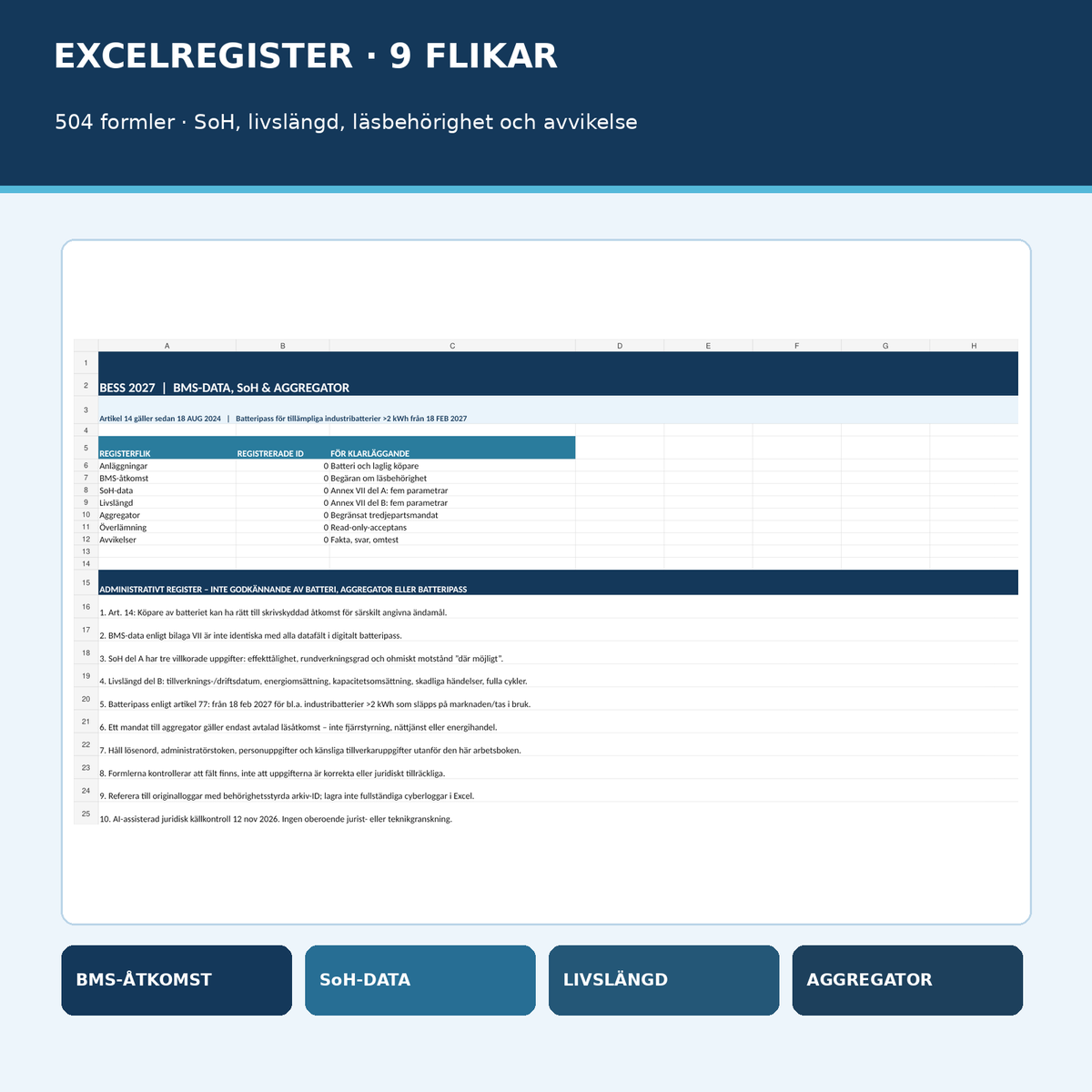
Excel register with nine tabs and 504 formulas
Start – process and number of registered cases. Installations – BESS and owner/battery reference. BMS access – right of purchase, purpose and data request. SoH data – five Part A parameters and basis status. Lifespan – five Part B parameters. Aggregator – proxy, validity and read-only mandate. Handover – read test, timestamps and acceptance references. Non-conformances – supplier response, correction and retest. Sources – official legal sources.
The formulas have passed five scenario tests: complete registered basis, missing conditional parameters, missing core data, empty registration row and failed read test. They show ”Missing core basis”, ”TEST CONDITIONAL PARAMETERS”, ”READ TEST FAILED – ACTION” or ”Basis registered – MANUAL REVIEW”. No status certifies the actual health of the battery or that data access according to Article 14 has been correctly provided. No fictional test cases remain in the delivery.
Three practical examples
- The property owner who only sees SoC in an app: The battery storage buyer requests current remaining capacity, energy throughput and other applicable Annex VII data with reference to Article 14.2. A brochure for a new battery does not replace relevant BMS data for the actual system.
- Aggregator needs battery health: The battery owner gives a time-limited mandate for data reading. A check is made of data format, timestamps and authorization. The mandate does not cover operational commands, grid connection or an agreement on electricity market compensation.
- BMS is missing ohmic resistance: Document that Annex VII states ”where possible” and request a technically verifiable explanation. An empty cell does not automatically mean the battery is faulty or that the supplier has met the requirements. Neither.
How to use the package
- Identify the purchased battery system and the correct buyer, BMS version and desired legal purpose.
- Send the data request in document 01 and attach a secure reference to the proof of purchase/mandate.
- Inventory the ten Annex VII parameters in document 02, with value, unit, timestamp and source.
- Create a limited aggregator proxy with document 03 – without automatic right to remote control.
- Perform read-only read test and quality control in document 04. Test the battery passport separately when Article 77 is applicable.
- Follow up non-conformances in document 05 and Excel; keep original proof in a protected archive.
Frequently asked questions
Must the supplier give me access to the battery's SoH?
Article 14.2 gives the legal buyer, for specified purposes, the right to read-only access to Annex VII data on non-discriminatory terms with respect for the manufacturer's IP. Assess that the current battery, role and purpose are covered.
What is the difference between SoC and SoH?
SoC refers to approximately how charged the battery is right now. SoH refers to its health condition and remaining performance. An SoC indicator does not automatically provide access to the collective parameters of Annex VII.
Can an aggregator get its own read access without buying the battery?
Article 14.2 also covers certain actors and third parties on the buyer's behalf for intended purposes. Use a documented power of attorney and test exact applicability; the right is not a general free pass to system access.
Can I request API, admin password or remote control?
The rules refer to read-only access to certain battery data. They do not prescribe a specific technical API implementation or that the manufacturer must provide administrator passwords or remote control rights.
Must a stationary energy storage have a battery passport 2027?
Industrial batteries over 2 kWh covered by Article 77 that are placed on the market or put into use from 18 February 2027 must have battery passports. Test category, capacity, date and any special circumstances; the battery passport requirement is separate from BMS data access.
What happens if a parameter is missing?
Record the missing information, check if Annex VII uses the condition ”where possible” and request an actual explanation. The assessment is made manually and is not supported by an automatic legal decision in Excel.
Is Excel a technical BMS connection?
No. The workbook is a manual documentation register without real-time connection, API, battery test or remote control.
Are all working templates in English?
The five working templates and Excel are in Swedish. A separate English User Guide is included. All seven documents are delivered in Word and PDF.
Has a lawyer or accredited tester approved the product?
No. It is AI-assisted, source-reviewed editable support documents, not an independent legal review, authority form, technical test certificate or complete battery passport platform.
Related products on Mallbutiken
For overall battery regulations, see EU Battery Regulation and battery passport. For batteries that have been repurposed or put into use for another life cycle, see Battery passport 2027 – second life and traceability to the original battery. This product focuses instead on the buyer's read access to current BMS data and a practical handover test to an aggregator.
Official legal sources and limitation of liability
Regulation (EU) 2023/1542, primarily Article 14 and Annex VII as well as Article 77 and Annex XIII; EU Commission's Battery Passport FAQ; the Commission's guidance published 21 August 2026.
Version 1.0 · AI-assisted legal source control 12 November 2026. No independent legal, electrical safety, cybersecurity or BESS specialist review. Check the latest legal text, right of purchase, manufacturer's technical documentation and agreement before actual use. Digital files are linked to Shopify delivery only after a separate decision on publication.