Svenska Dokumentmallar
CMDB & Configuration Management Database – CI Register, System Dependencies, and Excel | Word/PDF/Excel
CMDB & Configuration Management Database – CI Register, System Dependencies, and Excel | Word/PDF/Excel
- File format
- DOCX, PDF, XLSX
- Document language
- Five Swedish working documents Swedish guide and English User Guide
- Number of files
- 7
Digital download. No physical product is shipped.
Couldn't load pickup availability
About this template
CMDB & Configuration Register is a digital template package for IT system management, IT support, and organizations that need to document configuration items (CIs), their owners, dependencies, change history, and verifications. The package contains 15 files in Word, searchable PDF, and Excel and is primarily suitable for small and medium-sized register environments where manual documentation support is appropriate.
01. Package Contents
7 editable Word files (DOCX), 7 searchable PDF files, and 1 Excel workbook (XLSX), delivered in a ZIP file. Five Swedish operational documents, one Swedish user guide, and one English User Guide in Word and PDF. The main templates are in Swedish; the English file is a guide, not full English translations.
02. What the Files Contain
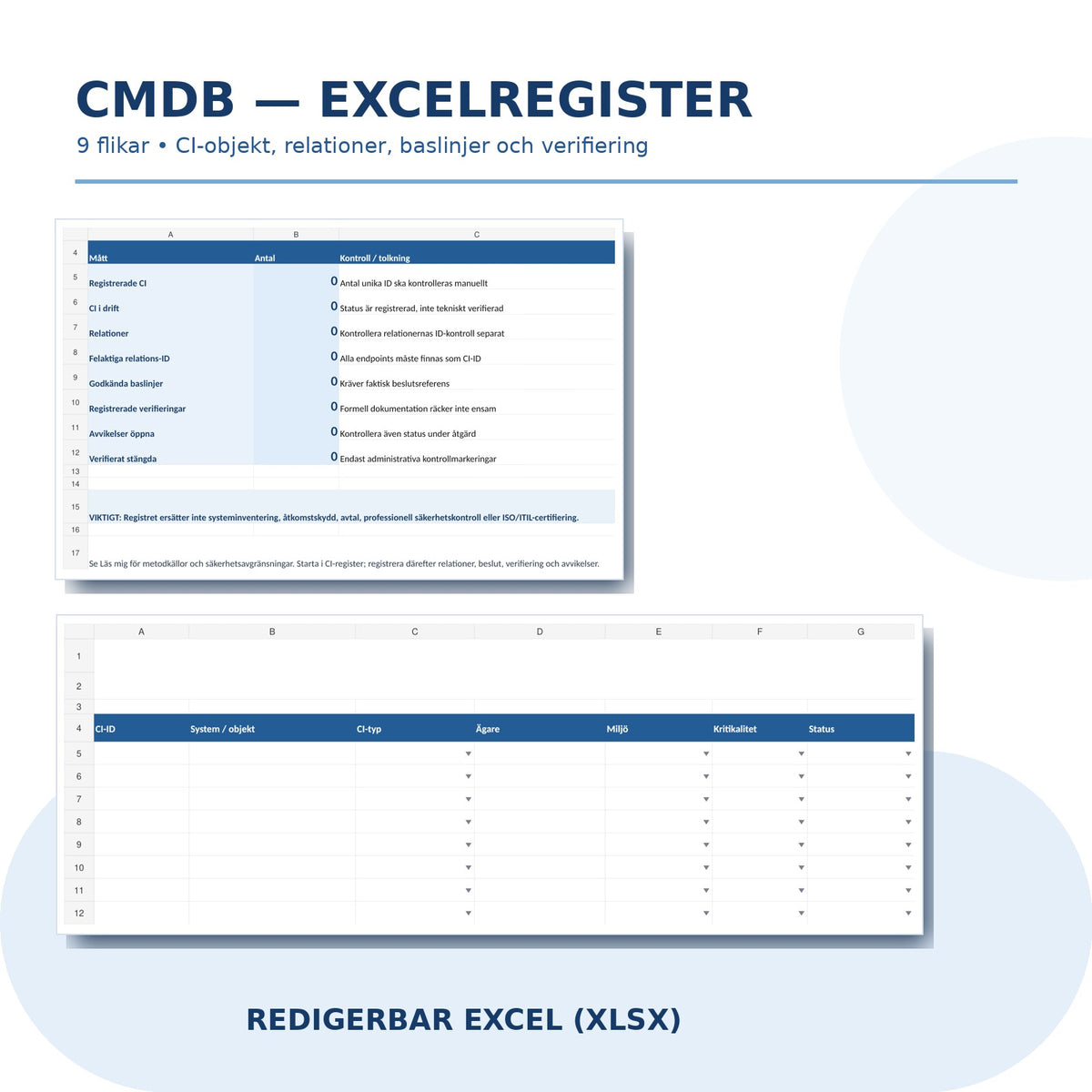
CI cards for systems and services, a relationship matrix with directional dependencies, a lifecycle and change log, baseline and control protocols, and ownership and register audit. The Excel workbook has nine tabs and an overview that only counts registered IDs. It also checks whether both CIs in a relationship exist in the register and flags self-relationships.
What is a CMDB?
A CMDB (Configuration Management Database) is a structured register of configuration items and relationships that helps an organization understand how IT services are built and which components they depend on. A configuration item can, for example, be an application, database, server, or service. This Excel model is a manual register, not a database application, monitoring system, or automated inventory.
The Documents – File by File
| No. | File | Use | Format |
|---|---|---|---|
| 1 | CI card and system description | Unique CI ID, system class, owner, environment, criticality, version, and control | DOCX + PDF |
| 2 | Relationship matrix and dependencies | Directional relationships between configuration items, owners, and control | DOCX + PDF |
| 3 | CI lifecycle and change log | Change references, decisions, implementation, and verification | DOCX + PDF |
| 4 | Baseline and configuration verification | Approved state, actual control, deviations, and evidence | DOCX + PDF |
| 5 | Ownership and register audit | Roles, responsibilities, audit intervals, and quality assurance | DOCX + PDF |
| 6 | Swedish user guide | Step-by-step workflow, limitations, security, and methodology sources | DOCX + PDF |
| 7 | English User Guide | English instructions for the Swedish templates | DOCX + PDF |
| 8 | Excel – CMDB configuration register | Nine tabs with CI register, relationships, baselines, and verifications | XLSX |
The Excel Register – Nine Worksheets
Overview, CI Register, Relationships, Owners, Baselines, Changes, Verifications, Deviations, and Read Me. Each configuration item is assigned a unique ID. Relationships are linked to existing CI IDs and checked for missing or invalid endpoints. The overview shows the number of registered items, relationships, baselines, verifications, and deviations. However, an entered status is not evidence of actual technical control.
How to Use the CMDB Templates
- Determine which system, service, and operating environments the register should cover.
- Define local rules for CI IDs, categories, status, relationships, and responsibilities.
- Register items and relevant management tasks in the CI register.
- Create directional dependencies between existing items and check their IDs.
- Document baselines, planned changes, and decisions in the regular change process.
- Verify actual conditions and register deviations, owners, and follow-up.
- Audit the register regularly and when significant changes occur.
CMDB or Regular Inventory Register – What Is the Difference?
A traditional inventory register often focuses on assets, quantities, procurement, and financial tracking. The CMDB configuration register, instead, focuses on IT service components, their configuration, ownership, and how they depend on each other. It complements, for example, IT Change Request & Change Management and IT Problem Management & Known Errors (KEDB). These two products may still be unpublished; the links are not automatically activated by this draft.
Frequently Asked Questions
Is This a Real Automated CMDB?
No, it is a professional manual document package. The Excel register does not automatically retrieve data from servers, cloud services, or other systems.
What Is a CI ID?
It is a unique identifier for a configuration item. The same ID is used in registers, relationships, and control documents so that information can be tracked throughout the item's lifecycle.
Does Excel Check Whether System Dependencies Work?
No. Excel checks that both specified CI IDs exist in the register and flags certain common registration errors. It does not test whether a technical integration or service works.
Are the Documents ISO or ITIL Certified?
No. The product consists of standalone templates with methodology references to ITIL Service Configuration Management and ISO/IEC 20000-1. No certification, recommendation, or external audit is included.
How Do I Protect Sensitive System Information?
Avoid passwords, private keys, authentication credentials, and unnecessary personal data. Limit access and tailor the level of detail to information classification and the organization's security routines.
Are the PDF Files Fillable?
The PDF versions are searchable and intended for viewing and printing. Edit the Word and Excel versions to enter information. Interactive PDF forms are not included.
Is There an English Template Version?
An English User Guide is included in Word and PDF. However, the five operational documents are in Swedish.
Sources and Limitations of Use
Methodology basis: PeopleCert – ITIL 4 Service Configuration Management, NIST/FedRAMP – system component inventory (CM-08), and ISO/IEC 20000-1:2018. These are references for the design, not approvals of the product. The templates do not replace organization-specific security controls, regulatory requirements, agreements, or ITSM systems. Version 1.0, October 29, 2026. AI-assisted methodology review; no external legal, security, or certification review has been performed.