Svenska Dokumentmallar
Data Act solar cell data 2026 – inverters, data access and service replacement | Word/PDF/Excel
Data Act solar cell data 2026 – inverters, data access and service replacement | Word/PDF/Excel
- File format
- DOCX, PDF, XLSX
- Document language
- Five Swedish workbooks and a Swedish user guide an English User Guide for the Swedish workbooks; Swedish Excel
- Number of files
- 7
Digital download. No physical product is shipped.
Couldn't load pickup availability
About this template
Do you own, rent or lease a connected solar PV system – but can only see the production values in the manufacturer's own app? The EU Data Act may give users the right to access actual product data and request that it be shared with an independent service technician or other authorised third party. With this practical package, you can request data, document a failure to respond or an inadequate response, and check an export before switching service partners.
For: individuals with a connected inverter, solar PV system owners, property managers, small businesses, housing cooperatives and solar PV service companies. The package covers data access and data sharing, not an agreement on electrical installation or direct technical connection.
Package contents
01 User, connected product and actual data holder; 02 Request for operating data and metadata; 03 Data sharing with an independent service partner; 04 Rejection, failure to respond and chain of evidence; 05 Data export and acceptance test when switching service; 06 Swedish user guide; 07 English User Guide for the Swedish work templates; 08 Excel register with nine tabs. The seven documents are delivered as editable Word and searchable PDF. Total 7 DOCX + 7 PDF + 1 XLSX = 15 customer files.
What the files contain
Fields for system/case ID, verified user role, supplier and actual data holder, requested data points (e.g. existing kWh series, power values and fault events), time zone and metadata, machine-readable format, request timeline, third party identity and purpose, relevant exceptions, GDPR assessment, rejection, export test and final certificate. Excel records status and de-identified evidence ID – not login credentials or raw user data.
Exactly which files are included?
| Document | Practical benefit | Format |
|---|---|---|
| 01 User and application | Test Data Act scope, the actual user, product connectivity, the data holder and Article 7 exceptions. | Swedish DOCX + searchable PDF |
| 02 Request for operating data | Individual access letter under Article 4, with period, data points, machine-readable format and metadata. | Swedish DOCX + PDF |
| 03 Sharing with service partner | Request for the data holder to share in-scope data with a named third party under Article 5. | Swedish DOCX + PDF |
| 04 Rejection and chain of evidence | Document refusal, failure to respond, format issues and controlled escalation. | Swedish DOCX + PDF |
| 05 Export and service switch | Test whether measurement data can be interpreted by a new supplier, including time zone, unit, missing values and receipt. | Swedish DOCX + PDF |
| 06 Swedish user guide | Workflow, scenario exercises, legal sources, limits of rights and GDPR check. | Swedish DOCX + PDF |
| 07 English User Guide | English instructions for the Swedish work templates and Excel register. | English DOCX + PDF |
| 08 Excel – data access register | Nine tabs for systems, data fields, request, third party, delivery test, deviations and actions. | Swedish XLSX |
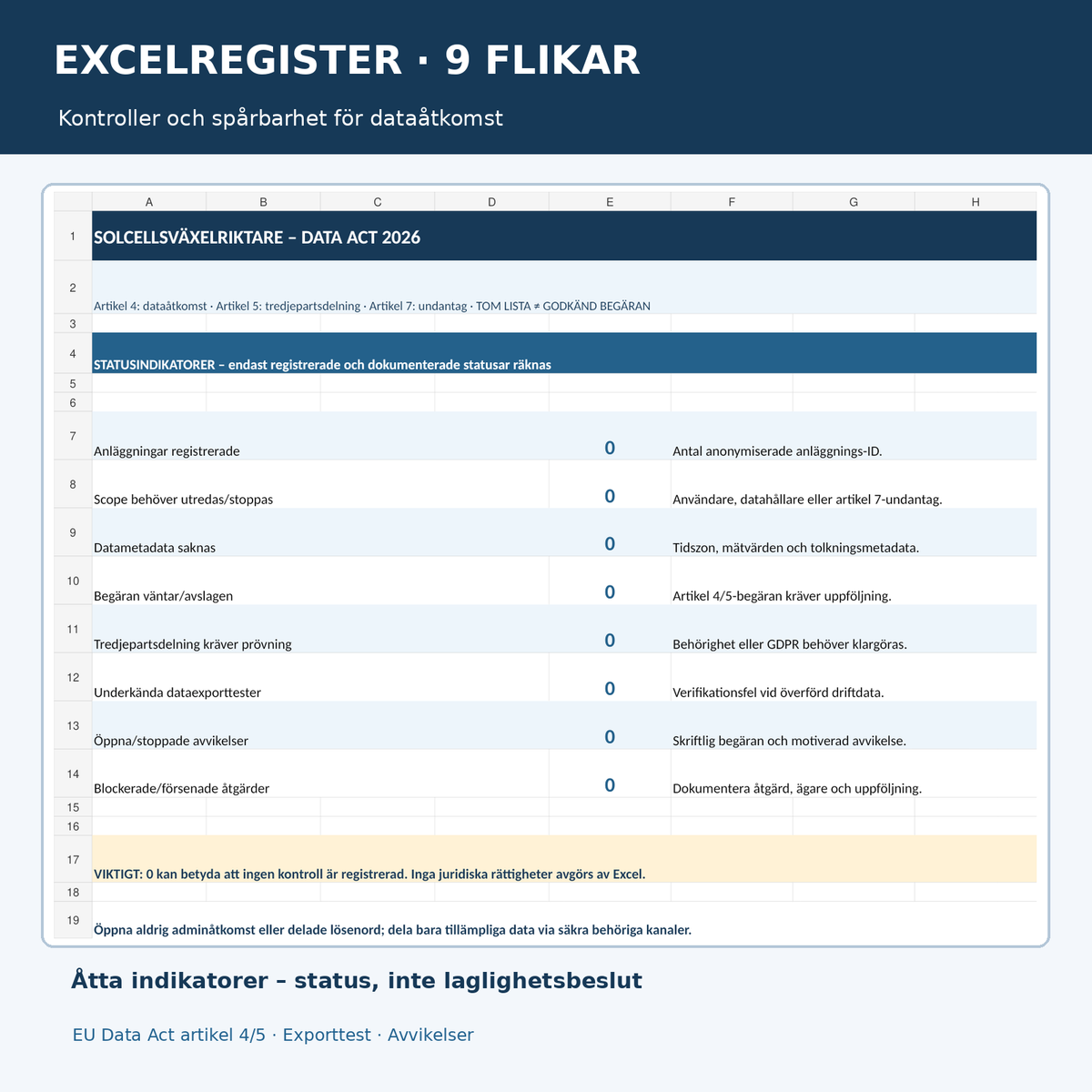
Excel – nine tabs and eight control indicators
Overview, Systems, Data Fields, Request, Third Party, Delivery Test, Deviations, Actions and Read Me. The overview calculates explicitly registered cases, unclear application issues, missing metadata, pending or rejected requests, third party/GDPR issues, failed export tests and blocked/delayed actions. Formulas and status selections have been tested with synthetic cases and the customer version has been cleared.
Note: Zero warnings in an empty workbook does not mean that legal obligations are met. Excel cannot automatically retrieve data, connect to the inverter or decide a legal dispute.
Legal basis – EU Data Act 2026
General application: Regulation (EU) 2023/2854 (Data Act) began to apply substantially on 12 September 2025. The regulation applies, subject to its conditions, to connected products and associated services, including product data that can be retrieved from the actual product or its service.
Article 3.1 and Article 50: the requirement that new connected products be designed so that certain data is directly accessible applies to products and associated services that have been placed on the market after 12 September 2026. This is a different rule from the right under Article 4 to request access to already readily available data.
Article 4 – user access: when the user does not have direct access, the data holder shall make readily available product data and related service data, including relevant interpretative metadata, accessible without unreasonable delay, free of charge for the user, securely and in a structured, commonly used and machine-readable format. Requirements for continuous access and real-time apply only where relevant and technically possible. There is no general right to require the supplier to invent history that does not exist.
Article 5 – data to a third party: the user may request that an identified service partner be given access to such data. The data holder and recipient must consider rules on purpose, security, trade secrets and any applicable conditions between businesses. Do not share account passwords to bypass technical controls.
Article 7 – exceptions: special exceptions may apply when a connected product has been manufactured or designed by certain micro/small enterprises or, for a limited time, certain enterprises recently classified as medium-sized. These must be assessed before an unconditional right to data is claimed.
What is not automatically covered: proprietary forecasts, complex algorithmic analyses, the supplier's source code, history that has not been stored or all existing third-party APIs. The European Commission's explanation distinguishes between raw/pre-processed data and information created through more extensive analysis.
GDPR: if product data shows, for example, how and when people use a home or a system, an independent data protection assessment must be carried out before data is shared, especially if the user and the data subject are different persons. The Data Act does not replace the GDPR.
Practical workflow
- Identify the product and check that it is indeed a connected inverter or associated service covered by the scope.
- Verify the user's eligibility and identify the actual data holder.
- Define which existing raw/pre-processed data points and metadata are needed for troubleshooting, comparison or service switch.
- Fill in Word Template 02 for personal access or 03 for sharing with a selected third party.
- Document receipt, the format delivered and any deficiencies.
- Make a separate GDPR and security decision before forwarding the basis.
- Test exported data with Template 05 and record only de-identified statuses and evidence references in Excel.
Frequently asked questions
Can I retrieve data from my old solar PV system?
It may be possible. Article 4 and Article 3.1 have different time rules, and the right only applies to data that is actually available within the scope of the regulation. Check the product's market date and specific data categories.
Do I have a right to all data in the manufacturer's app?
No. Raw and pre-processed product data and necessary metadata differ from proprietary forecasts, analyses and other derived information.
Can I choose a different service technician?
Article 5 may give the right to request that covered data be shared with a selected third party. It does not replace warranty conditions, electrical safety requirements or any special installation qualifications.
Do I have to pay to get my data?
The user's own access under Article 4.1 should generally be free of charge when the requirements are met. Terms and compensation between the data holder and third party are assessed separately.
Can Excel retrieve data directly from the inverter?
No. The workbook is a status and control register for requests, deliveries and deviations.
Are the PDF files digitally fillable?
No. The PDF files are searchable and printable. Edit the Word and Excel originals.
Are the work templates included in English?
The five work templates and Excel are in Swedish. An English user guide describes how the Swedish files are used.
Other useful Mallbutiken products
The solar PV system's production journal and operating register is used for ongoing self-monitoring of kWh and operation. The heat pump's operating data under the Data Act applies to a different type of connected system, while The milking robot's data is limited to agriculture. This product applies to connected solar PV inverters and any authorised service partner.
Version and legal transparency
Version 1.0 · 12 November 2026 · Sweden/EU. AI-assisted source control has been performed against the EU Data Act and the European Commission's guidance. No external legal review, actual request to the data holder, live retrieval of solar PV data, system integration, electrical safety check or permit review has been carried out. The documents are general working materials and must be adapted to the actual supplier, data category and applicable exceptions. The product is an unpublished draft; ZIP is not connected to Digital Products until a separate decision has been made.