About this template
Hidden defects in property – claim letters and evidence logs after purchasing a house
Have you discovered a suspected hidden defect in a house or property after purchase? This professional template package helps the buyer report defects to the seller, document findings, and gather supporting documentation for a legal and structural assessment. The package includes a claim letter, property timeline, defect and evidence log, documentation for claims, and a follow-up log – as well as an Excel register with nine tabs.
15 files: 7 editable Word (DOCX), 7 searchable PDF (A4), and 1 Excel (XLSX). Five main templates in Swedish, one Swedish user guide, and one English user guide. For Swedish property purchases where the buyer needs to document a potential defect in accordance with the Land Code.
01. Package contents
- 7 Word (DOCX): five separate work templates, Swedish user guide, and English User Guide.
- 7 searchable PDF: corresponding A4 versions that can be read and printed.
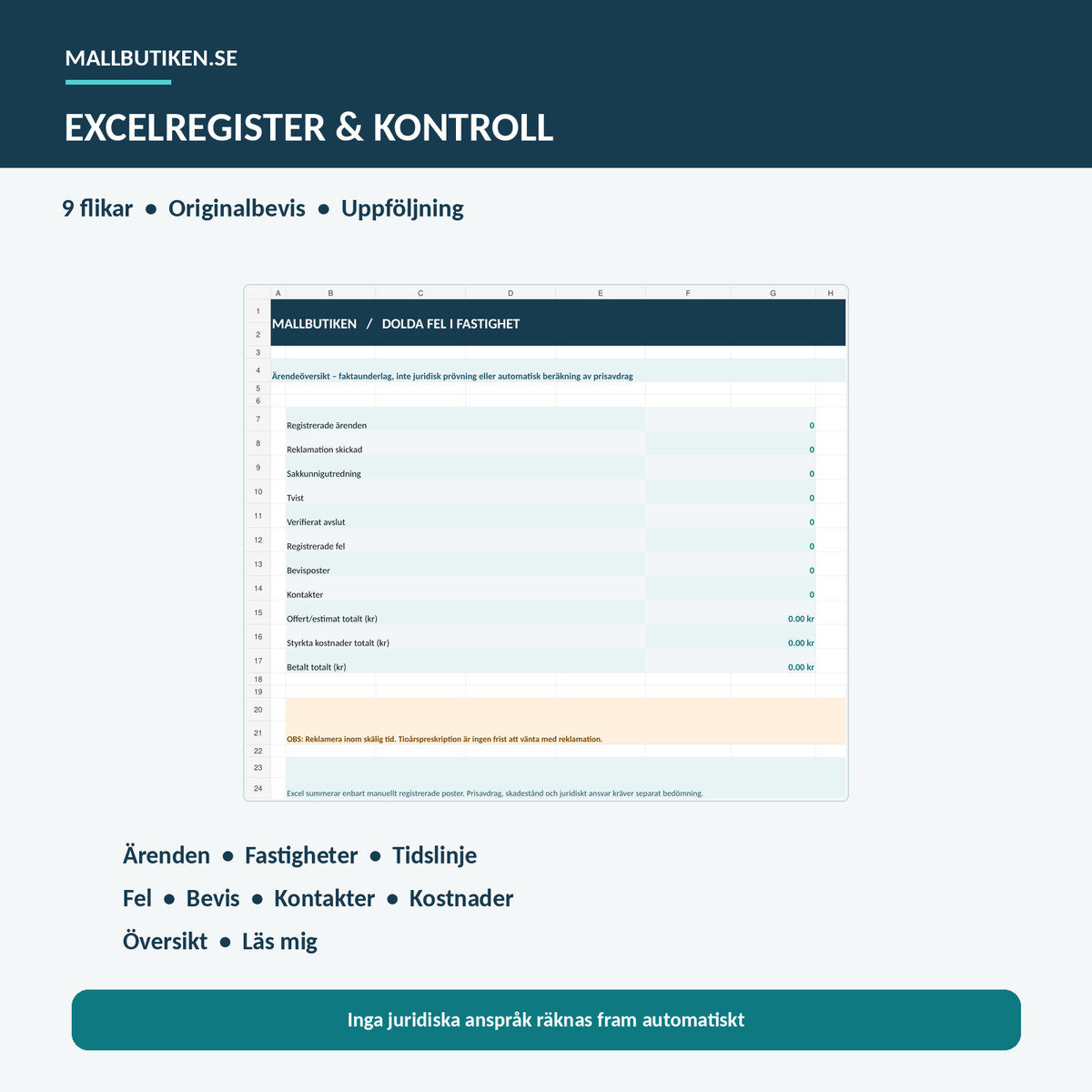
- 1 Excel (XLSX): nine tabs, case overview, claim status, chronology, defect log, evidence, contacts, and financial records.
- Design: Every Word/PDF document features two clear framed information boxes regarding the package and the function of the files.
- Version: 1.0 – 2026/2027, source review October 19, 2026. The year 2027 does not guarantee future legislative changes.
The documents are delivered in a ZIP file. The templates contain editable fields but no pre-filled assertions that a defect is legally "hidden" or that a specific amount is to be paid.
02. What the files contain – document by document
| File | What you document | Format |
|---|---|---|
| 01. Claim letter to the seller | Written initial claim with a description of the defect, date of discovery, and explicit reservation for later additions. | DOCX + PDF |
| 02. Property, purchase docs & timeline | Purchase contract, inspection report, seller disclosures, any disclaimers, and events in chronological order. | DOCX + PDF |
| 03. Defect log & evidence appendix | Objective observations, photo references, expert statements, possible cause, and separate assessment of discoverability. | DOCX + PDF |
| 04. Claims & value documentation | Purchase price, market values at possession, quotes, certified expenses, and checklists for legal assessment. | DOCX + PDF |
| 05. Correspondence & follow-up | Log for messages, confirmations, investigations, responses, contacts, and verified settlement. | DOCX + PDF |
| 06. Swedish user guide | Twelve work steps, legal definitions, and source references. | DOCX + PDF |
| 07. English User Guide | English instructions for the Swedish main templates and the Excel register (not a translation of the templates). | DOCX + PDF |
| 08. Excel register – nine tabs | Overview, Cases, Properties, Timeline, Defects, Evidence, Contacts, Costs, and Read Me. | XLSX |
The templates are intended for factual documentation of events and attached evidence. Assessing the structural causal link, discoverability at the time of purchase, the amount of the claim, and the seller's liability requires individual assessment.
What counts as a hidden defect in a property?
In everyday language, a deviation that existed at the time of purchase but which should not have been discovered during a required inspection is often called a hidden defect. According to Chapter 4, Section 19 of the Swedish Land Code (1970:994), it is examined, among other things, whether the property deviates from what follows from the agreement or what the buyer could justifiably assume at the time of purchase. The buyer's duty of investigation is central. Age, condition, high-risk structures, inspection remarks, seller's promises, and possible warning signs can influence the assessment.
Therefore, not all defects discovered after possession are hidden defects. An inspection report or an invoice alone does not prove that the seller is liable for compensation. The Swedish Consumer Agency describes the requirements for the buyer's investigation and the possibilities of complaining about defects in a house.
File a claim within a reasonable time – ten years is not a waiting period
According to Chapter 4, Section 19 a of the Land Code, the buyer must normally report a defect within a reasonable time after the defect was discovered or should have been discovered. Therefore, file a written claim to the seller as soon as there is a concrete suspected defect; additional technical investigation can often be reported later. Save proof of dispatch.
According to Chapter 4, Section 19 b of the Land Code, the buyer's claim due to a defect is generally statute-barred ten years after possession if the limitation period is not interrupted. This is not the same thing as the deadline for filing a claim. There are exceptions and special circumstances that require assessment. If the seller has "hidden defect insurance," a claim should normally still be directed to the seller. Read the Consumer Insurance Bureau's guidance on hidden defect insurance and the buyer's claim.
Price reduction, damages, and valuation – no automatic amounts
According to Chapter 4, Section 19 c of the Land Code, a price reduction is calculated based on the proportional relationship between the property's value in a contractually compliant condition versus its defective condition at the time of possession. The repair cost is not automatically equal to a legal price reduction. Damages require additional legal conditions, such as negligence or a relevant promise from the seller. Cancellation of the purchase also has special conditions and time aspects that should be assessed by a lawyer.
The Excel register can compile entered quotes, verified costs, and payments. It does not calculate the buyer's right to price reduction, damages, or insurance compensation.
How to use the template package step by step
- Get the purchase contract, inspection reports, the seller's questionnaire, and the property description.
- Note when the suspected defect was discovered and document the symptoms without concluding an unconfirmed cause.
- Send the claim letter in writing to the seller without undue delay. Save the message and proof of dispatch.
- Fill in the property timeline – distinguish between events before the purchase and what was discovered later.
- Describe each defect separately in the defect log with photos, observations, and relevant reports.
- Investigate what should potentially have been discovered at the time of purchase, including risk indicators and seller promises.
- If necessary, bring in an independent structural expert to assess the cause, age, and scope of the damage.
- Keep quotes, actual paid costs, and market value assessments separate.
- Ask a lawyer to assess legal remedies, the claim, limitation periods, and the size of any potential claim.
- Follow up on the seller's response and document only actual finalized agreements.
Excel register with nine tabs
The workbook contains Overview, Cases, Properties, Timeline, Defects, Evidence, Contacts, Costs, and Read Me. It calculates the number of registered cases, the number of claims in various administrative statuses, and summarizes estimated, certified, and paid costs separately. It has data validation for status and follow-up. The control calculations tested have been delivered without test data.
Note: The Excel file does not calculate legal deadlines, seller liability, or a potential price reduction. Save personal data and sensitive property documents in a suitably secure storage location.
Related document templates at Mallbutiken
- Real estate purchase contract – documentation for the actual property purchase.
- Property damage report – to document and report water damage or other property damage to insurance companies.
- Complaint to contractor – for deficiencies in purchased craft services under other rules.
- Down payment agreement for property – separate purchase document.
- More property and transfer templates.
Frequently asked questions – hidden defects in houses
How do I write a claim letter for a hidden defect in a house?
Specify the property and the parties, contract and possession dates, what you discovered, when it happened, and what supporting documentation exists. Send a written claim to the seller within a reasonable time and save proof of dispatch.
Can one claim a hidden defect ten years after purchasing a house?
There is a general ten-year limitation rule for claims based on defects, calculated from the time of possession, but you must normally file a claim within a reasonable time after discovery. It cannot, therefore, be used as a ten-year grace period.
Is the cost of repair always the amount I can claim?
No. A price reduction for a defect in a property is calculated according to Chapter 4, Section 19 c of the Land Code, taking into account the property's value at the time of possession. A repair cost may be relevant as documentation but does not automatically determine the price reduction.
Do I have to wait for the inspector before contacting the seller?
No, you should not delay a claim unnecessarily. An initial written notice can be submitted and supplemented later when more technical documentation is available.
What happens if the seller has hidden defect insurance?
The claim is, as a starting point, directed to the seller even if there is insurance. The insurance may have exceptions, and the terms do not always determine the seller's liability.
Is this template intended for tenant-owned apartments (bostadsrätt)?
No, the package's legal basis is the purchase of real property according to Chapter 4 of the Land Code. The purchase of tenant-owned apartments is handled according to other rules.
Are English contracts included?
No. The five main documents are in Swedish. A separate English User Guide for understanding how to use them is included.
Legal sources and version information
- The Riksdag – The Land Code (1970:994), Ch. 4, Sec. 19–19 c
- Swedish Consumer Agency – hidden defects and defects in houses
- Consumer Insurance Bureau – hidden defect insurance
Version 1.0 – 2026/2027, legal sources checked on October 19, 2026. Editable documentation templates according to Swedish law; not a government form, no guarantee of legal outcome, and no external legal certification. In the event of a dispute or high amounts, individual legal and structural advice is recommended.