Svenska Dokumentmallar
Building Automation 2026 – BFS 2026:9, 290 kW and Indoor Environment | Word/PDF/Excel
Building Automation 2026 – BFS 2026:9, 290 kW and Indoor Environment | Word/PDF/Excel
- File format
- DOCX, PDF, XLSX
- Document language
- Five Swedish work templates Swedish user guide English User Guide; Excel in Swedish.
- Number of files
- 7
Digital download. No physical product is shipped.
Couldn't load pickup availability
About this template
Does your non-residential building have a larger heating or air conditioning system – and can you demonstrate that the building automation really meets the functional requirements? Boverket's new rules from October 1, 2026 mean that certain existing non-residential buildings with a relevant rated capacity exceeding 290 kW must have control and regulation systems for energy monitoring, efficiency analysis, system communication, and monitoring of indoor environmental quality. This is a concrete document package for technical management, functional testing, and verifiable handover – not a regulatory inspection.
Read the guide: Building automation above 290 kW – BFS 2026:9 and indoor environment in 2026. It explains the rules and practical assessments.
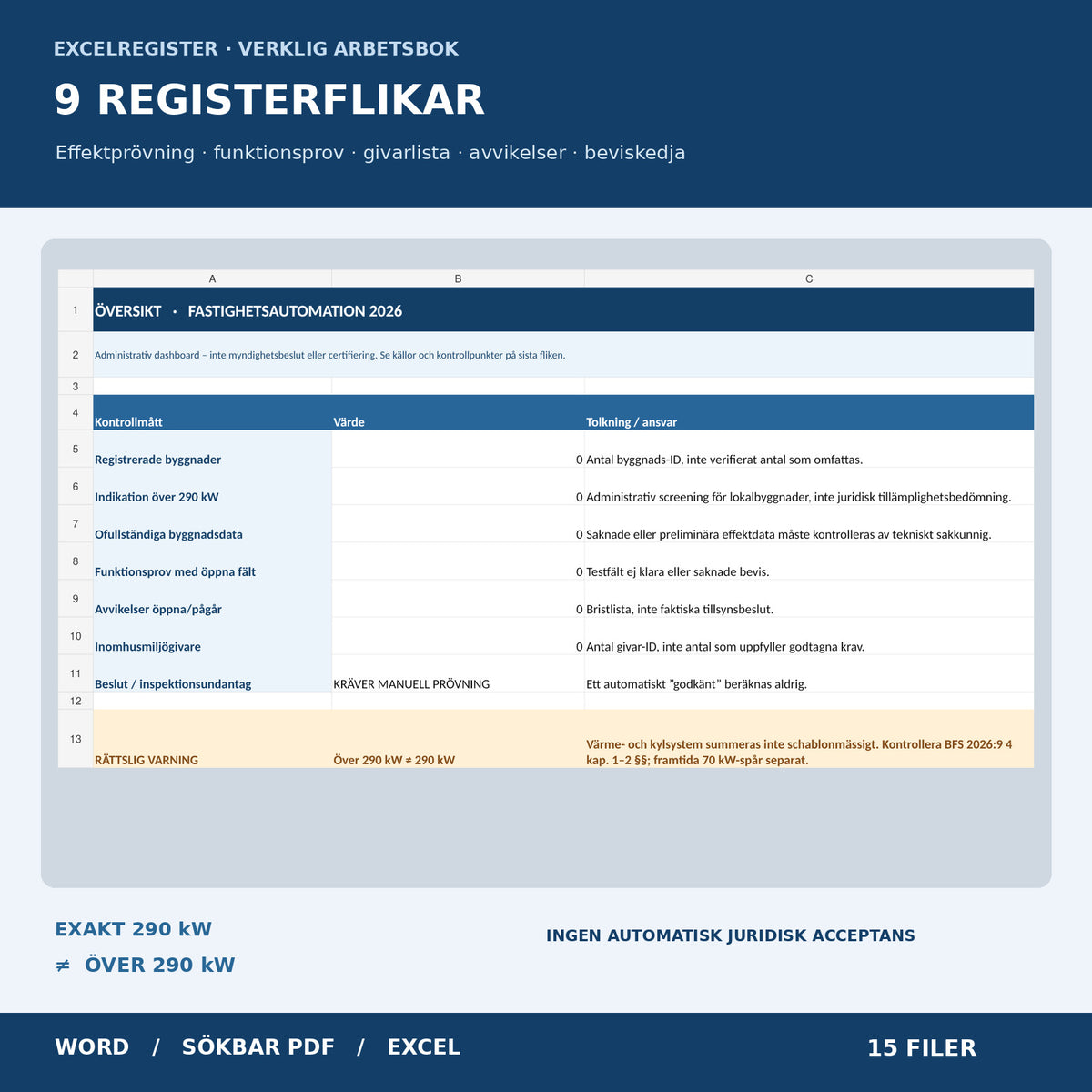
Quick facts: Five Swedish work templates, a Swedish user guide, an English User Guide, and a real Excel register. 7 editable Word files + 7 searchable PDF files + 1 XLSX workbook with nine tabs = 15 delivery files. The PDF files are searchable and printable but not digitally fillable. Digital ZIP delivery after separate publication and file linking.
01. Package contents
Applicability assessment, BACS functional testing and acceptance, indoor environmental sensors, supplier letter, non-conformance and inspection assessment, and two guides (Swedish and English User Guide). Each document is available in DOCX and searchable PDF. In addition, there is an XLSX with nine tabs – a total of 15 files.
02. What the files contain
Fields for building ID, rated capacity, and verified system boundary, functional protocols for four requirement points, sensor list, relevant test evidence, version control, communication interfaces, deficiencies, retesting, and manual attestation. Excel helps identify missing information but never issues legal approval or inspection exemptions.
Who needs this template?
It is aimed at property owners, operations managers, technical managers, HVAC/automation consultants, system integrators, and contractors for non-residential buildings that need to produce actually supporting documentation. For example, an office building with a larger heating system, a school, or a commercial premises with integrated ventilation and control systems. If you only want to create a general energy budget, choose our Energy Monitoring & Energy Cost Budget. For general commissioning, there is Coordinated Functional Testing; this package specifically addresses the BACS functions and 290 kW testing of BFS 2026:9.
What does BFS 2026:9 actually say?
Chapter 4, Section 2 refers to existing buildings where the majority of the temperature-controlled area consists of premises and relevant heating or air conditioning systems – where applicable, combined with ventilation – have a rated capacity exceeding 290 kW. The regulation specifies four functions: (1) continuous monitoring, recording, analysis, and adjustment of energy, (2) benchmarking and detection of efficiency losses, and information to the responsible party, (3) communication and interoperability between relevant parts of the building's installation system, and (4) monitoring of indoor environmental quality.
A stated capacity of exactly 290 kW is not “exceeding 290 kW”. Separate heating and cooling capacities must not be blanketly summed to a new rated capacity; document the technical system boundary and actual rated capacity. Adaptations according to Chapter 4, Section 1 must be assessed individually, for example in certain technical, cultural-historical, or cost-related circumstances. The product does not determine by itself whether an adaptation reason is met.
The 2026 novelty: indoor environmental monitoring and inspection exemptions
Boverket states that the requirement point regarding the indoor environment is new since October 1, 2026. A building that previously met the criteria for exemption from certain inspections of heating/air conditioning systems may therefore need to be reassessed. According to BFS 2007:4, 3 b, this exemption is linked to documented functions according to BFS 2026:9, Chapter 4, Section 2, points 1–4. A purchased system, a supplier certificate alone, or a green Excel field is not automatically a valid exemption. Boverket's explanation of inspection and control systems.
Exact file list
| Document | Function | Language | Format |
|---|---|---|---|
| 01 – Applicability and 290 kW | Assess non-residential building, majority premises area, rated heating/cooling capacity, and any adaptation. | Swedish | DOCX + PDF |
| 02 – BACS functional testing and acceptance | Test energy monitoring, benchmarking, interoperability, and indoor environmental monitoring. | Swedish | DOCX + PDF |
| 03 – Indoor environment – sensors and test evidence | Track zones, sensors, calibration, logs, alarms, test sources, and actions. | Swedish | DOCX + PDF |
| 04 – Supplier letter on BACS evidence | Request actually verifiable documents, system versions, and integration details. | Swedish | DOCX + PDF |
| 05 – Non-conformances and inspection assessment | Document errors, retesting, and separate assessment of a possible inspection exemption. | Swedish | DOCX + PDF |
| 06 – Swedish user guide | Step-by-step for implementation, source testing, and four concrete scenarios. | Swedish | DOCX + PDF |
| 07 – English User Guide | Instructions for the Swedish documents; no English operative contract templates. | English | DOCX + PDF |
| 08 – BACS Excel register | Nine work tabs, administrative flags, formulas, test and evidence registers. | Swedish | XLSX |
Excel: nine practical tabs
Overview, Buildings, Capacity Basis, Functional Testing, Indoor Environment, Integrations, Non-conformances, Evidence Register, and Read Me & Sources. Excel contains administrative status formulas. A non-residential building with a verified heating capacity of 320 kW will receive the indication “>290 – manual assessment”, while exactly 290 kW will not be flagged as exceeding the threshold. If capacity verification is missing, a completion marker is displayed. For functional testing, four “Yes” responses, an actual log reference, a date, and the person responsible for the text “test fields complete – manual acceptance” are required. It is never a legal statement or an actual measurement result without a real source.
How to use the material
- Identify the legally relevant building, its premises area, and the actual rated capacity of the heating/cooling system; hire an expert if necessary to assess system boundaries.
- Fill in the applicability assessment and review whether Chapter 4, Section 1 may be relevant without assuming any general exemption.
- Request the actual software version, measurement point list, logs, system architecture, and evidence of interoperability from the supplier.
- Perform reliable functional tests for energy, benchmark/efficiency losses, communication, and indoor environment in installed operation.
- Verify sensors, test intervals, and alarms with source-backed parameters; do not invent universal CO₂ or temperature limits.
- Record open non-conformances, the responsible party, retesting, and a separate final attestation. Maintain versions and original evidence.
- If asked about an energy declaration inspection: perform a separate expert assessment of a possible exemption according to current Swedish law and always check whether regulations have changed.
Separate current requirements from future EPBD steps
The EU's revised energy performance directive (EU) 2024/1275 has specific future steps in Article 13: including a greater expansion of automation to buildings over 70 kW by December 31, 2029 at the latest and automatic lighting control with different stages for 290 and 70 kW. This package does not make it applicable that all future 70 kW requirements are already fully applicable in Swedish law in November 2026. Check current Swedish amending regulations and transitions before making a final decision.
Limitations
The documents are private work templates and not official Boverket forms, a control statement from the municipality, or an accredited inspection. They do not replace a qualified electrical, HVAC, automation, energy expert, or regulatory assessment. A programmed test must not pose a danger to people or property. Do not save passwords or unauthorized access routes in Excel. Information about the sensors' presence monitoring and the property's operating system must be handled with relevant information security and data protection.
Questions and answers
Does this apply to every property over 290 kW?
No. An actual assessment of the building's primary use, temperature-controlled area, the system type affected, rated capacity, and any adaptations is required.
Is 290 kW exactly the same as over 290 kW?
No. The regulation says “exceeding 290 kW”. Exactly 290 kW is not over the limit, but other requirements may still apply.
Can two capacities of 200 kW be summed to 400 kW?
Not blanketly just because they belong to the same building. Assess actual technical systems, relevant combination cases, and how rated capacity is to be determined.
Does an inspection exemption apply if we have BACS installed?
Not automatically. The functionality must actually meet the requirements, and the exemption conditions must be assessed according to current Swedish law.
Do I have to use sensors for CO₂?
The BFS provision here specifies monitoring of indoor environmental quality, but this template does not prescribe a universal CO₂ method. Determine relevant parameters and limits with the correct standard support.
Are the PDF files fillable?
No. Use the editable Word documents and Excel; the PDF versions are searchable and intended for printing or archiving.
Are all documents also in English?
No. Five operational templates, the Swedish guide, and Excel are in Swedish. The English User Guide provides instructions on how the Swedish documents are used.
Legal sources and review
Boverket: retroactive requirements and BFS 2026:9 Chapter 1–2 §§ · Boverket: inspection and BFS 2007:4 3 b § · Boverket: EPBD implementation and new energy regulations from 2026-10-01 · EU Directive 2024/1275 Article 13.
Product version 1.0 · AI-assisted review of official legal sources November 10, 2026 · No external independent legal review, regulatory certification, or automatic inspection exemption. Before actual use, the current legal wording and the building's specific circumstances must be checked.