About this template
Kanban & Two-Bin System 2026/2027 – Replenishment Cards, Inventory Flow, and Excel
Do you want to implement Kanban in production, workshops, or warehouses? This downloadable template package provides practical support for two-bin systems, Kanban cards, material supply, and replenishment. Document consumption signals, organize storage locations, and plan appropriately sized reserve containers without building an entire ERP system.
15 editable and searchable files: 7 Word (DOCX), 7 PDF, and 1 Excel (XLSX) with nine tabs. Five Swedish master templates, one Swedish guide, and one English user guide. The package is intended for warehouse managers, CNC workshops, material planners, and manufacturing companies with recurring consumption of standard items, fasteners, and consumables.
Kanban is a signal for the production or movement of material in a pull-flow system. A two-bin system can use an empty container to request replenishment while the other is in use. It requires knowledge of actual lead times, a functional signaling chain, and physical control. No formula guarantees delivery, stock availability, or safety. The year 2027 denotes the document version, not new regulatory requirements. Method principles: Lean Enterprise Institute and ASCM SCOR BP.009.
01. Package contents
- 7 Word files (.docx): five editable Swedish master templates, one Swedish user guide, and an English User Guide.
- 7 searchable PDF files: corresponding content in a clear A4 format for printing and archiving.
- 1 Excel workbook (.xlsx): nine tabs with formula calculation for proposed reserve B, registration of actual signals, and separate journals.
A total of 15 files in a ZIP. Five Swedish master documents plus guides in Swedish and English; this is not a complete English version of the templates. Template version 1.0 – 2026/2027. Digital download, no subscription, and no physical shipping.
02. What the files contain
| No. | Document | Practical function | Format |
|---|---|---|---|
| 01 | Kanban Policy and Launch Plan | Roles, scope, criticality, container sizing, trial period, and decision authority. | Word DOCX + PDF |
| 02 | Kanban Card – Two Containers | Printable card with item ID, revision, quantity, storage location, recipient, and signal path. | Word DOCX + PDF |
| 03 | Consumption and Signal Log | Actual withdrawals, card/signal ID, containers, and events requiring escalation. | Word DOCX + PDF |
| 04 | Replenishment and Receipt Journal | Separate verification, actual order, promised date, actual receipt, and quality control. | Word DOCX + PDF |
| 05 | Deviation and Kanban Audit | Actual material shortages, incorrect signals, action responsibility, root cause, and effect verification. | Word DOCX + PDF |
| 06 | Swedish User Guide | Workflow, formulas, criteria for suitable items, and control of governance. | Word DOCX + PDF |
| 07 | English User Guide | English guidance for the Swedish master templates and the Excel tool. | Word DOCX + PDF |
| 08 | Excel – Kanban and Two-Bin System | Nine tabs with item registry, proposed reserve B, consumption, signals, replenishment, deviations, and actions. | Excel XLSX |
Kanban in Excel – nine interconnected worksheets
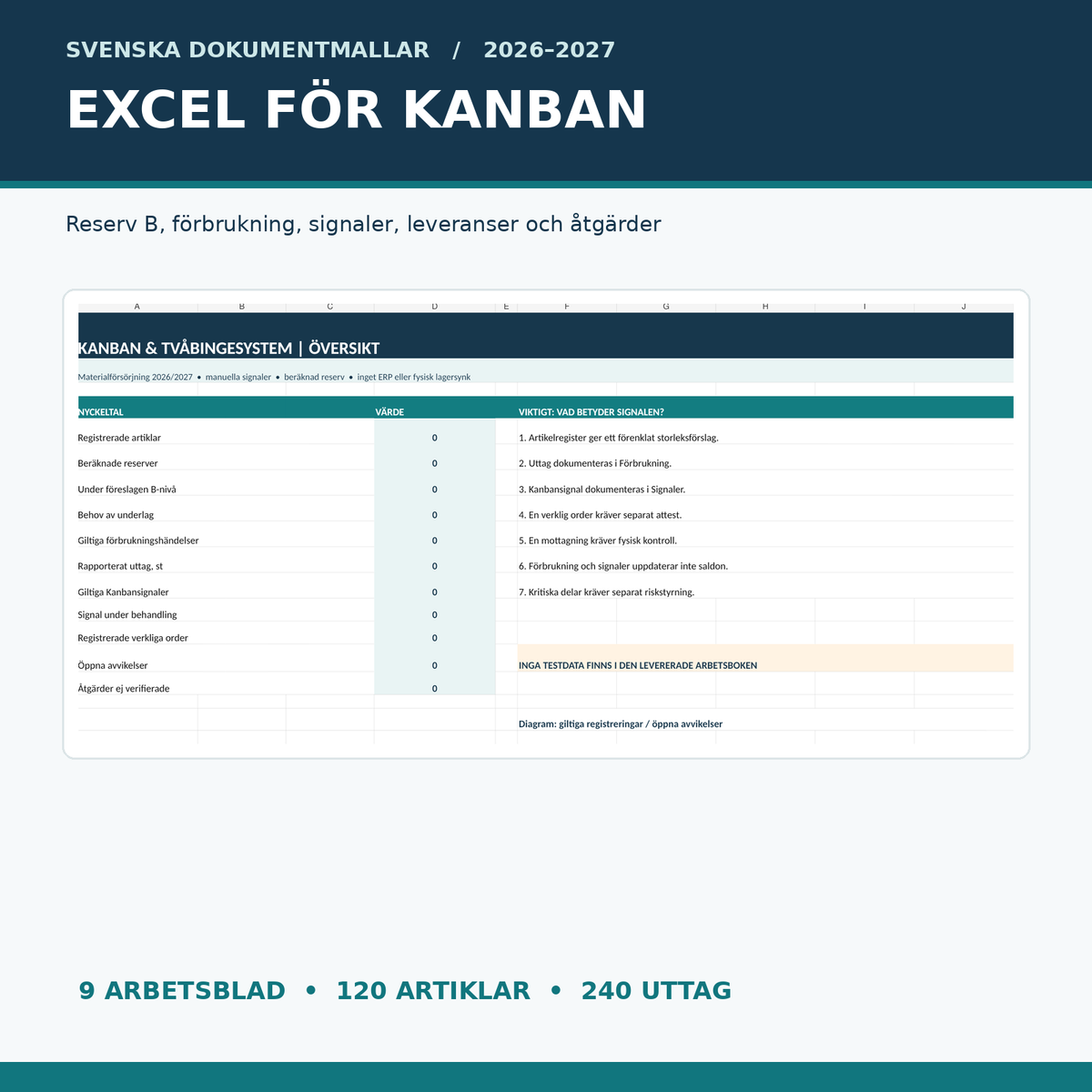
The workbook contains Overview, Item Registry, Consumption, Kanban Card, Signals, Replenishment, Deviations, Actions, and Read Me. It is delivered without dummy item numbers, stock balances, or order details. Summaries are based on the user's actual entries.
- Overview: eleven indicators for items, sized reserve containers, warning levels, valid withdrawals, registered signals, actual orders, deviations, and unverified actions, as well as status charts.
- Item Registry: space for 120 items with item ID, revision, packaging multiple, consumption per day, actual lead time, potential order gap, safety margin, and actual container size A/B.
- Proposed Reserve B: a clear, simplified formula: round up to the nearest full package of daily consumption × (lead time + potential order gap) + safety margin. Suggested and actual reserves are compared, but this does not constitute safety or purchasing approval.
- Consumption: 240 log rows for actually observed withdrawals. Checks for missing IDs, duplicate IDs, positive quantity, and known items prevent obvious errors from being counted in key performance indicators.
- Kanban Card: 20 prepared print rows that pull item and reserve details from the registry. The signal address and card revision are filled in according to local instructions.
- Signals: 220 entries with actually triggered signals, recipients, status, and order reference. A registered signal is not an order.
- Replenishment: 200 rows for separately approved orders, calculated quantity, actual received quantity, date, and quality status. No external orders are sent from Excel.
- Deviations and Actions: 120 and 160 rows respectively for shortages, lost cards, delivery problems, responsible parties, due dates, and actual effect verification.
How to use Kanban cards and two-bin systems
- Select suitable items: start with standard materials whose actual consumption is relatively predictable. Safety-critical or highly sporadic items may require separate risk-based control.
- Determine the right data basis: measure daily consumption, actual lead time including handling, ordering frequency, and uncertainty. Determine package size and safety margin locally.
- Document items and processes: give each item a unique ID, verify technical revision, responsible party, and material location, fill in the Excel Item Registry, and review the proposals.
- Create and print Kanban cards: mark container A/B with item, quantity, local signal path, and revision. Perform a physical test of how the empty vessel or card is reported.
- Register actual withdrawals: enter actual consumption events into Consumption. Then send a signal to the authorized person and document it in Signals.
- Control purchasing and delivery: an authorized person reviews the need and, if necessary, places a real order in the existing purchasing system. Register the separate order, receipt, inspection, and the return of the card.
- Follow up and adjust: review material shortages, delivery variations, and the number of unnecessary signals. Only change container quantities and instructions after actual effect verification and decision-making.
Important method and safety limitations
No live connection to inventory or ERP: the workbook does not retrieve stock balances from the shelf and does not create orders, move material, or close physical signals. Consumption, Kanban signal, actual order, and receipt are four separate registrations. The card itself is not a receipt that material has been ordered or delivered.
Two-bin control is not a universal method: highly uneven demand, long or unreliable lead times, bulky goods, fire risks, hygiene requirements, technical revision requirements, or critical components may require a separate method. Ensure that the use and placement of containers comply with the company's work environment and quality procedures.
The reserve proposal is simplified: it is an operational planning basis and not a statistical service level guarantee or advice to automatically increase stock. Measured variation and local risks must be reviewed. The version 2026/2027 is a release designation, not a certification.
Supplementary document templates and guides
For overall production and purchasing planning, you can use Material Requirements Planning & MRP Light. For spare parts inventory, critical items, and inventory counts, there is Spare Parts Registry & Critical Spare Parts. For machine-specific availability, Machine Registry & Preventive Maintenance is used. Track the production impact of shortages with OEE & TEEP – Machine Efficiency.
Read related articles: Material Requirements Planning – BOM, net requirements, and purchasing, Production Management and Quality Management, and Inventory and Valuation. Explore Production & Industry – Templates and Quality Management & ISO – Templates.
Frequently asked questions about Kanban and two-bin systems
What is Kanban?
Kanban is a signal to initiate material movement or production in a pull-flow system. A physical card or an empty container can act as the signal carrier.
How does a two-bin system work?
Material is first used from one container. When it becomes empty, a replenishment signal is started, while the other container is intended to last during the actual wait time. The system must be sized and tested locally.
Does Excel calculate the correct Kanban container size automatically?
Excel suggests a reserve B based on the user's assumptions about consumption, total lead time, order gaps, safety margins, and packaging multiples. It does not guarantee that the level will be sufficient; management makes the decision.
Does the workbook create a purchase order?
No. It documents actual signals, approved orders, and receipts but does not send orders or update any physical stock balances.
Can I use the templates in a CNC workshop, assembly line, or warehouse?
Yes, for suitable standard items and material flows. Always adapt instructions, revisions, criticality, and container sizes to the workplace.
Are all documents in English?
No. The five master documents and the Excel file are in Swedish. The English User Guide describes how they are used but is not a complete translation.
Is any government-approved or ISO-certified model included?
No. The package is an independent documentation aid built on generally described Lean methodology. It is not a government form, system integration, or certification.
Sources and document version
Method review October 15, 2026, with Lean Enterprise Institute – Kanban and ASCM SCOR – Kanban. Protected standard texts and certification materials are not included. Version 1.0, 2026/2027. Delivery file: kanban-tvabinge-lagerpafyllnad-2027.zip.