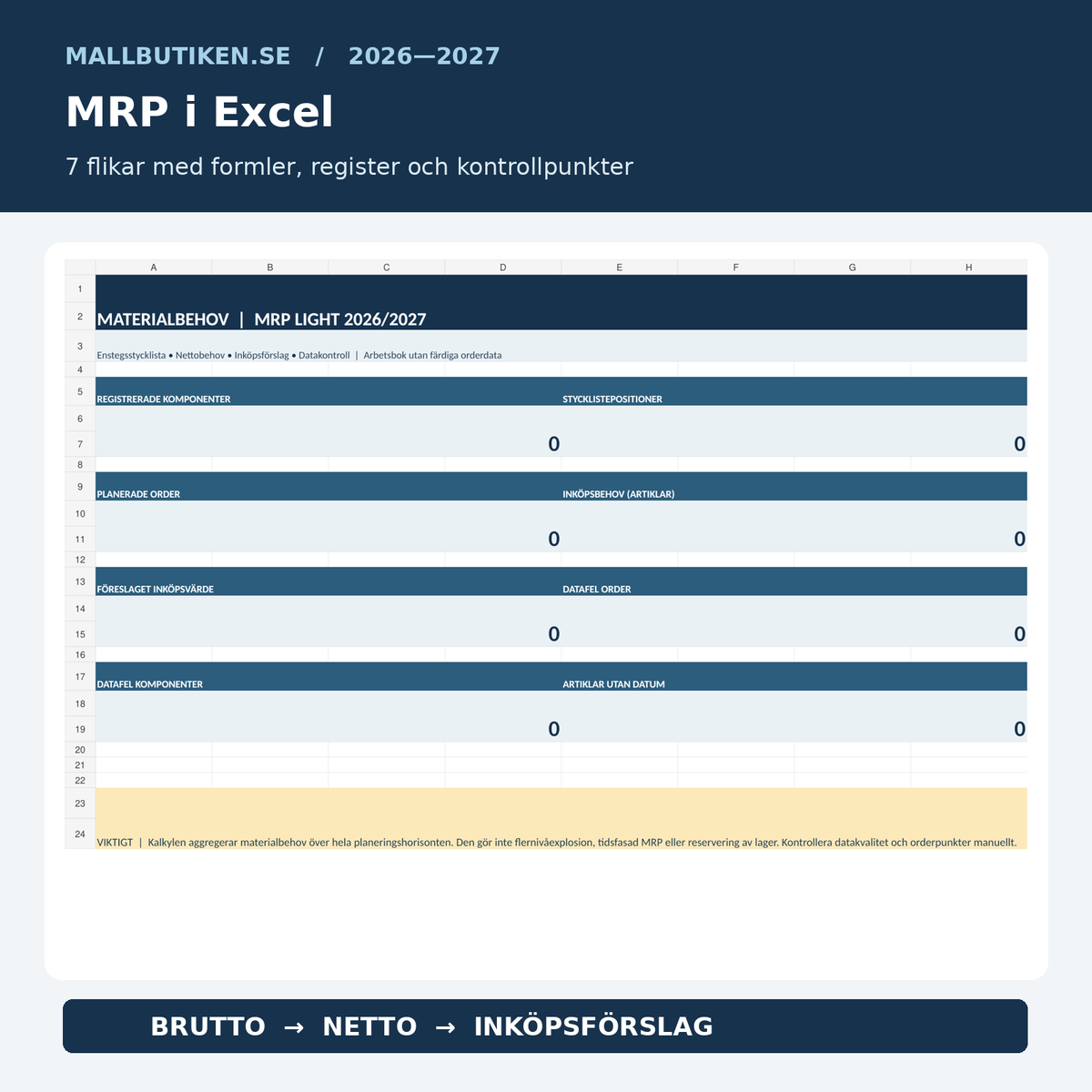


About this template
Material Requirements Planning & Purchasing Planning – MRP Light 2026/2027 is an editable toolkit for smaller manufacturers, workshops, production managers, and purchasing agents who need to plan components before production begins. It combines a professional Excel sheet with document templates for material planning routines, purchasing decisions, a detailed user guide, and an English working template.
Using a single-level Bill of Materials (BOM) and planned finished product orders, the gross requirements for purchased components are calculated. Excel then accounts for stock balances, safety stock, confirmed incoming deliveries, and ordering terms to suggest what needs to be purchased. This means less manual calculation and clearer documentation for responsible purchasing decisions.
Price 79 SEK as a one-time purchase – no subscription. This product is a limited and transparent MRP Light tool, not an ERP system, advanced multi-level MRP, or automatic inventory bookkeeping system.
Version 1.0, intended for 2026/2027. Formulas and control values have been tested, and the method description has been source-checked against public information regarding material requirements planning. The marking refers to an internal editorial/technical review, not external certification, site audit, or an individual legal opinion.
What is included in the MRP package
| Document | Content | Format |
|---|---|---|
| Material Planning Routine | Responsibilities, data sources, work methodology, BOM control, decisions, deviation handling, and archiving. | Word + PDF |
| Material & Purchasing Decisions | Printable control and decision protocol for purchasing quantities, supplier data, deviations, and approval. | Word + PDF |
| Detailed Swedish User Guide | Review of all seven tabs, preparations, step-by-step instructions, calculation examples, common errors, and division of responsibilities. | Word + PDF |
| Material Planning – Working Sheet (English) | Supplementary English working sheet for personnel in Swedish companies. Not a complete translation of every Swedish document. | Word + PDF |
| Material Requirements & MRP Light | Excel workbook with integrated registers, BOMs, material requirements, purchase suggestions, control tab, and dashboard. | Excel (XLSX) |
9 delivery files in one ZIP: 4 DOCX, 4 searchable A4-PDFs, and 1 XLSX. Swedish is the primary language; an English working sheet is included.
Which businesses is the tool suitable for?
Small industrial companies with recurring finished products and clear component BOMs, workshops and assemblers that need to order material for specific jobs, production planners who want to derive material needs from product orders, and purchasing agents who want to consolidate component data, purchase terms, and individual decisions.
MRP Light is best suited for a straightforward product structure where a finished product consumes purchased components at a single BOM level. For intermediate products with their own underlying BOMs and multiple levels, you should use a more advanced MRP method.
Excel – seven worksheets with calculation functions
| Worksheet | What can you do? |
|---|---|
| Overview | Dashboard with registered components, BOM lines, orders, components requiring purchase, calculated purchase value, and data warnings. |
| Items | 80 component lines for component ID, unit, balance, safety stock, confirmed incoming quantity, lead time, minimum order size, order multiple, unit price, and date. Gross, net, purchase suggestions, and value are calculated. |
| BOM | 120 lines for finished product, component, quantity per finished unit, and scrap percentage. Summarizes input order volumes per product and calculates gross requirements per line. |
| Order Requirements | 100 order lines with ID, finished product ID, volume, due date, customer/project, and verification of whether the product's BOM exists. |
| Purchasing Plan | 80 lines to retrieve suggested quantities and calculated value via component ID, along with actual ordered quantity, order number, confirmed delivery, and receipt. |
| Control | Compilation of orders without a BOM, components missing from the item register, items with requirements, missing due dates, and potential item ID duplicates. |
| Instructions | Tab-by-tab guide, defined limitations, and methodology sources. |
The workbook has clear headings, frozen top rows, input fields, data validation for certain status fields, and an automatic overview. It is designed for manual use offline in Microsoft Excel or compatible software.
How the MRP calculation works – a concrete example
Assume you are going to manufacture 40 finished products. Each product requires 3 components and you have accounted for 5% scrap. The gross requirement for the component will be 40 × 3 × 1.05 = 126 units after rounding up.
At the same time, you have 40 units in stock, require 10 units in safety stock, and have 20 units in actual confirmed incoming deliveries. The net requirement therefore becomes 126 + 10 − 40 − 20 = 76 units. If the minimum order quantity is 50 units and the order multiple is 10 units, Excel suggests a purchase of 80 units.
With a unit price of 15 SEK, this corresponds to a calculated purchase value of 1,200 SEK excluding any VAT. The calculation determines this value but does not purchase material and does not automatically determine correct VAT or delivery time.
How to use material requirements planning
- Select planning horizon and order selection. Collect only the production and customer orders that are actually to be calculated. Remove canceled orders from the selection before calculating.
- Register purchased components. Give each component a unique ID, enter unit, actual stock, safety stock, and confirmed incoming deliveries.
- Create single-level BOMs. List which components are needed per finished product, how many, and if a verified scrap allowance is needed.
- Enter planned finished product orders. Use a product ID that matches the BOM and enter the requested quantity.
- Check automatic gross calculation and net requirements. Verify that no component or BOM is missing and that units are comparable.
- Assess lead time and dates. State when the component is needed at the latest. The calculated order date subtracts calendar days and needs to be reviewed against holidays, transport times, and the supplier's actual order handling.
- Make actual purchasing decisions. Check MOQ, order multiple, agreements, price, and supplier confirmation. Document decisions in the separate protocol.
- Keep balances current. Register purchase orders, deliveries, and actual stock events in correct systems or your own controlled routines. Then update the calculation.
Important error sources and when you need more than Excel
- BOM version: Incorrect component consumption results in incorrect material requirements even if the formula is mathematically correct.
- Stock and reservations: Available balance may be lower than physical balance if material is reserved for other orders.
- Components in multiple products: Excel sums component requirements across matching BOM lines, provided codes are unique and consistent.
- Lead time: Calculated order dates use calendar days, not a separate supplier calendar or working day model.
- Units: Never mix meters, kilograms, or pieces without a documented unit conversion.
- Confirmed incoming: Confused or double-counted incoming deliveries can create misleading purchase suggestions.
- Complex business: Multi-level BOM, multiple warehouses, traceability requirements, batch control, dynamic weekly plans, and automatic transactions require special systems or customized controls.
What applies according to Swedish regulations?
There is no general Swedish legal requirement that all companies must use a specific MRP template. Material requirements planning is an administrative method. However, actual purchasing, documentation, inventory management, accounting, and products may be covered by separate contractual, accounting, work environment, or product safety requirements. A purchasing plan is not a binding supplier contract, a goods receipt check, an accounting voucher, or proof of product safety.
Frequently asked questions and answers
What is the difference between production planning and material requirements planning?
Production planning assesses when and with what resources something should be manufactured. Material requirements planning calculates which components are needed for the planned production and what purchasing requirements remain after stock and planned deliveries.
Can the template calculate net requirements and purchase suggestions?
Yes. With complete registered component, BOM, and order data, Excel calculates total gross/net requirements and suggestions using MOQ and order multiple. Calculation results should be reviewed before ordering.
Are multi-level BOMs or MRP per calendar week supported?
No. The product is explicitly limited to single-level BOMs and aggregated requirements for a specified selection. It is an MRP Light model without automatic time-phased planning.
Is the stock balance updated automatically when an order is manufactured or a purchase is received?
No. Inventory is manually entered and must be kept accurate by the company. Actual purchase orders in the purchasing plan are separate registration items.
Is a user guide and English version included?
Yes. A detailed guide in Swedish and a separate supplementary working sheet in English are included. The main Swedish documents are not fully translated.
Can I use the Excel tool as a purchase contract or invoice?
No. It is a calculation and decision support tool. For commercial agreements, invoicing, and accounting, correct documents and routines are needed.
Can I use the template for many items and customers?
The workbook has prepared rows for 80 purchased components, 120 BOM lines, 100 finished product orders, and 80 purchasing plan lines. For larger volumes, a more advanced business system is recommended.
Format, price, and digital delivery
79 SEK, one-time purchase. Delivered as a ZIP with four Word files (DOCX), four searchable A4-PDFs, and one Excel workbook (XLSX). The files can be used offline in compatible software. The product is digital and requires no physical shipping. Automatic download after purchase assumes the ZIP file is linked to the correct Shopify variant in Digital Products.
Methodological sources and further reading
- Mallar.biz – Material and Purchasing Planning (MRP)
- User Solutions – Material Requirements Planning, Excel
- Stocksmith – MRP, BOMs, and inventory requirements
Related products on Mallbutiken.se
Supplement with Production Planning & Capacity Calculation when you also need resources and machine hours, or Supplier Assessment & Supplier Follow-up for quality and supplier assessment. The Machine Register & Preventive Maintenance is also relevant within the same production cluster.
Disclaimer: The documents are general planning aids and cannot guarantee actual balances, error-free BOMs, correct prices, or agreed delivery times. They do not replace technical, legal, or accounting specialist assessment when required.