Svenska Dokumentmallar
Purchase Agreement General Template – Personal Property | Word/PDF + English reference + guide
Purchase Agreement General Template – Personal Property | Word/PDF + English reference + guide
- File format
- DOCX, PDF
- Document language
- Swedish + English
- Number of files
- 8
Digital download. No physical product is shipped.
Couldn't load pickup availability
About this template
Sales Agreement template – general sale of movable property (Word/PDF) for the purchase of physical goods between two private individuals or two business entities in Sweden. The new 2027 document edition contains a complete Swedish main agreement, a separate user guide, an English reference version, and an English guide. The agreement includes specific annexes for the condition of the goods, title, accessories, payment, and delivery receipt.
Important: This template is not a real estate contract or a consumer sales agreement.
It is primarily intended for physical movable goods between private individuals (C2C) or businesses (B2B), where the Sale of Goods Act (1990:931) is normally relevant. Purchases of real estate, tenant-owned apartments, services, and sales from traders to consumers are covered by other or specific rules. Do not use this template unchanged for such transactions.
Legal framework verified October 8, 2026. The content has been drafted with reference to the Sale of Goods Act (1990:931), the current Consumer Sales Act (2022:260) for delimitation, and relevant formal requirements for real estate and tenant-owned apartments. The product is general documentation support, not a guarantee that a specific agreement will be valid.
What is included – 8 files in DOCX and PDF
| Swedish Sales Agreement – DOCX + PDF | 14 agreement sections plus Annex A (goods, condition, accessories) and Annex B (handover and receipt). |
| Swedish User Guide – DOCX + PDF | Step-by-step guide on form of purchase, title, "as-is" condition, inspection, complaints, delivery, and special property. |
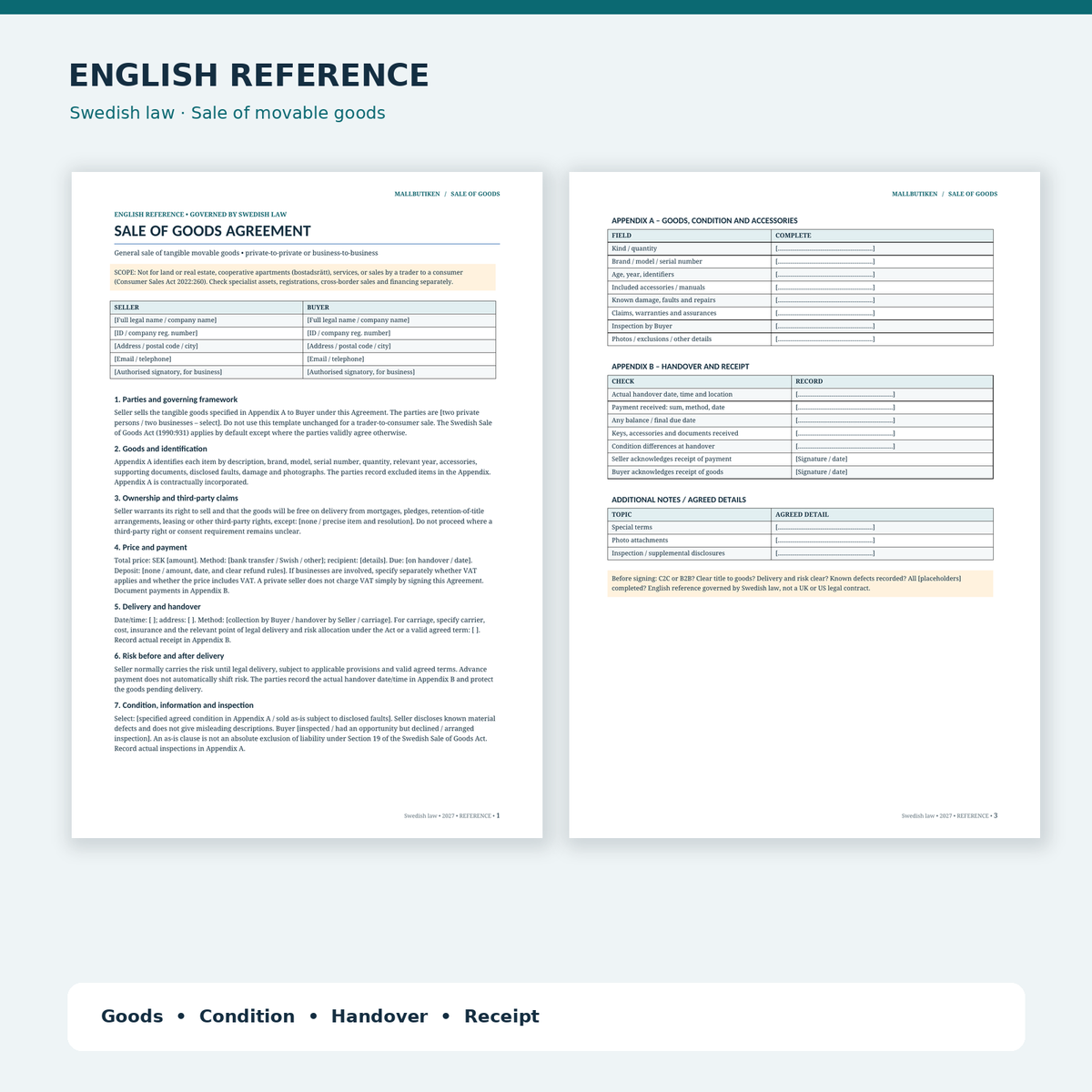
| Sale of Goods Agreement – English reference, DOCX + PDF | English reference version based on Swedish law, with corresponding agreement structure and annexes. |
| English User Guide – DOCX + PDF | English guidance and legal limitations. |
The Word files are editable and the PDF files are searchable A4 documents. The delivery format for the new version is ZIP.
When can the sales agreement be used?
The product is mainly suitable when a private individual sells a used movable item to another private individual, or when two companies buy and sell physical movable property. Examples include used furniture, tools, electronics, machinery, or other individually identified movable objects, provided that no special requirements arise.
The general template handles, for example, seller and buyer details, identification of the goods, price, payment, delivery, risk, known defects, potential inspection, complaints, warranties, and receipts.
For vehicles, boats, horses, dogs, real estate, tenant-owned apartments, and other objects with specific registration, insurance, animal welfare, inspection, or financing issues, it is recommended to primarily use the respective special template.
Why does the status of the parties matter?
Private individual → private individual: in normal cases, the Sale of Goods Act and the agreement entered into by the parties apply. The Sale of Goods Act is primarily dispositive according to Section 3, meaning that validly agreed terms may take precedence over the standard rules of the Act.
Business → business: the Sale of Goods Act can also serve as a starting point, but business practice, tax/VAT issues, liability, and any industry terms must be reviewed.
Business → consumer: the Consumer Sales Act (2022:260) normally applies, which contains mandatory consumer protection. The older act number 1990:932 is not the current Consumer Sales Act. Therefore, use a consumer-adapted sales agreement instead of this template.
Read the Consumer Sales Act (2022:260).
The 14 sections of the Sales Agreement
- Parties and applicable legal framework.
- Object of sale and exact identification.
- Title, right to sell, and claims by third parties.
- Purchase price, any VAT, payment terms, and down payment.
- Handover, delivery method, place, and time.
- Risk allocation before and after handover.
- Condition of the goods, seller disclosures, and buyer's inspection.
- Express warranties and documentation.
- Defects in the goods, complaints, and potential remedies.
- Delays, non-payment, and notices.
- Right of withdrawal, voluntary return policy, and cancellation.
- Contract documents, annexes, and amendments.
- Choice of law and disputes.
- Signatures and copies.
Annex A – condition, identity, and accessories of the goods
One of the most important improvements is a separate annex where the parties document what is actually being sold. There are fields for brand, model, serial number, model year, quantity, accessories, receipts, known defects, previous repairs, special promises, inspection, and photo annexes.
Also, verify that the seller has the right to dispose of the goods and that they are not pledged, financed with retention of title, or subject to leasing or other third-party rights. Such issues cannot be resolved solely by a clause in the agreement.
"As-is" condition – what does it mean under the Sale of Goods Act?
"As-is" (befintligt skick) does not mean that the seller is always exempt from liability.
According to Section 19 of the Sale of Goods Act, the goods may be defective despite such a reservation, for instance if the seller has provided incorrect relevant information, withheld significant information, or if the goods are in a significantly worse condition than the buyer could justifiably have expected.
Section 20 of the Sale of Goods Act also contains rules on what the buyer knew or should have noticed during a relevant inspection before the purchase. Therefore, it is valuable to document which checks were made and any deficiencies in Annex A.
Delivery, handover, and transfer of risk
Transfer of risk is not always the same as the time of payment. According to Section 13 of the Sale of Goods Act, the risk normally transfers to the buyer when the goods are handed over according to the agreement or Sections 6–7. In transport purchases, the handover point may differ from collection and personal handover.
The agreement therefore has separate fields for collection, delivery or transport, freight costs, insurance, delivery time, and the legal handover point agreed upon by the parties.
Complaints when the Sale of Goods Act applies
If the goods turn out to be defective, the buyer must, as a starting point, notify the seller within a reasonable time from when the defect was noticed or should have been noticed. According to Section 32 of the Sale of Goods Act, there is also normally a final two-year limit from receipt, with certain exceptions and possibilities for validly agreed deviations.
This procedure should not be confused with the liability for defects and complaint rules of the Consumer Sales Act for purchases from traders. For private purchases, the buyer's rights are also dependent on what the parties have validly agreed.
Swedish Consumer Agency (Konsumentverket): Buying from a private individual.
Annex B – payment receipt and handover
The second annex is used to document when the goods were actually handed over, what the buyer received, how much the seller received in payment, any remaining amount, and whether any discrepancies were noted during the handover. Both parties can sign off on their respective parts.
This is particularly useful for the sale of more expensive used items, deliveries on a date other than the signing of the agreement, and purchases with a down payment.
Down payment, right of withdrawal, and return policy
A down payment should not automatically be treated as forfeited if the deal is called off. Fill in the payment date and explicitly specify the conditions under which the down payment shall be refunded, deducted, or otherwise handled.
In purchases between two private individuals, there is as a general rule no statutory right of withdrawal or return policy. The parties can, however, agree on a return policy. The right to rescind due to a breach of contract is another matter and follows from the terms of the agreement and applicable sales law rules.
When do you need a specific sales agreement template?
- Real estate purchase: Chapter 4 of the Land Code contains special formal requirements. Sales agreement for real estate.
- Tenant-owned apartment: Section 4, Chapter 6 of the Tenant-Ownership Act requires a specific written transfer agreement. Transfer agreement for tenant-owned apartment.
- Car: special checks of registration, vehicle details, and financing may be needed. Sales agreement for a car.
- Boat: check of identity, equipment, insurance, and potential rights may be required. Sales agreement for a boat.
- Separate down payment: Down payment agreement – general template.
How to use the sales agreement
- Verify that the transaction concerns a physical movable good between two private individuals or two companies, not a consumer purchase from a trader.
- Fill in the correct parties, contact details, and any authorized company representatives.
- Check title and whether the goods are pledged, financed, or leased.
- Describe the object and all known defects, accessories, and images in Annex A.
- Determine price, payment, any down payment, and VAT if applicable.
- Specify delivery method, date, place, and who bears the risk during transport.
- Clearly choose whether the goods are sold with specific agreed properties or "as-is".
- Adjust warranties, complaint, and return rules within applicable legal limits.
- Remove all unused options and replace all brackets.
- Sign both copies and use Annex B for payment and handover receipt.
Common questions about sales agreements for movable property
Does the template apply to purchases between private individuals?
Yes, that is a central area of use. The Sale of Goods Act is then normally relevant, and the parties can to a large extent agree on the terms.
Does it apply when a business sells to a consumer?
No, not unchanged. The Consumer Sales Act (2022:260) has specific mandatory consumer protection rules.
Can the template be used for real estate?
No. Real estate purchases have formal requirements according to the Land Code Chapter 4 and must be handled with a specific deed of sale.
Can the seller exclude liability for all defects through "as-is"?
No, a general formulation of that kind does not automatically provide total immunity from liability. See, among other things, Section 19 of the Sale of Goods Act.
How long is the complaint period between private individuals?
According to the standard rules of the Sale of Goods Act, complaints must be made within a reasonable time, normally with a final two-year limit from receipt according to Section 32. Exceptions and valid contractual deviations can affect the assessment.
Are both Swedish and English included?
Yes. The main agreement and guide in Swedish as well as the English reference and English User Guide, all in DOCX and PDF. The English version is a reference under Swedish law.
Is the template legally binding once signed?
The legal effect depends on the concrete agreement, the authority of the parties, the object of sale, and applicable rules. A signature alone does not guarantee that all terms will be enforceable.
Official legal sources
Sale of Goods Act (1990:931) – especially Sections 1, 3–7, 13, 17–20, and 31–33.
Consumer Sales Act (2022:260) – delimitation against consumer sales.
Land Code (1970:994), Ch. 4 Section 1 – real estate purchase.
Tenant-Ownership Act (1991:614), Ch. 6 Section 4 – transfer form requirements.
Edition 2027, legal framework verified October 8, 2026. General template that needs to be adapted to the circumstances of the parties and the object. Legal advice is recommended for high values, financed property, or specially regulated transactions.