Svenska Dokumentmallar
Cosmetics & Waste Water Directive 2028 – Extended Producer Responsibility, 1-Ton Test & Substance Register | Word/PDF/Excel
Cosmetics & Waste Water Directive 2028 – Extended Producer Responsibility, 1-Ton Test & Substance Register | Word/PDF/Excel
- File format
- DOCX, PDF, XLSX
- Document language
- Five Swedish work templates Swedish guide and English User Guide; Excel in Swedish.
- Number of files
- 7
Digital download. No physical product is shipped.
Couldn't load pickup availability
About this template
Does your company produce, import, or sell cosmetic products on the EU market? The EU's revised Urban Wastewater Directive (EU) 2024/3019 introduces upcoming extended producer responsibility for cosmetics, among other products. This niche Word/PDF/Excel package helps Swedish businesses gather the correct data on producer roles, product and substance volumes, potential exemptions, and future annual reporting.
Read the guide: Wastewater Directive 2028 – producer responsibility for medicines and cosmetics. It explains the rules and practical assessments.
It is a preparation package, not a completed fee calculation or official extended producer responsibility registration. Swedish implementation, fee levels, and administrative procedures have not yet been finalized.
Package Contents
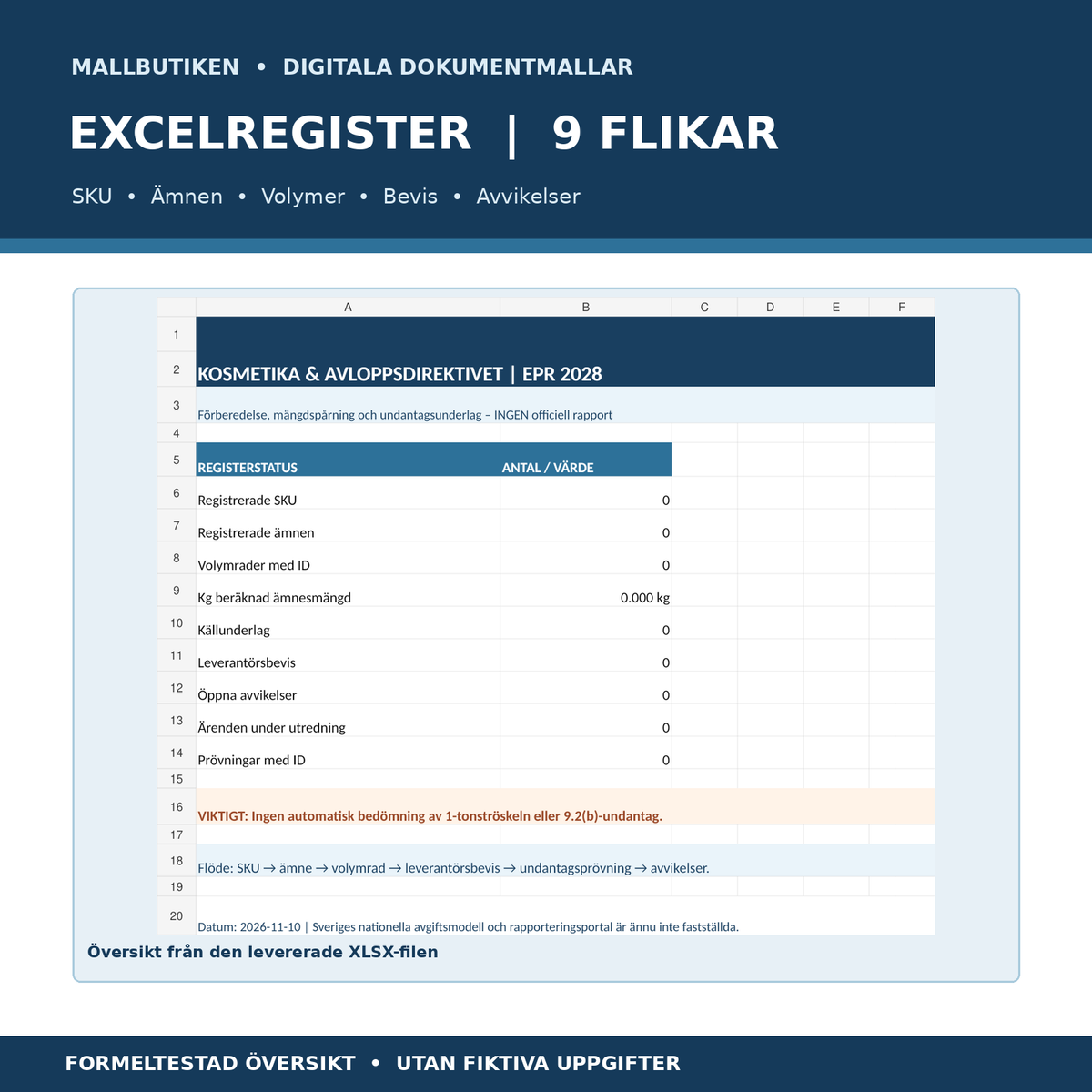
7 editable Word documents – five Swedish working templates, a Swedish user guide, and an English User Guide. 7 corresponding searchable PDF files – printable but not interactive. 1 Excel file with nine tabs – SKU, substances, annual volumes, supplier evidence, exemption assessment, deviations, and source register. A total of 15 customer files in a compressed ZIP for future digital delivery.
What the Files Contain
Concrete forms and control matrices that link product ID and substance ID to formulation version, product mass, actual annual volume, supplier evidence, exemption assessments, deviations, and certification. The Excel file includes formula calculations and a clear warning against automatic legal decisions. No fictitious substance values, test results, regulatory decisions, or fees are included.
All Documents and Templates in the Package
| Document | Practical Use |
|---|---|
| 01 – Producer Role and Scope | Assessment protocol for cosmetic classification, relevant markets, producer responsibility, and Swedish implementation rules. |
| 02 – Substance Inventory and Annual Volumes | Link SKU, formulation, net mass, unit sales, substance ID, verified concentration, and evidence. |
| 03 – Supplier Letter Regarding Ingredient Data | Substantive request for actual formulation data, degradability data, micro-pollutant data, and change procedures. |
| 04 – Exemption Assessment Under Article 9.2 | Working matrix for substances under 1 tonne per year or scientifically supported substance properties without claiming regulatory approval. |
| 05 – EPR Reporting and Cost Readiness | |
| 06 – Swedish User Guide | Workflow, practical cases, data quality, EU Directive versus Swedish implementation. |
| 07 – English User Guide | Instructions for international suppliers and users of the Swedish templates. |
| 08 – Excel Register with Nine Tabs | Overview, SKU Register, Substances, Annual Volumes, Supplier Evidence, Exemption Assessment, Deviations, Source Register, and Read Me. |
Which Rules Apply – and When?
Directive (EU) 2024/3019 entered into force on January 1, 2025. Sweden must transpose the Directive by July 31, 2027 at the latest. Article 9 requires Member States to introduce relevant extended producer responsibility by December 31, 2028 at the latest. This applies to the products concerned in Annex III, especially cosmetics and medicinal products for human use. This product is specifically intended for cosmetic companies.
Article 9.1 states that the producers concerned shall collectively cover at least 80% of certain costs for quaternary wastewater treatment and monitoring. This is not 80% of the company's sales. The Swedish fee model itself, reporting format, and organization must be verified once they are finalized.
The 1-Tonne Rule – What Needs to Be Proven?
According to Article 9.2(a), a producer may be exempt if the company can demonstrate that the quantity of substances in the relevant products placed on the Union market is less than one tonne per year. The wording does not automatically mean that turnover is low, that the number of articles is small, or that each individual product weighs less than one tonne.
The template package includes support for traceable calculation from the actual number of units, net mass, and verified substance proportion. If formulations, markets, or SKUs are missing, the data should be marked as incomplete, not as evidence of exemption.
Degradability and Micro-pollutants
Article 9.2(b) covers an alternative exemption situation where relevant substances are readily biodegradable in wastewater or do not generate micro-pollutants at the end of their life cycle. The Commission's detailed criteria and Swedish application need to be considered. A marketing claim that a cosmetic product is "biodegradable" does not alone constitute sufficient evidence.
How to Use the Template Package in Six Steps
- Assess the company's actual producer role and which cosmetic products are covered.
- Inventory SKUs, markets, formulations, and relevant substances with unique IDs.
- Request substance proportions, methodological documentation, and change logs from relevant suppliers.
- Build annual volumes and check data coverage, without making automatic exemption decisions.
- Document any basis under Article 9.2, as well as open uncertainties and the responsible assessor.
- Prepare Article 9.3 data and monitor Swedish legislation and the future producer responsibility organization.
Who Is the Product Suitable For?
Swedish cosmetic brands, product developers, importers, and relevant producers who want to be able to answer questions about ingredient quantities, origin, annual volumes, exemption data, and future financial responsibility. A company that only resells someone else's product should not be treated as a producer under the upcoming system without further assessment.
Important Limitations Before Purchase
- No official extended producer responsibility registration, approved exemption assessment, or Swedish fee is calculated.
- No individual substance degradability, toxicity, or micro-pollutant impact is assumed without actual sources.
- The English file is a user guide, not a complete legal translation of the Swedish working templates.
- Excel calculates registered quantities, but missing formulation data does not prove an exemption.
- The material must be adapted to the final Swedish implementation, the company's role, and actually available data.
Frequently Asked Questions About Extended Producer Responsibility for Cosmetics 2028
Who Is Covered by the New Extended Producer Responsibility?
Annex III of the Directive specifies cosmetic products according to (EC) 1223/2009 as well as medicinal products for human use. This product focuses solely on cosmetics. A company's producer role must be assessed against the relevant definition and upcoming Swedish implementation.
Does My Cosmetic Company Have to Pay Already in 2026?
No, Article 9 states that Member States shall have relevant extended producer responsibility measures in place by December 31, 2028, at the latest. Swedish implementation and the concrete fee model are not yet finalized as of November 10, 2026.
What Does the 1-Tonne Exemption Mean?
Article 9.2(a) refers to producers who can show that the quantity of substances in the products concerned placed on the Union market is less than one tonne per year. It is not an automatic exemption for a certain number of products or turnover.
Is It Enough That the Ingredients Are Stated as Biodegradable?
No. Article 9.2(b) requires a relevant assessment of rapid degradability in wastewater or that the substances do not generate micro-pollutants at the end of their life cycle. Future EU implementation criteria must be considered.
Do We Have to Pay 80 Percent of Our Turnover?
No. At least 80 percent refers to the costs for relevant quaternary wastewater treatment and monitoring covered by Article 9, not a percentage of each company's turnover or profit.
Do I Get an Official Registration Form in the Package?
No. The package provides preparatory working documents and Excel registers. An actual Swedish portal, future producer responsibility organization, and reporting format should be checked against finalized rules when they are available.
Can We Automatically Calculate in Excel Whether We Are Exempt?
No. Excel calculates quantities based on data from actual and complete sources, but makes no legal decision. Incomplete data coverage or an unclear producer role makes an automatic conclusion misleading.
Are Word, PDF, Excel, and English Files Included?
Yes, seven Word and seven searchable PDF files, as well as one Excel register with nine tabs. Five operational templates and the Swedish guide are in Swedish, and a separate English User Guide is included. The PDF versions are not interactively fillable.
Are the Templates Approved by Lawyers?
No. The material has AI-assisted legal source control dated November 10, 2026. No external legal review, official registration, or approved exemption application is included.
Official Legal Sources and Continued Control
EU Urban Wastewater Directive (EU) 2024/3019 – Article 9 and Annex III · Swedish Environmental Protection Agency – Revised Urban Wastewater Directive and Swedish Implementation · Swedish Government – Uncertainty and Implementation 2026 · EU Cosmetics Regulation (EC) 1223/2009.
Related Templates at Mallbutiken
For separate labeling of cosmetic products, there is Allergen Labeling for Cosmetics 2026/2028. For general environmental and regulatory compliance, relevant supplier documentation may also need to be reviewed. This product differs with extended producer responsibility for micro-pollutants under the Urban Wastewater Directive.
Version 1.0 | AI-assisted legal source control 2026-11-10 | No external legal review | Jurisdiction: Sweden/EU | SEK 79