Svenska Dokumentmallar
Medicines & Wastewater Directive 2028 – substance masses, 1-ton test and PRO basis | Word/PDF/Excel
Medicines & Wastewater Directive 2028 – substance masses, 1-ton test and PRO basis | Word/PDF/Excel
- File format
- DOCX, PDF, XLSX
- Document language
- Five Swedish work templates Swedish guide and English User Guide. Excel in Swedish.
- Number of files
- 7
Digital download. No physical product is shipped.
Couldn't load pickup availability
About this template
Does your pharmaceutical company need to start gathering evidence ahead of the EU's new extended producer responsibility for wastewater treatment? Under Directive (EU) 2024/3019, Member States must ensure extended producer responsibility for relevant products by 31 December 2028 at the latest. Article 9 and Annex III cover, among other things, medicinal products for human use. This Swedish specialist package helps companies assess their producer role, inventory substance quantities, request supplier evidence, and document potential exemptions – before Swedish legislation and the fee model are fully implemented.
Read the guide: Wastewater Directive 2028 – producer responsibility for medicines and cosmetics. It explains the rules and practical assessments.
Quick facts: 7 Word documents, 7 searchable PDF versions, 1 Excel workbook with 9 tabs; a total of 15 actual delivery files. Five Swedish working templates, one Swedish guide, and one English user guide. Word and Excel files are editable. The PDF files are searchable and printable but not interactively fillable. The product is intended for digital ZIP delivery following separate Shopify publication.
01. Package contents
Five separate Swedish working templates for role assessment, supplier letters, substance mass calculation, exemption assessment, and PRO/annual data. Also a Swedish user guide and an English User Guide. Seven DOCX files with seven corresponding searchable PDFs, plus one Swedish XLSX workbook. 15 files in total, not 15 separate legal documents.
02. What the files contain
Editable information fields, actual supplier requests, substance and market data, chain of evidence, checks of potential grounds for exemption, manual decisions, and registers for the forthcoming Swedish producer responsibility organisation (PRO). Excel performs mathematical calculations but does not calculate legally binding fees, official reports, or exemption decisions.
Why is the documentation needed?
Article 9.1 of the Directive states that relevant producers must ensure, through their systems, that they cover at least 80% of certain costs for quaternary treatment and for the collection/verification of relevant product data. This is not a pre-determined percentage of an individual pharmaceutical company's turnover. Article 9.3 describes collective producer responsibility and annual data on substance quantities, the hazard of substances in wastewater, and biodegradability.
The timeline: The Directive entered into force on 1 January 2025. According to the Swedish Environmental Protection Agency's guidance, Sweden has until 31 July 2027 to transpose it. The specific deadline for a functioning extended producer responsibility is 31 December 2028. As of 10 November 2026, the details of the Swedish administrative process, Swedish fee model, and exact evidence format have not been conclusively verified. TLV and the Swedish Medical Products Agency have an ongoing investigation mandate, with an interim report planned for 16 November 2026.
Complete file list
| Document | Function | Language | Format |
|---|---|---|---|
| 01 – Role and applicability assessment | Assess producer role, medicinal products for human use, EU markets, and overlapping responsibilities. | Swedish | DOCX + searchable PDF |
| 02 – Supplier letter – substance data | Request substance quantities, product identities, hazards, biodegradability, and evidence references. | Swedish | DOCX + searchable PDF |
| 03 – Substance masses – control memo | Define the relevant substance scope, avoid double counting, and document the calculation basis. | Swedish | DOCX + searchable PDF |
| 04 – Exemption assessment | Investigate under 1 tonne according to Art. 9.2 a or evidence of biodegradability according to Art. 9.2 b. | Swedish | DOCX + searchable PDF |
| 05 – PRO data and final check | Prepare product/substance lists, open evidence chain, annual data, and actual proof of payment. | Swedish | DOCX + searchable PDF |
| 06 – Swedish user guide | Practical workflow, fictitious examples, limitations, and legal sources. | Swedish | DOCX + searchable PDF |
| 07 – English User Guide | Instructions for the Swedish templates, not English legal agreements. | English | DOCX + searchable PDF |
| 08 – Excel – substance register (9 tabs) | Calculation of indicative quantity, role register, exemption assessment, environmental evidence, and action log. | Swedish | XLSX |
Excel: nine practical register tabs
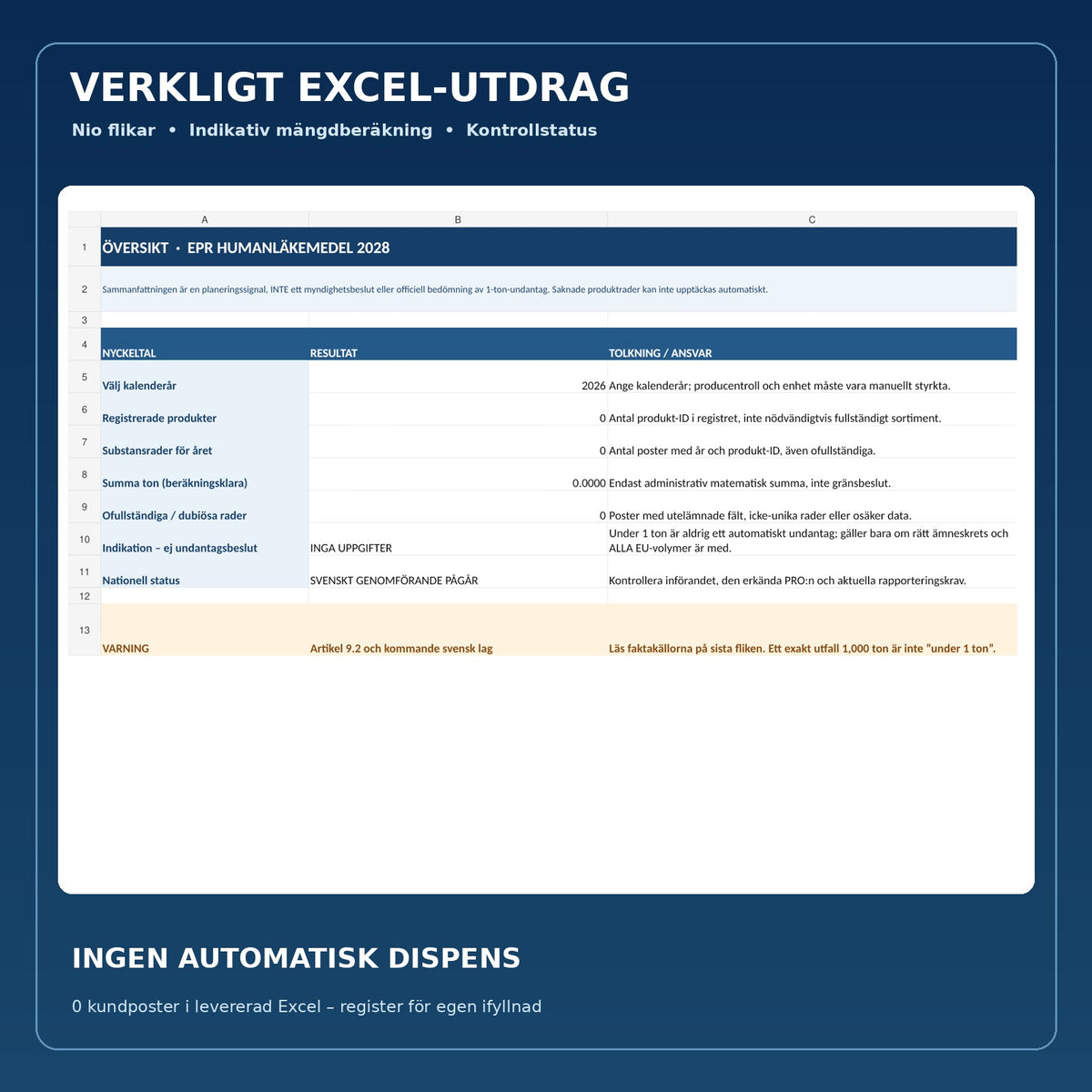
The workbook contains Overview, Actor Roles, Products, Substance Masses, Market per Year, Exemption Assessment, Environmental Evidence, PRO & Actions, and Read Me & Sources. In the substance register, the company can enter the substance quantity per unit in milligrams, the number of units on the EU market, the source reference, and a double-counting check. The indicative calculation is mg per unit × units / 1,000,000,000 = tonnes. It is a mathematical unit conversion, not a legally binding method established by authorities for all substances, products, and markets.
A test with 250 mg × 1,200,000 units yielded 0.300 tonnes at both the product and overview levels. An incomplete entry and a flagged duplicate signal EVIDENCE MISSING. At exactly 1,000 tonnes, INDICATIVE AT LEAST 1 TONNE is displayed. No Excel status automatically grants an exemption or claims that the product and substance scope is complete.
How do exemptions work under Article 9.2?
Ground A: Producers shall be exempt if they can show that the quantity of substances contained in the products they place on the Union market is less than one tonne per year. Exactly 1,000 tonnes is therefore not “less than one tonne”. Which substances and volumes are included must be assessed against the original law and current methodology – only active pharmaceutical substance, sales value, or the product's gross weight may be chosen without evidence.
Ground B: Article 9.2 b covers special cases where the substances contained are rapidly biodegradable in wastewater or do not generate micropollutants at the end of the life cycle. Such a claim must be supported by relevant studies and current criteria. The package records evidence but neither certifies biodegradability nor issues exemptions.
Who should buy – and who should not buy?
Typical case 1: A company that professionally places medicinal products for human use on the Swedish market needs to decide which legal entity will collect data from multiple manufacturers. Typical case 2: An importer does not receive complete substance data and needs a concrete supplier letter, a follow-up log, and a traceable decision on missing evidence. Typical case 3: A producer wants to prepare a documented assessment of the one-tonne limit without incorrectly claiming that the exemption has already been granted.
Not the right product if it only concerns cosmetic products, veterinary medicinal products without separate legal assessment, registration that already requires an official national form, technical environmental measurements, the wastewater treatment plant's own operational reporting, or an actual application for an official exemption. For cosmetic products, there is our separate Cosmetics & Wastewater Directive 2028 package.
How to use the product in seven steps
- Identify the responsible legal entity and investigate whether it is actually a producer according to Article 2.19; distinguish between manufacturer, importer, distributor, and marketing authorisation holder.
- Review which products are medicinal products for human use according to Annex III point 1 and the medicinal products Directive 2001/83/EC.
- Send the supplier letter and collect product, substance, and market data with source references.
- Document the legal substance definition and all relevant product/substance lines. Check for duplicates between units and markets.
- Use Excel for indicative quantities and flags; let the responsible function determine whether the quantity calculation truly represents the correct product scope.
- Gather scientific evidence when assessing biodegradability and document separately whether a potential exemption can be invoked at all.
- Verify Swedish implementing legislation, the recognised PRO, and reporting requirements when established; record only actual official decisions and proof of payment.
Legal limitations and data protection
The product is a preparatory documentation package. It is not an official authority form, registration, or approval. The Member States' future requirements may entail additional fields and limitations. The register should not contain personally identifiable patient data; protect commercially sensitive formulations and studies in the company's own authorisation-controlled system. An actual national fee cannot be calculated based on the template's mathematical mass formula.
Frequently asked questions
Does producer responsibility for medicinal products already apply in Sweden in 2026?
The EU Directive is in force, but the Swedish implementation process is ongoing. The Member States' specific producer responsibility must be in place by 31 December 2028 at the latest. Treat this as preparation and check current Swedish law when using it.
Is the one-tonne exemption automatic when Excel shows 0.99 tonnes?
No. Excel only calculates based on the data entered and the limitations chosen by the company. If any substance, product, or EU market is missing, the total sum may be incorrect. A claim of exemption requires a correct legal assessment and supported evidence.
Do I only calculate the active substance?
Not without legal and methodological assessment. Article 9.2 refers to substances contained in the products; which substances are relevant in final application must be supported by legal sources and future criteria.
Do I already have to pay 80% of our sales?
No. The Directive refers to the financing of at least 80% of certain costs for quaternary treatment via producer responsibility. It is not 80% of an individual company's turnover.
Is this a legally reviewed official form?
No. It is a private document package with AI-assisted source control. No independent external legal review or official certification has been performed.
Are the PDF files editable forms?
No. They are searchable and printable. Word is used for editing; Excel is used for registers and calculations.
Does the package contain English contract templates?
No. The five operational templates and Excel are in Swedish; the seventh Word/PDF file is an English User Guide for the Swedish templates.
Official legal sources and verification
Directive (EU) 2024/3019, Articles 2, 9–10, and Annex III · Swedish Environmental Protection Agency on the Directive's entry into force and transposition · Swedish Environmental Protection Agency's ongoing implementation mandate · TLV/Swedish Medical Products Agency's impact assessment.
Product version 1.0 • AI-assisted source control performed 2026-11-10 • No external legal review • VAT/shipping/Google Shopping data should follow the store's existing routines.