Svenska Dokumentmallar
Political Advertising 2026/2027 – Local Issue, Labeling & Transparency | Word/PDF/Excel
Political Advertising 2026/2027 – Local Issue, Labeling & Transparency | Word/PDF/Excel
- File format
- DOCX, PDF, XLSX
- Document language
- Five Swedish working documents one Swedish user guide and one English User Guide; the main templates and Excel files are in Swedish.
- Number of files
- 7
Digital download. No physical product is shipped.
Couldn't load pickup availability
About this template
Is a non-profit organization, advertising agency, or local newspaper buying or publishing an advertisement that could influence a municipal decision? Then EU rules on political advertising may be relevant—even if the advertiser is not a political party. This niche product helps Swedish sponsors, advertising intermediaries, and media publishers document whether the message is covered, who the sponsor is, how the advertisement should be labeled, and how information, corrections, and evidence are followed up.
EU Regulation 2024/900 came into full effect on 10 October 2025. The Commission's implementing regulation 2025/1410 specifies the format and technical specifications for labeling and transparency notices. The package focuses on local issue-based advertisements and purchased political advertising services—not political campaign strategy, message formulation, or personal profiling.
Quick facts: 5 editable Swedish templates + 1 Swedish user guide + 1 English User Guide, all in Word (DOCX) and searchable/printable A4 PDF, plus 1 Excel workbook (XLSX) with 9 tabs and 540 formulas. 7 DOCX + 7 PDF + 1 XLSX = 15 customer files. The PDF files are not interactively fillable. Intended for digital ZIP delivery after separate product publication and file linking.
01 · Package contents
Five Swedish templates: classification of local issue-based advertisements, sponsor certificate, advertisement labeling/transparency notice, publisher's publication control, and notification/correction. One Swedish and one English user guide are included. Seven standalone documents in Word and PDF plus Excel with nine tabs—a total of 15 files.
02 · What the files contain
Fields for the advertisement's service and context, Article 8 assessment, the sponsor's identity and any controlling entity, remuneration and funding, label/notice, publication channel, accessibility, personal data issues, complaints, amendment versions, and evidence. An Excel result does not constitute legal approval or automatic advertising.
What situations does this template package help with?
Example 1 – locally purchased advertising space. An organization wants to buy an advertisement in a local newspaper about an upcoming municipal regulatory decision. The advertising intermediary must be able to determine whether the order is covered by TTPA and provide the publisher with the correct sponsor information.
Example 2 – error in the sponsor labeling. A publisher discovers that the sponsor's name, the cost, or the link to the transparency notice is incorrect. A traceable record is then needed for investigation, suspension, or correction.
Example 3 – own post without purchased distribution. The same organization publishes its own organic post. This does not automatically trigger the special labeling requirements: the assessment depends on, among other things, whether there is a political advertising service. The package therefore also includes a documented boundary for situations that are not covered.
Not the right product: for writing party-political messages, influencing a specific group of voters, building audience profiles, buying advertising services, or guaranteeing that an advertisement is legally approved. The product is only a neutral administrative and legal control record.
Exact contents of the ZIP package
| Document | Use | Language and format |
|---|---|---|
| 01 Classification of local issue-based advertisements | Separate purchased advertising services from internal publication and editorial material; document the Article 8 factors. | SV · DOCX + PDF |
| 02 Sponsor certificate and information transfer | The sponsor's identity, control details, remuneration, funding source, and information actually provided according to Article 7. | SV · DOCX + PDF |
| 03 Advertisement labeling and transparency notice | Field matrix and neutral labeling structure according to Articles 11–12 and EU 2025/1410. Must be adapted to the actual channel. | SV · DOCX + PDF |
| 04 Publisher's publication control | Review label, working notice link, accessibility, information, notification path, and separate publication decision. | SV · DOCX + PDF |
| 05 Notification, correction, and amendment log | Document concrete deficiency, investigation, update, screenshot, version history, and final decision. | SV · DOCX + PDF |
| 06 User guide | Seven working steps, legal boundaries, sources, and three neutralized examples. | SV · DOCX + PDF |
| 07 English User Guide | English instructions for using the Swedish compliance forms; this is not a full translation of all templates. | EN · DOCX + PDF |
| 08 Excel – control register | Nine tabs, 540 formulas, and administrative status tracking without macros or customer test data. | SV · XLSX |
Excel for sponsor, labeling, and publisher follow-up
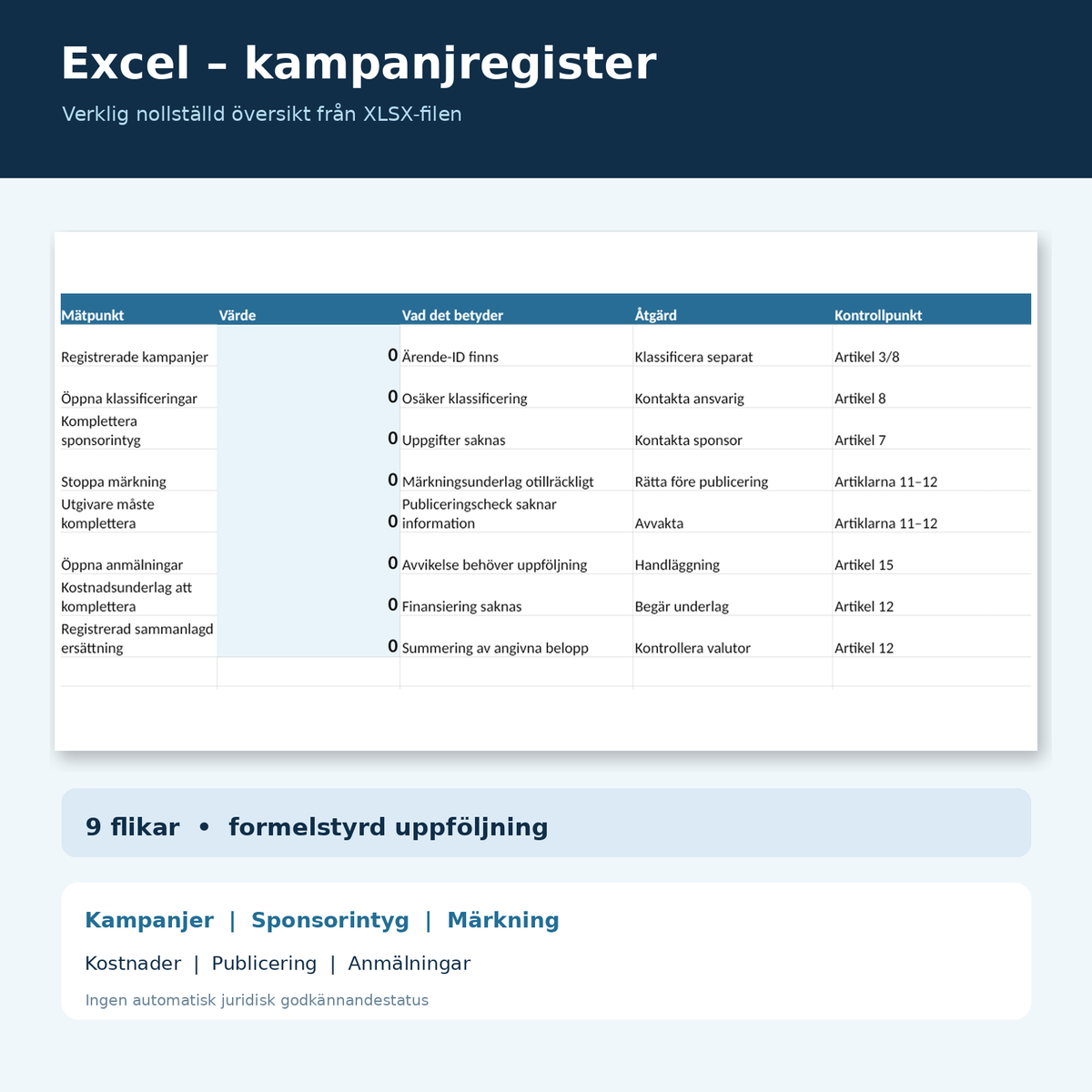
Nine tabs: Read me, Overview, Campaigns, Sponsor certificate, Labeling, Costs, Publication, Notifications, and Sources. Enter actual campaign IDs, sponsors, publication channels, information transfers, costs, and controls. The overview shows open cases and entries where information is missing.
The workbook's **540 formulas** display administrative warnings such as "INVESTIGATE – MANUALLY", "COMPLETE", "STOP – GDPR REVIEW" and "FOR MANUAL PUBLICATION REVIEW". They never mean that the advertisement is legally permitted, fact-checked, or published. 16 test controls are approved; the fictitious test data is not in the customer's XLSX. No data connection to an advertising platform or web publication is included.
Workflow – from advertisement order to preservation
- Classify the case. Check according to Articles 3 and 8 whether it is a relevant political advertising service. Review message, sponsor, language, context, channel, target audience, and purpose. Political content is not enough on its own.
- Establish the roles. The sponsor, advertising service provider, and publisher do not have identical obligations.
- Request a sponsor certificate. Collect truthful information, paid amounts, any other benefits, and the relevant funding source. Check whether special sponsor restrictions apply.
- Prepare the label and transparency notice. Follow EU 2025/1410 Annex I and II for the medium's actual format. Ensure that the information is clear and that the link works.
- Perform a separate privacy assessment. If online advertising is targeted or delivered using personal data, special rules apply in Articles 18–19. IMY's guidance and GDPR need to be considered.
- Verify actual publication. Save evidence of the displayed label, accessibility check, URL, time, and version number. An internal Word or Excel file is not the published evidence.
- Handle corrections and preserve. Document notifications according to Article 15, corrections, and the actual final publication day.
What does the legislation say—and which exceptions are important?
Articles 7–8: Sponsors must truthfully declare relevant political advertising services, and publishers/service providers must assess advertisements based on the actual circumstances. Article 8 is a factor model for certain political issue-based advertising, not an automatic prohibition or permission. EU 2024/900, official Swedish regulation.
Articles 11–12: Publishers must ensure that political advertising messages have appropriate labeling and transparency notices with, among other things, sponsor and funding information. If mandatory information cannot be completed without unreasonable delay, publication may need to be stopped according to Article 12.2. The format of labeling is also regulated by implementing regulation 2025/1410.
Article 12.4: Publishers must retain transparency notices and amendments for seven years from the advertisement's last publication. Article 9 contains another retention rule and a narrow exception for certain micro-enterprises with only marginal ancillary advertising services. The exception does not automatically apply to all small media publishers or all requirements.
Articles 18–19: For targeted political online advertising using personal data, special privacy rules exist, including those around consent. This product contains no audience profiling. See IMY's guidance.
Internal distribution and editorial content: The Swedish Media Authority states that own organic internal publication normally does not trigger the same requirements for advertisement labeling. A separately purchased advertising service may, however, make the regulations relevant. Also check any special media law rules.
Frequently Asked Questions
Must all posts about politics or municipal decisions be labeled?
No. The rules cover political advertising services according to the regulation's definitions. An own organic post, editorial material, or a private opinion is not automatically covered by corresponding labeling requirements. Classification requires a factual assessment.
Do the rules apply to an organization that is not a political party?
An organization may be covered if it orders an advertising service that constitutes political advertising according to the regulation. It is not determined solely by the form of the organization. A paid advertisement about a local regulatory process may therefore need to be assessed.
Can I use the Word label directly on the web?
No. It is a working structure with placeholders. The publisher must complete the correct information and follow EU 2025/1410 for the actual format, including readability, placement, language, and accessibility.
Does the seven-year retention requirement apply to all small actors?
Article 12.4 covers publishers' transparency notices and amendments. Other obligations and narrow exceptions need to be assessed separately. Article 9's micro-enterprise exception does not generally apply to all labeling.
Can the package be used for targeted advertisements based on personal data?
Only as an administrative checklist and warning. The special rules for such advertising according to Articles 18–19 and GDPR require a separate assessment, and no personal profiles or audience lists are included.
Are the PDF files editable forms?
No. They are searchable and printable A4 copies, without interactive PDF form fields. Use the Word versions when information needs to be edited.
Are all documents in English?
No. The five templates, the Swedish guide, and Excel are in Swedish. A separate English User Guide for using these files is included.
Sources, version, and transparency
EU 2024/900 (Articles 3, 7–12, 15, and 18–19), EU 2025/1410 (label and transparency notice format), The Swedish Media Authority, and IMY.
Version 1.0. AI-assisted legal source control and technical file tests 8 November 2026. No independent lawyer, political advertising specialist, or authority has reviewed or approved the material. Always adapt information, obligations, and actual labeling formats to your specific advertising service and responsible actors. No election campaign, political recommendation, or audience-targeted persuasion is produced by the package.