About this template
Complaint regarding defects in a tenant-owned apartment – complaint letter, defect log, and Excel
Have you discovered a suspected defect after purchasing a tenant-owned apartment? With this professional template package, you can file a written complaint regarding the apartment to the seller, document what has been discovered, build a timeline, and collect photos, inspection reports, and other evidence. You receive five editable Swedish working templates, Swedish and English user guides, and an Excel register with nine tabs.
15 downloadable files: 7 Word (DOCX), 7 searchable A4-PDF, and 1 Excel (XLSX). Designed for complaints in accordance with the Sale of Goods Act (1990:931) for the purchase of a tenant-owned apartment. The package does not determine whether a legal defect exists or whether the seller is obligated to pay a specific amount.
01. Package contents
- 7 editable Word files: five Swedish working templates, Swedish guide, and English User Guide.
- 7 searchable PDF files: corresponding print-friendly A4 versions.
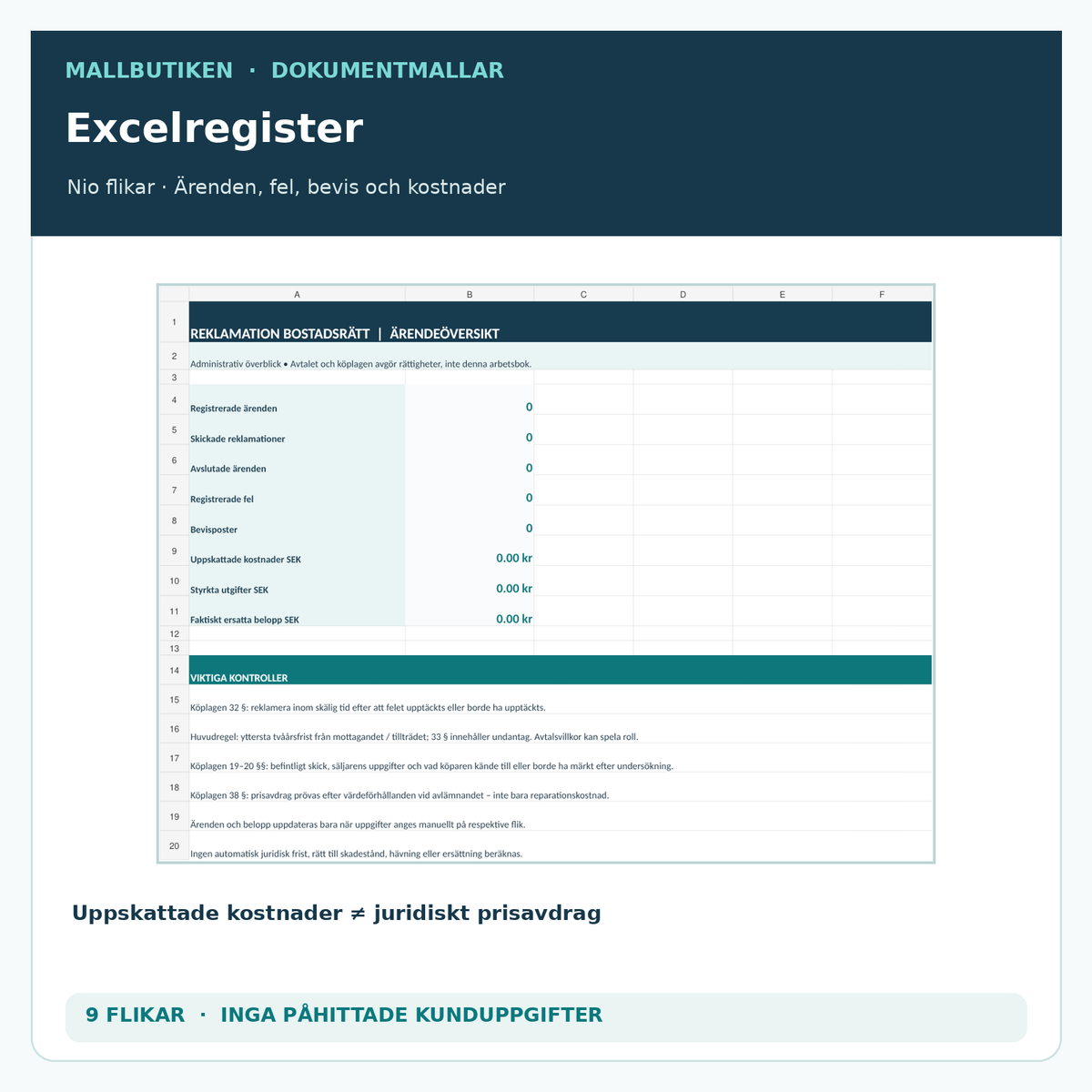
- 1 Excel (XLSX): nine tabs for cases, defects, evidence, communication, costs, and follow-up.
- Edition 1.0 – 2026/2027: legal sources reviewed October 19, 2026. The year 2027 does not imply that future regulatory changes have been automatically incorporated.
- Document design: every Word and PDF file features two separate information boxes regarding the package and file contents.
Delivery comprises a ZIP file after purchase, once it is registered for the product variant in Shopify Digital Products. The templates are editable and do not contain any pre-filled real personal data or allegedly valid signatures.
02. What the files contain – document by document
| Document | Function and details | Format |
|---|---|---|
| 01. Complaint letter to seller | Formal, objective complaint with details on the transfer agreement, date of discovery, symptoms, and request for a response. | DOCX + PDF |
| 02. Transfer & incident timeline | Agreement, possession, seller information, inspection, any disclaimers, and chronology. | DOCX + PDF |
| 03. Defect log & evidence attachment | Factual observations, photo references, potential cause, and what requires further investigation. | DOCX + PDF |
| 04. Claim & cost documentation | Estimated cost, verified expenses, valuation basis, parties' positions, and potential remedies. | DOCX + PDF |
| 05. Response and follow-up | Acknowledgment of receipt, seller's response, contacts, supplements, dispute status, and verified agreement. | DOCX + PDF |
| 06. Swedish User Guide | Step-by-step usage with legal sections, complaint rules, inspection, and legal precautions. | DOCX + PDF |
| 07. English User Guide | English guidance for the five Swedish working templates and the Excel register. | DOCX + PDF |
| 08. Excel register – nine tabs | Overview, Cases, Apartments, Timeline, Defects, Evidence, Contacts, Costs, and Read me. | XLSX |
The fields in the templates concern, among other things, the buyer, seller, housing association (BRF), apartment, agreement, possession, date of discovery, agreed features, photos, expert assessment, responses, and actual supporting documentation. Use them for verified information, not to establish in advance who is responsible.
Hidden defects in tenant-owned apartments – what applies under the Sale of Goods Act?
A tenant-owned apartment is personal property. When purchasing a tenant-owned apartment, the parties' agreement applies primarily, followed normally by the Sale of Goods Act (1990:931). These rules differ from the provisions in the Land Code regarding the purchase of real property, such as a detached house.
The concept of a "hidden defect" is not an independent legal category in the Sale of Goods Act. A defect may still be relevant if the apartment deviates from agreed specifications or if there are circumstances as referred to in Sections 17–19 of the Sale of Goods Act. That a deficiency is discovered after taking possession does not automatically mean the seller is responsible. Factors such as what the buyer knew, what was shown during the inspection, what the seller stated, and the agreed terms all play a role. Read the Swedish Consumer Agency's guide on defects in tenant-owned apartments.
When must you file a complaint regarding a defect in a tenant-owned apartment?
According to Section 32 of the Sale of Goods Act, the buyer must normally notify the seller of the defect within a reasonable time after it was noticed or should have been noticed. As a general rule, defects cannot be invoked later than two years from the date the apartment was received, normally upon taking possession, though guarantees, agreements, and exemptions under Section 33 may affect this. The two-year limit does not mean you can wait two years after discovering a defect.
Therefore, file a written complaint without unnecessary delay and save proof of dispatch. You can describe a concrete suspected defect and supplement it with a technical investigation later. This template does not automatically calculate any legally binding complaint deadline.
"As is" condition, the buyer's inspection, and liability distribution
A clause regarding "as is" condition does not preclude a tenant-owned apartment from being defective in certain situations according to Section 19 of the Sale of Goods Act. According to Section 20, what the buyer was aware of, what the buyer actually inspected, and what should have been discovered during such an inspection may be significant. Unlike property purchases, there is no general, unconditional duty to inspect according to the same rules as in the Land Code. The housing association’s (BRF) maintenance responsibility and the seller's potential liability for defects are separate issues.
Price reduction, remediation, cancellation, and damages
The Sale of Goods Act contains provisions regarding potential remedies in, among other sections, 34–40. Remediation may be applicable in certain cases; price reduction, cancellation, and damages have different requirements. According to Section 38, a price reduction is in principle calculated proportionally based on the value of the apartment in its defective state versus its agreed state at the time of delivery. A quote or repair cost is not automatically the amount the buyer is entitled to.
In the case of major claims or if the seller’s liability is contested, an individually tailored building-technical and legal assessment is appropriate. The package does not in itself create any right to withhold payment, cancel the purchase, or receive compensation.
How to use the complaint package – step by step
- Gather the transfer agreement, questionnaire, information provided by the seller, and any inspection report.
- Note when the suspected defect was first noticed and what you were actually able to observe.
- Send the complaint letter to the seller in writing without unnecessary delay. Save the date and receipt.
- Fill in the timeline with the agreement, inspection, possession, discovery, and subsequent contacts.
- Describe each suspected defect separately in the defect log and link photos and reports to clear evidence IDs.
- Note which terms, information, and risk indicators were present at the time of purchase.
- If necessary, obtain an expert opinion and distinguish between established causes and preliminary assumptions.
- Separate quotes, actually paid expenses, valuations, and any claim amounts.
- Have a lawyer assess the appropriate remedy, applicable deadlines, and whom a claim should be directed toward.
- Follow up on receipt, the seller's response, and any potential written agreement.
Excel – nine tabs for complaints and evidence
Overview, Cases, Apartments, Timeline, Defects, Evidence, Contacts, Costs, and Read me. The workbook provides a status overview and summarizes registered estimates, verified expenses, and actually received compensation. A simple variance column shows only verified expense minus actually compensated amount. This is not an automatic calculation of a legal price reduction or damages.
The Excel is delivered without real customer data and without test data. The formulas are tested, and received claims are kept separate from technically verified data. Keep personal data and sensitive documents in a suitably secure storage location.
Related document templates at Mallbutiken
- Transfer agreement for tenant-owned apartment – agreement for the purchase or sale of a tenant-owned apartment.
- Hidden defects in real property – for real property according to different legal regulations.
- Property damage report – document water damage and insurance matters.
- Maintenance report and case management for housing associations – report and follow up on deficiencies in the property.
- More templates for tenant-owned apartments.
Frequently asked questions about defects in tenant-owned apartments
Can I file a complaint for a hidden defect in a tenant-owned apartment?
Yes, certain defects that manifest after the purchase can be subject to a complaint, but the Sale of Goods Act does not use "hidden defect" as its own legal term. The agreement, the seller’s disclosures, the nature of the defect, and what the buyer should have discovered need to be assessed.
How much time do I have to file a complaint for defects after purchase?
Normally within a reasonable time after discovery and, according to the main rule, no later than two years from the date the apartment was received. Exceptions may follow from the Sale of Goods Act, a guarantee, or an agreement. Therefore, do not wait to contact the seller.
Does the same ten-year rule apply as for hidden defects in houses?
No. A tenant-owned apartment is personal property; for the purchase of real property, other rules apply. The templates are adapted to the Sale of Goods Act and are not based on the ten-year rule for defects in real property.
Must I have an inspection report before I send the complaint?
Not necessarily. Describe the concrete suspected deviation without unnecessary delay and supplement with technical documentation as it becomes available. A claim does not become verified just because it is mentioned in a letter.
How is a price reduction calculated for a defect in a tenant-owned apartment?
Section 38 of the Sale of Goods Act is based on a proportional value comparison at the time of delivery. A repair cost can be relevant documentation but does not automatically correspond to the price reduction.
Does the Excel calculate the compensation or the complaint deadline?
No. The Excel manually compiles documented cases and amounts, without determining legal liability, legal deadlines, or compensation.
Are the documents also in English?
The five main Swedish templates have Swedish Word and PDF versions. A separate English User Guide is included, but the main templates are not translated.
Sources and version information
- The Swedish Parliament – Sale of Goods Act (1990:931), specifically sections 17–20, 32–33, and 34–40
- Swedish Consumer Agency – Defects in tenant-owned apartments: inspection, complaints, and remedies
Version 1.0 – 2026/2027. Source review October 19, 2026. These documents are editable support for objective complaints and documentation – not official government forms, external legal opinions, or a guarantee of a specific legal outcome. Always check applicable law and the individual agreement before use.