About this template
Debt forgiveness and final settlement agreement for companies – Word, PDF, and Excel
Do two companies need to document that an identified debt is being fully or partially forgiven, or that a debt shall be considered finally settled only after an agreed amount has actually been paid? This package provides separate templates for immediate debt forgiveness, conditional final settlement, claim appendix, final receipt, and audit log, with an Excel register for administrative amounts. Intended for individual Swedish B2B monetary claims.
01. Package contents
7 editable Word documents (DOCX), 7 corresponding searchable PDF files, and 1 Excel workbook (XLSX). A total of 15 files in ZIP format. Five Swedish working documents, one Swedish user guide, and one English user guide. 2027 edition, Swedish law.
02. What the files contain
Agreements distinguishing between definitive forgiveness and conditional settlement, claim and balance specification, final receipt after verified completion, risk/VAT/tax audit, guides, and an Excel file with nine tabs. No documents automatically certify that a debt is time-barred or that a forgiveness has tax implications.
All files in the ZIP package
| No | Document | Purpose | Format |
|---|---|---|---|
| 01 | Debt forgiveness agreement – B2B | Immediate forgiveness or explicitly conditional forgiveness of an identified debt. | DOCX + PDF |
| 02 | Conditional final settlement agreement | Forgiveness takes effect only after verified payment and fulfillment of conditions. | DOCX + PDF |
| 03 | Claim appendix and balance specification | Specify principal, interest, credits, objections, and remaining amounts. | DOCX + PDF |
| 04 | Forgiveness notice and final receipt | Confirmation that conditions have been met and the specified claim is finally settled. | DOCX + PDF |
| 05 | Audit and risk assessment | Authorization, guarantees, collateral, VAT, tax, and documentation audits. | DOCX + PDF |
| 06 | Swedish user guide | Legal limitations, instructions, and four fictional test cases. | DOCX + PDF |
| 07 | English User Guide | English guidance for the Swedish templates. No English master template. | DOCX + PDF |
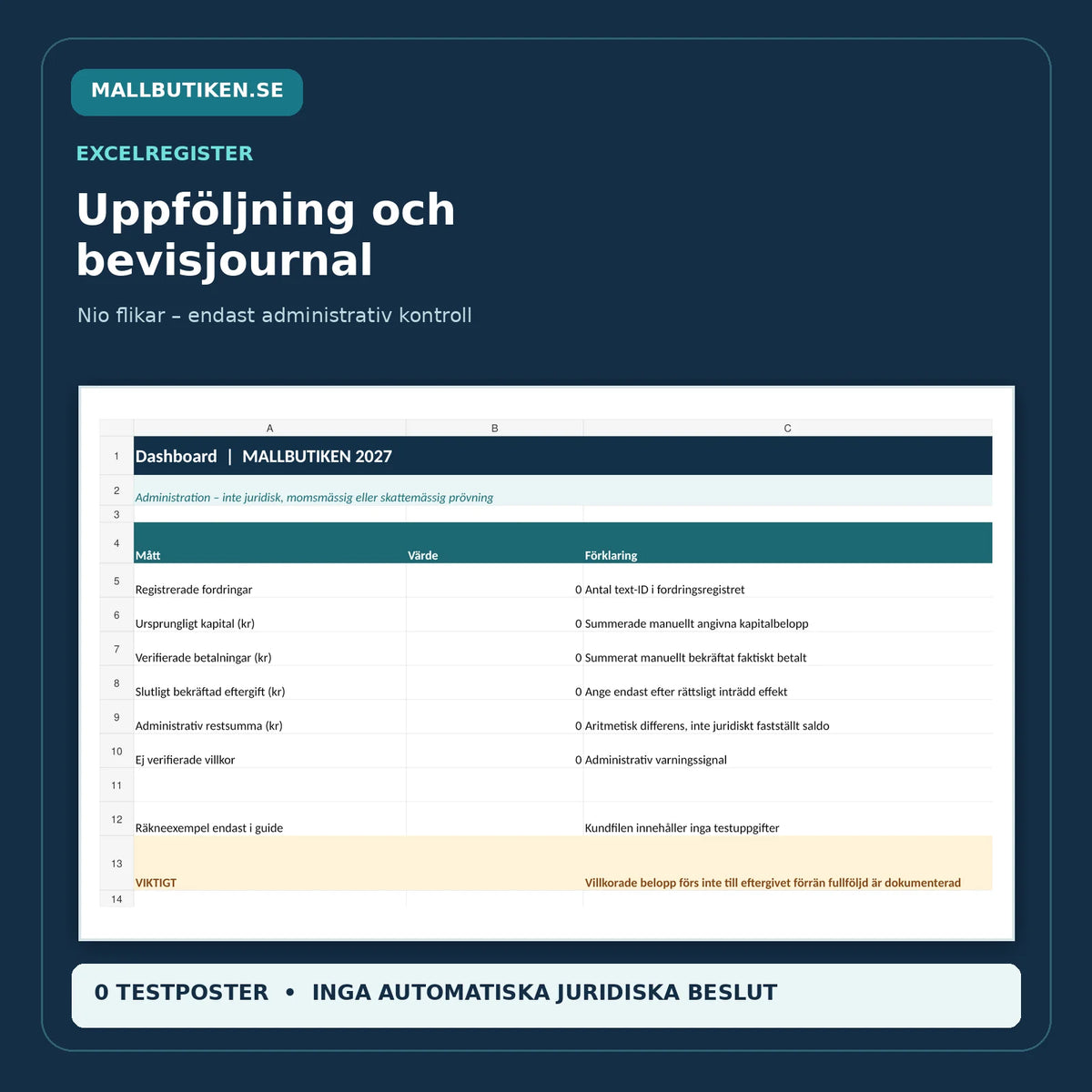
| 08 | Excel – Forgiveness register 2027 | Nine tabs for claims, forgiveness, actual payments, conditions, collateral, VAT audit, documentation, and dashboard. | XLSX |
Immediate debt forgiveness or conditional final settlement – what is the difference?
With immediate debt forgiveness, the parties expressly agree that the creditor definitively waives a specified part of the identified claim. With conditional final settlement, forgiveness of the remaining amount shall only take effect if a specific payment has actually been received by the creditor and any other agreed conditions have been met. Therefore, a final receipt should not be issued before the payment is verified.
Agreements must specify exactly which items are affected: principal, default interest, fees, objections, and any reservations. It is important not to accidentally write off other claims. The Contracts Act (1915:218) forms part of the general contractual legal basis. Under Section 36, unfair contractual terms may be adjusted or disregarded after individual assessment.
Guarantees, collateral, and third-party rights
A debt may be associated with, for example, a guarantee, pledge, or a claim assignment. It cannot be assumed that a bilateral forgiveness agreement automatically has a specific effect on a guarantor's liability, pledge, or other third-party rights. Such issues must be assessed separately and relevant agreements and consents checked.
Tax and VAT for debt forgiveness
A voluntary debt write-down is not automatically a tax-exempt composition. The Swedish Tax Agency (Skatteverket) distinguishes between, among other things, private compositions, other voluntary forgiveness, and debt settlements within corporate reconstruction. Tax effects depend on actual circumstances, such as insolvency, the nature of the settlement, and applicable rules on losses. Let your accounting or tax officer assess both parties' treatment. Swedish Tax Agency's guidance on compositions and debt settlements.
For VAT, it is also crucial to distinguish between determined bad debt and price reduction after the fact, for example after a final debt settlement. There may be requirements for credit notes and corresponding adjustments. The package does not draw an automatic conclusion regarding VAT reduction. See Swedish Tax Agency's guidance on VAT for bad debts and price reductions.
Excel register with nine tabs
The Excel file includes Dashboard, Claims, Forgiveness, Payments, Condition Audit, Collateral, VAT & Tax, Evidence Log, and Read Me. The register distinguishes between the original claim, actually verified payments, and finally realized forgiveness. A future or unconfirmed forgiveness should not be booked as definitive in the administrative residual balance. The formulas are arithmetic only and do not prove legal validity.
How to use the templates
- Identify both companies, authorized signatories, and the original agreement.
- Gather invoices, historical payments, interest, costs, and any objections.
- Check collateral, previous assignments, and any third-party rights.
- Select the document for immediate forgiveness or separate conditional final settlement.
- Specify the exact amount forgiven, any reservations, and the relevant effective date.
- Have your finance or tax officer assess VAT, tax, and verification requirements.
- Sign and document authorization and the agreed payment instruction.
- Issue a final receipt only after required conditions are met and payment has been verified.
Frequently asked questions
What does debt forgiveness mean?
That a creditor waives an identified claim or part of it. The agreement's wording and validity determine what is actually covered and when the forgiveness takes effect.
Is debt forgiveness the same as a composition?
No, not always. A composition has specific economic and tax implications. A standard voluntary forgiveness does not automatically lead to the same tax treatment.
Does the debtor receive a final receipt immediately when the agreement is signed?
Not if the forgiveness is conditional upon payment or other performance. A final receipt should be issued only after documented completion.
Can the company automatically deduct VAT or the entire claim as a bad debt?
No. This issue requires a separate assessment of the transaction and any credit note. Swedish Tax Agency rules on bad debt and price reductions may lead to different accounting treatments.
Does the Excel file calculate when a debt is legally gone?
No. The Excel file provides an administrative calculation based on actually entered principal, verified payments, and manually confirmed final forgiveness.
Are English agreements included?
No, the five working templates are in Swedish. An English user guide is included.
Related templates
- Installment agreement and payment plan B2B
- Interruption of limitation and claim monitoring
- Assignment of claims and denunciation
- Simple promissory note
Official legal sources
- Contracts Act (1915:218)
- Limitation Act (1981:130), including Sections 5–6
- Swedish Tax Agency – compositions, debt settlements, and taxation
- Swedish Tax Agency – VAT, bad debts, and price reductions
2027 edition. Internal AI-assisted source and document check performed October 20, 2026; no external legal, audit, or tax advisor review has been conducted. Intended for defined B2B claims, not consumer credits, bankruptcy proceedings, or formal corporate reconstruction.