
Switch Accounting Software in Sweden – SIE, Reconciliation & Archiving
Changing accounting software in Sweden? Learn how SIE 4 transfers work, what must be reconciled and how to retain accounting records for seven years. Practical checklist and templates.

You can change accounting software, but you must not lose the underlying accounting records. Choose a cutover date, export the information required for continued bookkeeping and statutory retention, reconcile it with the old system and make older records accessible for the entire retention period. An SIE file is often useful for transferring entries, but may not include invoice images, receipts, customer and supplier ledgers or audit history.
This guide addresses a software migration, not necessarily a change of accountant. If you are also replacing your external accounting firm, see the English guide on changing accounting firms and handing over records. The two changes can happen together but require different controls.
Before switching: decide which records must remain available
A change at the start of a new financial year can simplify reconciliations, but is not a legal requirement. Inventory the accounting system, invoicing and payroll modules, bank connections, integrations, service providers, administrators and export options. Read the current vendor contract for termination dates, charges, export access and access to historical records after cancellation.
| Information | What to verify | Possible transfer or retention method |
|---|---|---|
| General ledger and vouchers | Financial years, account numbers, dates, voucher numbers and opening/closing balances. | Suitable SIE export or system export; reconcile entries and balances after import. |
| Receivables and payables | Unpaid invoices, credit notes, partial payments, due dates and discrepancies. | System-specific exports, open-item lists and supporting invoice documents. |
| Supporting evidence | Receipts, scanned invoices, journal-entry support and linked attachments. | A separate document export or durable archive that preserves traceability to entries. |
| Fixed assets, payroll and VAT | Depreciation schedules, payroll information, incomplete return periods and adjustments. | Review separate modules and data-access restrictions. |
| System documentation and processing history | Chart of accounts, configurations and records needed to explain historical processing. | Retain sufficient old-system documentation and a record of what changed. |
The requirements depend on the business and are governed, among other things, by the Swedish Bookkeeping Act (1999:1078) and BFN's bookkeeping guidance. The table is a practical planning tool, not an exhaustive statutory export list.
SIE 4: what does it contain, and what is missing?
SIE is a Swedish format for exchanging accounting data. The SIE Group's English documentation distinguishes type 1 (annual account balances), type 2 (period balances), type 3 (object or profit-centre balances), type 4 (transactions and vouchers) and type 4i (voucher transfer, commonly from a subsidiary system such as payroll). A type 4 export can be useful when the receiving software supports it.
SIE 4 is not a complete archive of every business document. Linked invoice images, scanned receipts, customer-ledger status, approvals, user logs and particular configuration settings may be absent. Always test the contents of the actual imported file rather than relying on a successful import message alone.
Switch accounting software in eight steps
- Inventory the systems. List accounting, invoicing, payroll, cash-register and banking systems, all integrations, and their owners.
- Choose the cutover. Document the last posting in the old system and first posting in the new one, and prevent duplicate entries during the transition.
- Reconcile before exporting. Check bank balances, customer receivables, supplier payables, taxes, salaries and other material balance-sheet accounts. Log unresolved differences.
- Secure original records. Export ledger data, vouchers, supporting documents and any system information required to explain the records later.
- Perform a trial import. Check account mapping, character encoding, posting dates, periods, project dimensions, voucher numbering and links to attachments.
- Compare before and after. Match balances by relevant account, review open items and sample supporting vouchers. Record every adjustment and discrepancy.
- Choose a lawful archive solution. Confirm old records can be found, read and reproduced after cancelling the former subscription.
- Sign off before closing access. Assign a reviewer and keep old licences, accounts or archive services until retention and transfer have been verified.
For reconciliations ahead of the cutover, the Year-End Closing Checklist & Reconciliation Register may help allocate controls and record findings. The document package does not import SIE files or perform software migration.
Seven-year record retention: may you cancel the old software?
Under Chapter 7 of the Bookkeeping Act, accounting records must ordinarily remain available through the seventh year after the end of the calendar year in which the financial year ended. If an accounting year ends in 2026, the general deadline is 31 December 2033. A non-calendar financial year must be assessed using the calendar year of its end.
See BFN's official archive guidance. Information must remain organised, accessible and reproducible throughout the retention period. Terminating software access without a working archive may jeopardise that obligation.
Must original receipts and files always stay in their original format?
From 1 July 2024, Swedish rules permit disposal of certain paper accounting documents following a proper transfer of the information to another document, provided the transfer does not create a risk of alteration or loss. This does not mean that any incomplete export, detached spreadsheet or stand-alone SIE file is automatically sufficient.
BFN explains the 2024 amendment to Chapter 7, Section 6. The permitted transfer does not shorten the seven-year retention period. Check documentation and processing-history duties for the business's specific systems.
Data security, GDPR and service-provider changes
Customer, supplier and payroll records may contain personal data. Identify the parties' actual roles. When the new service provider processes personal data on the business's behalf, a GDPR Article 28 processing agreement is normally required. Sweden's data protection authority IMY explains the requirements for instructions, security and returning or deleting information after the processing ends, subject to legal retention obligations.
Use named user accounts, limited authorisations and suitable protection for exports. Do not migrate personal BankID credentials or shared passwords as part of an accounting file. Only close previous accounts when the handover, archive and legal responsibilities have been confirmed.
Illustrative example: cutover on 1 January
A Swedish limited company stops daily postings in its old software on 31 December 2026 and starts in the new software on 1 January 2027. It exports the general ledger and supporting records, reconciles closing balances and lists outstanding customer and supplier invoices. Before cancelling access it preserves historical invoice images and system documentation in a readable archive.
After trial import, the person responsible checks that the opening balances for 2027 agree with the approved closing balances for 2026, taking into account subsequent year-end adjustments. The method and dates are illustrative; actual steps depend on the systems and accounting rules.
Which templates help with a system migration?
IT system register and retirement plan
IT System Management Plan & Register can document system owners, vendors, risks, responsibilities and retirement activities. It is a planning template, not accounting migration software.
Financial reconciliation
Year-End Closing Checklist & Reconciliation Register supports comparing balances, assigning reviews and recording exceptions. It does not replace source vouchers or bookkeeping controls.
Changing the external accounting firm too
Change of Accounting Firm & Handover Plan can help coordinate records, outstanding tasks and authorisations when an outside accountant is replaced. It may not be necessary for a software-only switch.
See also the year-end closing guide for Swedish limited companies and the English guide to prepaid and accrued items.
Final checklist before the old system is retired
- Cutover date and all responsible persons are documented.
- Accounts, entries, balances, vouchers and essential supporting documents are accessible and reconciled.
- Outstanding customer and supplier items are recorded.
- Any payroll, VAT, fixed-asset and document modules have been evaluated separately.
- The imported information has been tested beyond a simple success notification.
- Older records can be read and reproduced from a tested archive for the legally required period.
- System documentation and processing history are retained as required.
- GDPR, access permissions and export security have been checked.
- Unresolved exceptions have named owners and target dates.
Why does migration data quality matter?
Azeroual and Jha (2021) studied data quality in enterprise migration projects. Their research is useful background for checking source and destination records, but it is not specific to Swedish bookkeeping programs and does not prove a particular commercial checklist prevents errors. Study reference.
Official sources
- Swedish Bookkeeping Act (1999:1078), Chapters 5 and 7
- BFN — accounting records and retention
- BFN — 2024 amendments on transferring accounting records
- BFN — bookkeeping and system documentation guidance
- SIE Group — format types and specifications (English)
- IMY — personal data processing agreements
Sources checked 24 October 2026. General guidance only. This is not an accounting audit, software certification or an assertion of approval by Swedish authorities. Verify your own contracts, accounting records and archive solution.
Templates in this article
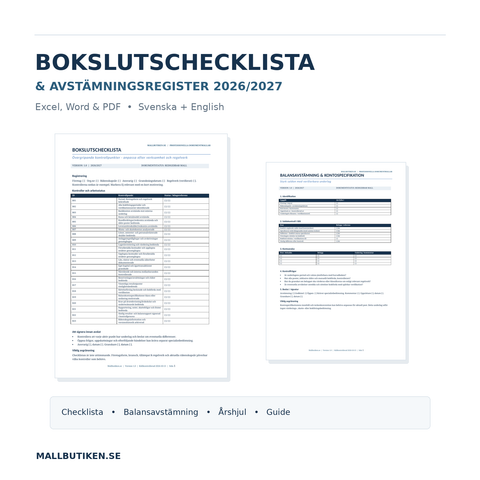
Year-End Closing Checklist & Reconciliation Register 2026/2027 – Balance Sheet Accounts, Year-End Schedules & Annual Cycle | Excel, Word & PDF
Excel (XLSX) + Word (DOCX) + PDF
79 SEK
View template: Year-End Closing Checklist & Reconciliation Register 2026/2027 – Balance Sheet Accounts, Year-End Schedules & Annual Cycle | Excel, Word & PDF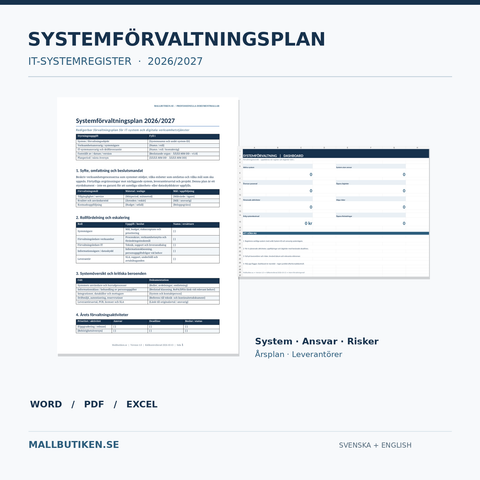
System Management Plan & IT System Register 2026/2027 – System Owners, Risks & Annual Cycle | Swedish + English Word/PDF/Excel
Word (DOCX) + PDF + Excel (XLSX)
79 SEK
View template: System Management Plan & IT System Register 2026/2027 – System Owners, Risks & Annual Cycle | Swedish + English Word/PDF/Excel
Explore the topic
 Business guides – contracts, HR, AI & compliance
Changing Accounting Firms in Sweden – Records, SIE & Access
Switching accounting firms in Sweden? Review SIE exports, invoices, payroll and VAT/AGI responsibilities, statutory archives, Tax Agency authorisat...
 Annual reports – guides, rules & templates
Year-end closing for limited companies – step by step 2026
Year-end closing for limited companies step by step 2026: reconciliation, accruals, valuation, tax, K2/K3, capital deficiency, and the path forward...
 Business guides – contracts, HR, AI & compliance
Prepaid or Accrued? Year-End Accounting in Sweden
Prepaid expenses, accrued expenses, deferred revenue and accrued income explained under Swedish accounting rules. Practical examples, K2/K3 guidanc...


