
Changing Accounting Firms in Sweden – Records, SIE & Access
Switching accounting firms in Sweden? Review SIE exports, invoices, payroll and VAT/AGI responsibilities, statutory archives, Tax Agency authorisations and GDPR. Practical handover checklist.

When changing accounting firms in Sweden, secure three things: complete and usable records, clear ownership of each unfinished accounting period, and properly controlled access permissions. Agree a written handover date, identify outstanding VAT, employer and payroll filings, and verify that the incoming firm can open the records before removing the previous firm's access.
An SIE file alone may not be enough. Ledger entries, receipts, supplier and customer invoices, payroll records and other supporting material can reside in separate applications. Treat the change as a documented handover process, not just the termination of a service contract.
Which records should be handed over?
Exact responsibilities depend on the company's circumstances and its current engagement agreement. This overview is a practical starting point, not a statutory list of attachments that must always be provided.
| Area | Typical handover material | Key controls |
|---|---|---|
| Bookkeeping | General ledger, voucher list, SIE export, chart of accounts, opening and closing balances. | Reporting years, covered dates, ability to read vouchers and reconcile amounts. |
| Supporting vouchers | Supplier invoices, customer invoices, receipts, journal-entry documents and bank evidence. | Can the original or appropriately transferred records be retrieved and read? |
| Accounts receivable/payable | Unpaid invoices, credit notes, part-payments and other outstanding items. | Do open-item balances and identified discrepancies agree as of the cutover? |
| Payroll and taxes | Payroll journals, holiday pay liabilities, VAT/AGI submission status and receipts. | Who prepares and submits the next return or correction, and when? |
| Year-end accounts | Last signed closing documents, account schedules, fixed-asset registers and open issues. | Which questions, supporting records or deadlines remain unresolved? |
| Permissions | List of access roles for the accounting system, banks and Swedish government e-services. | Which permissions should be added, adjusted or revoked, and on which date? |
Five steps: before, during and after the handover
1. Before terminating the agreement
Check the contractual notice period, agreed scope, termination charges, work still in progress and how records will be provided. There is no universal termination period for every Swedish accounting service. Document who may authorise the change and who may receive the files. For the contractual side, see the accounting services engagement guide.
2. Create a responsibility calendar
List the last payroll run, the next VAT declaration, the employer declaration at individual level (AGI), unpaid customer and supplier items, annual accounts and relevant income-tax filing. Name the person responsible before and after the handover, and flag work that remains open. Confirm actual due dates with the company and the Swedish Tax Agency: the correct date depends on the company's registrations, tax period and applicable decisions.
3. Request usable exports and supporting records
Agree on the format for each system and check that the incoming firm can import or read it. Ask separately for items not carried inside a standard accounting export, including invoice scans, payroll archive, aged receivables/payables and system documentation. Do not store passwords, BankID credentials or authentication codes in a shared handover spreadsheet.
4. On the handover date, reconcile balances and open issues
Compare material ledger accounts, outstanding claims, payables, paid and unpaid invoices and the last reconciled reporting period. Record discrepancies with a responsible owner and source reference. A receipt for transferred material should say what has been received; it must not imply that all bookkeeping has been independently audited or proven error-free.
5. Confirm new access and remove old permissions
Ensure the incoming accountant has permissions that are necessary for the agreed tasks, then revoke access no longer needed by the outgoing firm. The business must retain its own administrative control of accounts and historical records. Do not remove an incumbent's access until the next filing, archive and relevant handover actions are safely covered.
SIE exports: which type should you ask for?
SIE is a Swedish standard for transferring accounting data. The SIE Group describes type 1 (year-end balances), type 2 (period balances), type 3 (object balances), type 4 (voucher transactions) and type 4i (vouchers typically exported from a subsidiary system). SIE 4 can be appropriate when transferring transaction-level bookkeeping, provided the sending and receiving applications support the export and import in question.
Who remains responsible for bookkeeping and archiving?
The Swedish business remains responsible for fulfilling its bookkeeping and record-retention duties even where it engages an external accountant. Under the Swedish Bookkeeping Act (1999:1078), accounting records generally must be retained through the seventh year following the end of the calendar year in which the financial year closed. See BFN's explanation of retention periods.
Document where the historical records and system documentation reside, who can access them after the engagement ends and how they can be reproduced in readable form. A firm change does not erase the need to retain accounting information for earlier years.
Swedish Tax Agency representatives: add, amend and revoke authorisations
An external accountant may have been appointed as a representative (ombud) for certain tax matters. Under the Swedish Tax Agency's official guidance, a company can appoint, change or remove authorisations through Ombud och behörigheter or current forms; form SKV 4804 can be used for revocation. Select the specific access level needed for the tasks.
Tax Agency permissions are separate from permissions for online banking, payroll services, bookkeeping software and payment providers. Handle each service independently. Check both that unnecessary old rights are revoked and that the new authorised persons can actually perform upcoming filing duties.
GDPR, payroll information and secure data transfer
Personal information, including salary information, requires appropriate safeguards. If an accounting firm acts as a personal-data processor for the business, the parties must comply with Article 28 GDPR. Swedish supervisory authority IMY explains that processor agreements must address returning or deleting personal data when services end, except where EU or national law requires continued retention.
This does not mean every accounting firm is always a processor for all activities, nor that all documents must be deleted immediately. Establish each party's actual role, retention duties and instructions, then use access-controlled transfer instead of an open email attachment or unprotected shared link.
Example: changing firms part-way through a financial year
Imagine a small Swedish company replacing its accounting firm on 1 November. The old provider completes bookkeeping through October, while payroll, VAT and AGI may involve different reporting cutoffs. A handover plan separately records the last bookkeeping period, the final payroll run, responsibility for the next VAT/AGI submission, the date of the SIE export, open receivables and payables, and any unresolved balances. The incoming firm confirms readability before the old account is closed.
Illustrative only: The actual division of tasks is established by the engagement agreements and written instructions. Changing consultants does not remove the company's underlying legal duties.
Choose the relevant document package
Practical handover plan
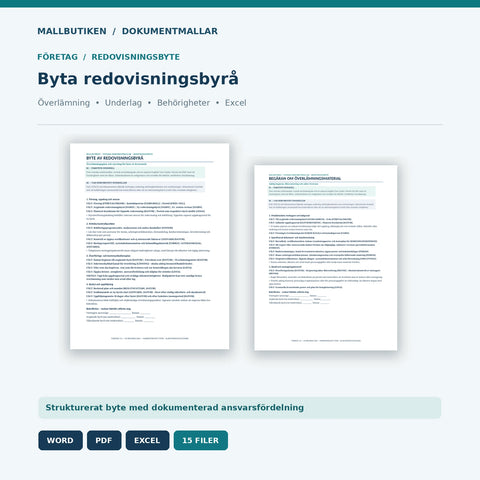
Change of Accounting Firm & Handover Plan (Word/PDF/Excel) is designed to document the cutover date, records, outstanding tasks, authorisations and acknowledgements. The product describes editable Word/PDF files and an Excel register. It does not cancel an existing engagement, nor guarantee that every document has been transferred.
Service engagement agreement
Accounting Services Engagement Agreement (Word/PDF) helps specify service scope, division of tasks, fees, reporting obligations and termination terms. It is an agreement aid rather than a full record-migration checklist.
For related workflows, see the English guide to switching accounting software and SIE files, the English guide to monthly VAT, AGI and holiday-pay reconciliations and the year-end closing guide for Swedish limited companies.
Checklist before marking the handover as complete
- Existing engagement and termination terms have been addressed.
- The cutover date, last responsible accounting period and pending work are documented.
- Ledger data, vouchers, reconciliations and customer/supplier items are identified and readable.
- The SIE export has been tested and missing supporting documents transferred separately.
- It is clear who files the next VAT return, AGI, payroll and annual-closing documents.
- Tax Agency representatives and bank/software authorisations have been reviewed.
- Personal data is transferred securely with an appropriate allocation of responsibilities.
- The company can access past bookkeeping information for the legally required period.
- The acceptance document records what was received and lists any outstanding exceptions.
Why do documented handovers matter?
Research into organisational processes, including Leyer, Iren and Aysolmaz (2020), illustrates methods for identifying handovers between roles. This is context about process management, not evidence that a particular Swedish accounting template prevents errors. Research reference.
Official sources and format references
- Swedish Bookkeeping Act (1999:1078), Chapters 4, 5 and 7
- Swedish Accounting Standards Board (BFN) — archiving
- Swedish Tax Agency — representatives and authorisations
- IMY — personal-data processor agreements
- SIE Group — format descriptions in English
Sources checked 24 October 2026. General information for Swedish businesses. Not a review of a particular service engagement, an accounting audit, individual legal advice or official approval. Template packs are administrative tools and do not replace the underlying accounting controls.
Templates in this article

Explore the topic
 Business guides – contracts, HR, AI & compliance
Engagement agreement for accounting and financial services – what should be regulated?
Guide to engagement letters for accounting firms and financial consultants: scope, division of responsibilities, deadlines, fees, GDPR, KYC, and te...
 Business guides – contracts, HR, AI & compliance
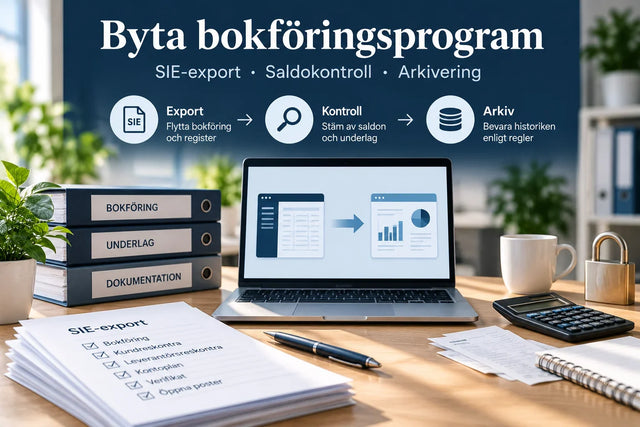
Switch Accounting Software in Sweden – SIE, Reconciliation & Archiving
Changing accounting software in Sweden? Learn how SIE 4 transfers work, what must be reconciled and how to retain accounting records for seven year...
 Business guides – contracts, HR, AI & compliance
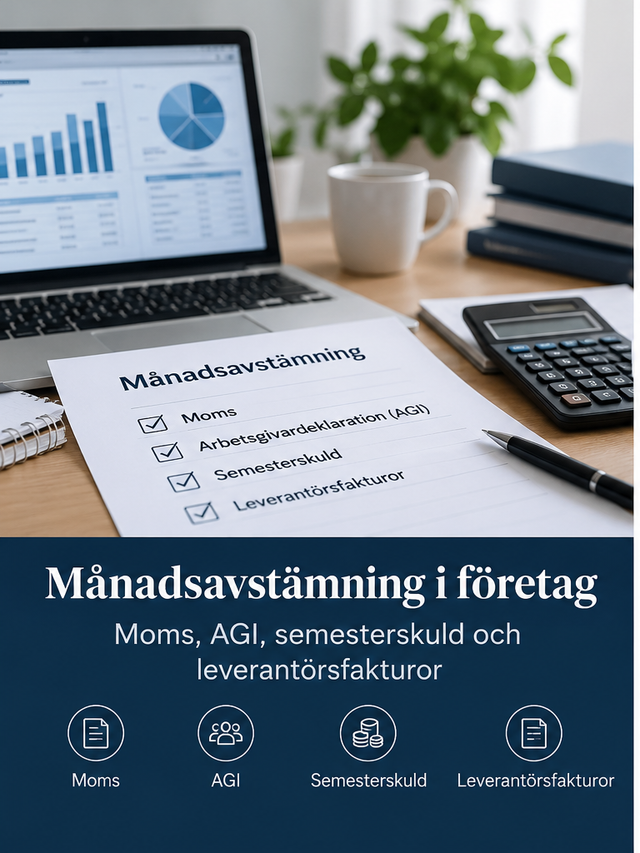
Month-End Reconciliation Sweden – VAT, AGI, Holiday Pay & Suppliers
How should Swedish companies reconcile month-end VAT, employer declarations (AGI), holiday pay liabilities and supplier invoices? Compare four cont...


