CLP 2027: distributor UFI and PCN duties for rebranding and new EU markets
When must a distributor report hazardous mixtures to poison centres from 2027? Check UFI, supplier PCN coverage, trade names and EU destinations.

Are you distributing a hazardous chemical mixture under a new trade name, with a different label or in another EU/EEA state? From 1 January 2027, some distributors may become responsible for poison centre notifications under CLP Article 45 and Annex VIII. A separate submission is not automatic if the original supplier has already provided all necessary information to the relevant designated bodies. A UFI printed on a label does not itself prove that the new name and market are covered.
What changes for distributors on 1 January 2027?
The harmonised poison centre reporting rules have applied to relevant importers and downstream users for years, with the transitional system ending on 1 January 2025. Regulation (EU) 2024/2865 extends Article 45 responsibilities from 1 January 2027 to distributors who place hazardous mixtures on another EU/EEA market or relabel or rebrand them. The scope concerns mixtures classified for health or physical hazards; not a pure substance or a mixture classified solely for environmental hazard. The Swedish Chemicals Agency says the new duty can already be applied voluntarily. Check the real business role and classification first.
Decision table: when should a distributor review PCN?
| Situation | Question to verify | Possible next step |
|---|---|---|
| Same mixture, name and country | Is the existing PCN still accurate for the UFI and product identity? | Keep evidence of existing coverage; a new submission is not automatic. |
| Sale in a new EU/EEA country | Has the designated body in that destination received complete details? | Ask for an upstream PCN update or assess an own notification. |
| New trade name or distributor label | Does the PCN include the new product identifiers and trade name? | Obtain documentary confirmation, update upstream, or notify where necessary. |
| The formulation may have changed | Is this only relabelling, or are composition or hazard classification different? | Hold release until the UFI and notification consequences are reviewed. |
| Pure substance or environment-only hazard | Does Article 45/Annex VIII cover this material? | Record why PCN is or is not relevant; assess other CLP duties separately. |
UFI, PCN and trade names: three separate checks
A UFI identifies a formulation, not a filing receipt
UFI is a unique formula identifier tied to a mixture composition. It may be printed on the label even where no complete poison centre notification exists for the destination state or new trade name. Do not invent a UFI or treat it as proof of filing.
A PCN needs market and product-identifier coverage
PCN means poison centre notification, normally submitted through ECHA's harmonised system. Obtain the supplier's confirmation showing notified countries, current trade names, linked UFI, formulation and responsible notifier. A general declaration that 'a UFI exists' is insufficient.
Relabelling is not necessarily a formulation change
If a distributor changes the product name but not the formulation, a new UFI is not automatically required. A genuine formulation change may require notification updating and potentially a different UFI under Annex VIII; verify it using the supplier's technical records.
Supplier update or independent notification?
| Route | Useful evidence | Caution |
|---|---|---|
| Supplier updates the PCN | Proof that the notification covers each destination, new trade name and product identifier. | A broad promise without country/name-specific evidence is not adequate operational proof. |
| Distributor submits its own PCN | Correct duty holder and required mixture data, evidence of actual submission and market coverage. | Composition may be commercially sensitive; use permissible mixture-in-mixture methods where supported. |
| Supplier's current submission covers everything | Traceable written confirmation for countries, UFI, trade names and up-to-date classification. | Do not infer coverage from the packaging UFI alone. |
Three practical distributor scenarios
A Swedish cleaning mixture is sold in Finland
The Swedish supplier has a UFI and a PCN, but the distributor begins Finnish sales. Confirm whether Finland's designated body has full data for the actual name and mixture. If not, arrange supplier updating or examine a distributor submission; check Finnish label language separately.
A retailer uses its own brand name
A supplier mixture is rebranded without changing its composition. Check that the new trade name and identifiers are covered. Do not automatically generate a new UFI solely for the new name, and do not assume the old submission covers it.
A mixture is classified only for environmental hazards
The harmonised poison centre duty concerns mixtures with health or physical hazard classifications. Record the real classification and check other applicable CLP requirements without asserting a PCN is automatically required.
Seven steps before releasing a product
- List SKU, mixture, classification, supplier, UFI, trade names and intended countries.
- Verify the actual legal role: distributor, importer, manufacturer or downstream user.
- Request documented supplier PCN coverage, not merely a UFI on the label.
- Compare new markets, names, labels and any real composition or hazard changes.
- Select supplier update, own PCN, or documented already-complete coverage.
- Record evidence, accountable person and a release hold until filing and relevant labelling are confirmed.
- Reassess when the formulation, market, identifiers, classification or emergency-response information changes.
FAQs on distributor PCN rules in 2027
Does this apply to every distributor?
No. It applies in specified situations involving hazardous mixtures and may not require a separate submission where the supplier has already provided every required detail to the relevant bodies.
Does a UFI prove the notification exists?
No. It identifies a mixture formula, not a verified filing for a particular Member State and trade name.
Must the distributor always submit a PCN?
No. The supplier may update its notification or an existing notification may already cover the relevant details, if that can be demonstrated.
Is PCN the same as hazard information on an online product page?
No. PCN under Article 45/Annex VIII concerns information for poison centres. CLP advertising and online product information are distinct obligations.
Does a new brand automatically require a new UFI?
Not necessarily. Review whether the underlying formula changed and how the trade name must be represented in the PCN.
Optional documentation templates
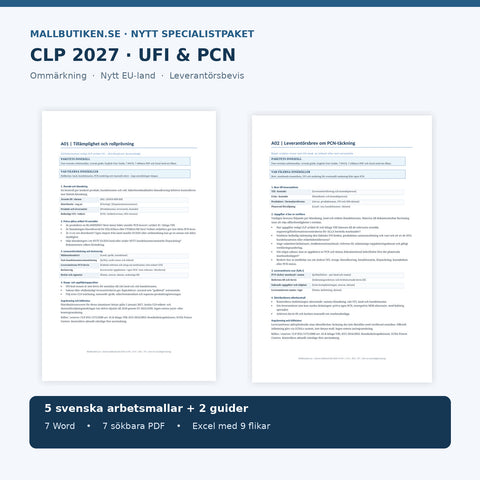
CLP 2027 – distributor UFI, PCN and poison centre documentation (Word/PDF/Excel) — For documented checks of trade names, countries, supplier evidence and UFI, this optional template pack can support your work. It does not file information with ECHA, generate a genuine UFI or certify compliance. The guide remains useful without buying the pack.
Official sources and review date
- CLP Regulation (EC) No 1272/2008, Article 45 and Annex VIII
- Amending Regulation (EU) 2024/2865
- Swedish Chemicals Agency – CLP questions and answers
- Swedish Chemicals Agency – poison centre notifications
- ECHA – distributor duties in poison centre notifications
- ECHA – supply-chain poison centre notifications
Editorial legal review: 11 November 2026. General guidance, not a real poison centre notification, chemical classification or personalised legal advice.