CLP in your online shop – hazard information before purchase and 2028/2030
What hazard information should an online shop show for chemical substances and mixtures? A practical guide to CLP Article 48, labels, SDS, Shopify mobile checks and EU dates.

Selling cleaning agents, glue, paints, solvents or other chemical substances or mixtures online? Depending on the offer, customers must see relevant hazard information before buying. A compliant package label or a link to a safety data sheet alone does not settle the online advertising requirements. This guide distinguishes rules already applicable from future CLP amendments and explains how to check a product page, its mobile view and advertisements.
Must hazard information be displayed online already in 2026?
Yes, where the existing CLP rules for advertisements of hazardous chemical products apply. The Swedish Chemicals Agency states that relevant hazard information must be visible on the site advertising the product before purchase. An online shop can constitute advertising under CLP Article 48. A mere link to a safety data sheet (SDS) is insufficient. Information targeting Swedish customers must be provided in Swedish. First determine whether the product is a substance or a mixture and whether customers are private or professional.
Substances versus mixtures: what information is required?
| Sales situation | Information to verify | Common mistake |
|---|---|---|
| Hazardous mixture offered for immediate consumer purchase | Display the types of hazard appearing on the actual label. The agency recommends full relevant hazard statements and also recommends pictograms and signal words. A readable image of the actual label may help. | Only writing 'hazardous', displaying a tiny unreadable image or providing an SDS link. |
| Hazardous chemical substance offered to consumers or professionals | Show hazard classes or categories corresponding to the substance's actual classification. | Copying generic mixture warnings without checking the substance's classification. |
| Mixture with supplementary hazard labelling | Check additional hazard statements, such as relevant EUH allergy wording even when there is no standard pictogram. | Assuming no pictogram means that no hazard message matters. |
| Professional sales with SDS duties | Assess REACH SDS supply duties separately. Make the packaging label, website information and SDS section 2.2 consistent. | Confusing the provision of an SDS with online advertising information. |
Hazard statements are standardised wording. A bare H-code or a demonstration image may mislead. Never invent hazard classifications, codes or pictograms. Use the actual current product label verified against the supplier's information.
CLP in 2026, 2028 and the proposal for 2030
| Date or process | Area concerned | Legal status on 11 November 2026 |
|---|---|---|
| Already applicable | Existing CLP advertising rules and relevant pre-purchase information for dangerous chemicals. | Applies now where relevant; do not wait to provide all hazard information. |
| 1 July 2026 | Selected parts of EU 2024/2865, including an EU-based responsible supplier, refill arrangements and fold-out labels. | Already applicable within their respective scope. |
| 1 January 2027 | Other specified amendments, including poison-centre information for certain distributors. | A different obligation from checking hazard text on a product page. |
| 1 January 2028 | Specified changes to advertising, distance selling and label formats under EU 2025/2439. | Published application date in the latest verified binding act for these provisions. |
| 2030, Omnibus VI | A provisional Council/Parliament deal in June 2026 proposed further delay. The Swedish Chemicals Agency says amendments were adopted on 22 October, but Official Journal publication was still expected. | Do not treat 2030 as a newly published binding date until the final act has been verified. |
Check the particular provisions and transition rules rather than relying on a single year. Earlier duties remain relevant despite future proposals.
How to review a real Shopify product page
Test the same SKU and selected variant in the product card, full page, mobile layout, cart and advertising channel. These are documentary checks, not an automatic legal approval or synthetic product classification.
| Control point | Evidence to preserve | Flag if |
|---|---|---|
| Label and SDS | Label version, supplier, dated SDS and section 2.2. | Classification, product ID or hazard wording conflict. |
| Desktop and mobile | Dated screenshots before purchase, locale, URL, variant and viewport. | Hazard wording is missing, hidden or unreadable. |
| Product photo | Readable actual label image, alternative text and product ID. | Wrong product image or unreadable hazard detail. |
| Ads and marketplaces | Ad copy, sales channel, targeted audience and date. | Ad information is inconsistent or insufficient. |
| Correction log | Issue ID, responsible person, change, retest and release decision. | No evidence of correction or older variants still displayed. |
Three situations requiring action
Consumer cleaning product
A dangerous cleaning mixture can be purchased from a product card displaying just price and a small photo. Compare its genuine hazard statements against the page and make information understandable before buying, including on mobile. An SDS link alone is insufficient.
Acetone sold as a substance to businesses
The product is a hazardous chemical substance, not a prepared mixture. Assess its hazard class and category under the currently applicable advertising provision and treat SDS distribution as a separate duty. Do not paste warnings copied from a consumer mixture.
Product with a supplementary EUH statement
A mixture lacks usual pictograms but carries supplementary allergy wording. The absence of icons does not mean the supplementary statement is irrelevant. Check the actual label and correct variant.
Seven-step process for online retailers
- Inventory SKUs and distinguish substances, mixtures and unrelated articles.
- Identify supplier role and intended consumers or professional customers.
- Request the genuine current label, documented classification and, where relevant, SDS section 2.2.
- Build a matrix of hazard wording, classes, EUH statements, recommended pictograms and what is legally required.
- Test Shopify desktop, mobile, variants, ads and marketplaces manually.
- Document screenshots, deviations, assigned correction owner and a retest; do not claim a fabricated compliance approval.
- Monitor publication of the Omnibus VI act and update dates only when the final legal position is established.
Frequently asked questions on CLP online
Must hazards be shown before checkout?
Yes when the online offer is covered by the existing CLP advertising rules. The agency explains that customers need relevant hazard information on the website before purchasing; assess substances, mixtures and audience separately.
Can I just link the safety data sheet?
No. An SDS does not replace required pre-purchase hazard information on the website. There may also be separate SDS supply obligations for professional customers.
Are hazard pictograms mandatory on every product page?
That depends on product and legal provision. For consumer mixtures the Swedish agency recommends pictograms and a signal word as well as a clear account of the hazard types. Do not turn a recommendation into a universal rule.
Are all CLP requirements postponed to 2028 or 2030?
No. Existing advertising duties and several revised provisions already apply. Certain new rules have a published 2028 date; the later 2030 process must be checked against a published final legal act.
Are UFI and PCN the same as hazard text on a product page?
No. UFI and poison-centre notifications address identification and reporting of dangerous mixtures under different CLP provisions. They do not replace product-page review.
Related document templates for CLP reviews
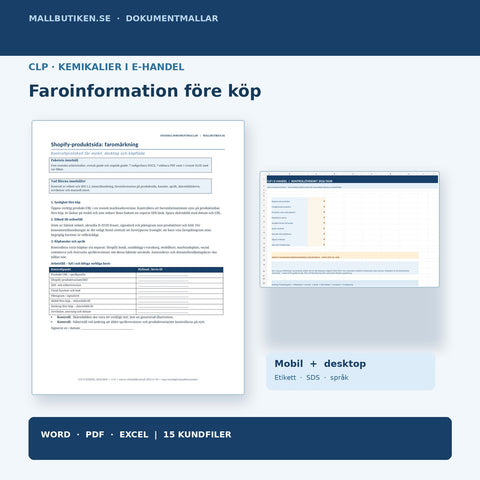
For documenting genuine product listings and deviations, the optional CLP online shop – hazard text, Shopify tests and label verification in Word/PDF/Excel can support your work. This guide is useful without buying anything. Templates do not classify chemicals, update Shopify automatically or certify compliance.
Official sources and review date
- CLP Regulation (EC) 1272/2008, Article 48
- Swedish Chemicals Agency – online hazard information
- Regulation (EU) 2024/2865
- Regulation (EU) 2025/2439
- Swedish Chemicals Agency – updated CLP rules
- EU Council – Omnibus VI provisional agreement
Editorial legal review: 11 November 2026. Verify Official Journal publication before applying future dates. General information, not individual legal advice, technical classification, authority approval or proof that a specific store complies.