
CSDDD 2026 after Omnibus I – which companies are covered and what needs to be done?

Short answer: The CSDDD has been simplified by Directive (EU) 2026/470. The mandatory scope has been concentrated to very large companies. For EU companies, the main threshold is now more than 5,000 employees and more than 1.5 billion euros in global net turnover. Member States must implement the rules by 26 July 2028, and they will largely begin to apply from 26 July 2029.
What is the CSDDD?
The Corporate Sustainability Due Diligence Directive regulates companies' obligations to work in a structured manner with negative impacts on human rights and the environment in their own operations, subsidiaries, and relevant parts of the value chain.
What does Omnibus I entail?
| Question | Status 2026 |
|---|---|
| Size threshold | More than 5,000 employees and more than 1.5 billion euros in global net turnover for EU companies according to the amended main scope following Directive (EU) 2026/470. |
| National implementation | By 26 July 2028. |
| Application | Primarily from 26 July 2029. |
| SME impact | Smaller companies may still face contractual and information requirements as suppliers, but are not automatically covered by the CSDDD as directly liable. |
What does a practical due diligence process look like?
For a concrete workflow involving supplier selection, targeted questions, and follow-up on deviations, read supplier assessment with ESG-DDQ and Corrective Action Plan (CAP). These tools are not generally mandatory forms.
- Map operations and the supply chain.
- Identify and prioritize actual and potential negative impacts.
- Integrate requirements into policy, procurement, and contracts.
- Use supplier code of conduct, DDQ, and documented risk assessment.
- Create corrective action plans where deficiencies are discovered.
- Implement a complaints/grievance process and follow-up.
- Document decisions, evidence, and follow-up so that the work can be audited.
Supplier contracts are not enough on their own
A Supplier Code of Conduct can be an important governance tool but should be linked to actual risk assessment, follow-up, escalation, and corrective actions. Merely obtaining a signature from a supplier is not the same as a functional due diligence process.
Frequently asked questions
Are SMEs directly covered?
As a general rule, no, not by the new direct scope thresholds. However, they may be affected as business partners to companies that are covered.
Is CSDDD the same as CSRD?
No. CSRD deals with sustainability reporting. CSDDD deals with due diligence and the management of negative impacts.
Should one start preparing before 2029?
Yes, for companies likely to be covered, supplier mapping, risk data, contracts, and processes represent multi-year work.
See Supplier Code & ESG Due Diligence 2026/2027.
Related guides
More work materials: See more templates for EU compliance and product regulations.
Sources
This guide provides general information and does not replace legal advice or a scope assessment for a specific group.
Templates in this article

Explore the topic
 Business guides – contracts, HR, AI & compliance
Supplier Assessment 2026/2027 – ESG, DDQ and Corrective Action Plan (CAP)
Practical guide for ESG supplier assessment: risk selection, DDQ questions, risk matrix, and Corrective Action Plan (CAP). The difference between v...
 Business guides – contracts, HR, AI & compliance
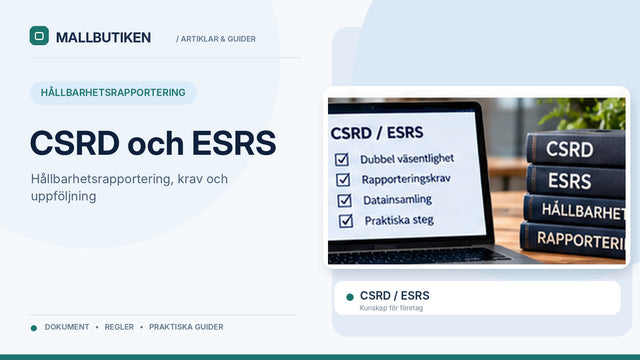
CSRD and ESRS 2026/2027 – which companies are covered after Omnibus I?
Guide to CSRD and ESRS after Omnibus I: new thresholds, double materiality, revised ESRS, and what companies should document in 2026/2027.
 Business guides – contracts, HR, AI & compliance
EUDR 2026/2027 – which companies are affected and how is due diligence conducted?
EUDR Guide 2026/2027 with current deadlines, product scope, roles, geolocation, risk assessment, risk mitigation, and due diligence statement.


