
CSRD and ESRS 2026/2027 – which companies are covered after Omnibus I?

Short answer: CSRD has been significantly amended by the EU's Omnibus I. Under the new rules, mandatory reporting is more concentrated on the largest companies. As a general rule, companies with more than 1,000 employees and a net turnover exceeding 450 million euros are affected. At the same time, in 2026, the EU adopted revised ESRS to reduce the reporting burden.
What changed with Omnibus I?
Directive (EU) 2026/470 amended both the CSRD framework and the rules on sustainability-related due diligence. For CSRD, the amendment means that mandatory sustainability reporting is aimed at a significantly smaller group of companies than under the original model.
| Question | Practical significance 2026 |
|---|---|
| Who is covered? | As a general rule, companies with more than 1,000 employees and a net turnover exceeding 450 million euros. |
| Which standard? | ESRS is used for companies that are covered. Revised standards were adopted by the Commission on July 3, 2026. |
| Smaller companies? | Companies outside the mandatory scope may report voluntarily, including using simplified standards. |
| Double materiality? | A central method that continues to apply: both the company's impact and the financial significance of sustainability issues must be analyzed. |
What is ESRS?
ESRS are the European Sustainability Reporting Standards. They structure information regarding environmental, social, and governance (ESG) issues. The revised standards from 2026 aim to maintain comparable and decision-relevant information while reducing unnecessary data points and administration.
How a company should prepare
- Determine scope. Check group structure, number of employees, and turnover against the current thresholds.
- Document double materiality. Describe the method, affected stakeholders, IROs (Impacts, Risks, and Opportunities), and priorities.
- Build data governance. Define owners for each data point, data source, control, and approval process.
- Create a disclosure index. Link relevant ESRS disclosures to the responsible function and supporting evidence.
- Manage value chain data proportionately. Document what supplier information is needed and why.
- Plan for assurance. Ensure traceable documentation and version control even before the report is finalized.
Common mistakes
- Using old CSRD thresholds without checking Omnibus I.
- Treating double materiality as a simple checklist without a documented analysis.
- Collecting large amounts of data before determining which disclosures are actually material.
- Confusing voluntary VSME-like reporting with mandatory ESRS reporting.
Frequently Asked Questions
Are all large Swedish companies covered by CSRD?
No. After Omnibus I, the new size criteria must be checked. Group rules and special situations can also affect the assessment.
Is ESRS the same thing as CSRD?
No. CSRD is the legal reporting framework. ESRS are the reporting standards that specify how disclosures are structured.
Do smaller companies need to do anything?
They may face information requirements from customers, banks, and larger companies even if they are not subject to mandatory CSRD themselves. Voluntary, proportionate reporting may therefore be relevant.
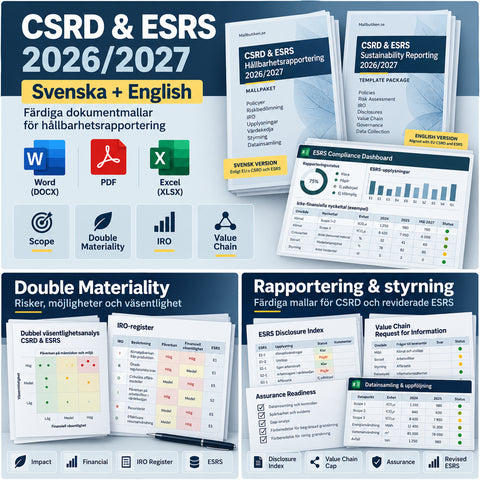
See the template package CSRD & ESRS Sustainability Reporting 2026/2027.
Related guides
- EU compliance for companies 2026/2027
- EUDR 2026/2027 – due diligence
- Environmental claims and greenwashing 2026
More working documents: See more templates for EU compliance and product rules.
Sources
The information provided is general and does not replace legal, accounting, or auditing advice in individual cases.
Templates in this article
Explore the topic
 Business guides – contracts, HR, AI & compliance
EU compliance for businesses 2026/2027 – guide to new EU regulations
Pillar guide to EU compliance 2026/2027: PPWR, ESPR/DPP, battery passport, CBAM, EUDR, greenwashing, Data Act, NIS2, and how companies can build a ...
 Business guides – contracts, HR, AI & compliance
EUDR 2026/2027 – which companies are affected and how is due diligence conducted?
EUDR Guide 2026/2027 with current deadlines, product scope, roles, geolocation, risk assessment, risk mitigation, and due diligence statement.
 Business guides – contracts, HR, AI & compliance
Environmental claims and greenwashing 2026 – what are companies allowed to say?
Guide to environmental claims and greenwashing 2026: Swedish Marketing Act, EU 2024/825, burden of proof, climate neutrality, net zero, sustainabil...


