Svenska Dokumentmallar
Supplier Code & ESG Due Diligence 2026/2027 – Swedish + English | CSDDD Readiness, DDQ & CAP Word/PDF/Excel
Supplier Code & ESG Due Diligence 2026/2027 – Swedish + English | CSDDD Readiness, DDQ & CAP Word/PDF/Excel
- File format
- DOCX, PDF, XLSX
- Document language
- Swedish
- Number of files
- 15
Digital download. No physical product is shipped.
Couldn't load pickup availability
About this template
Supplier Code & ESG Due Diligence 2026/2027 – complete 2-in-1 package in Swedish + English
A complete work and document package for companies wanting to build a professional, risk-based process for Supplier Code of Conduct, supplier due diligence, human rights, environmental risks, forced-labour risks, DDQ, CAP, audits, and grievances.
The package is specifically designed for procurement, compliance, ESG, legal, quality, and management. It serves both as a practical tool for companies already meeting customer or group requirements for supplier due diligence and as CSDDD-readiness ahead of upcoming national implementation.
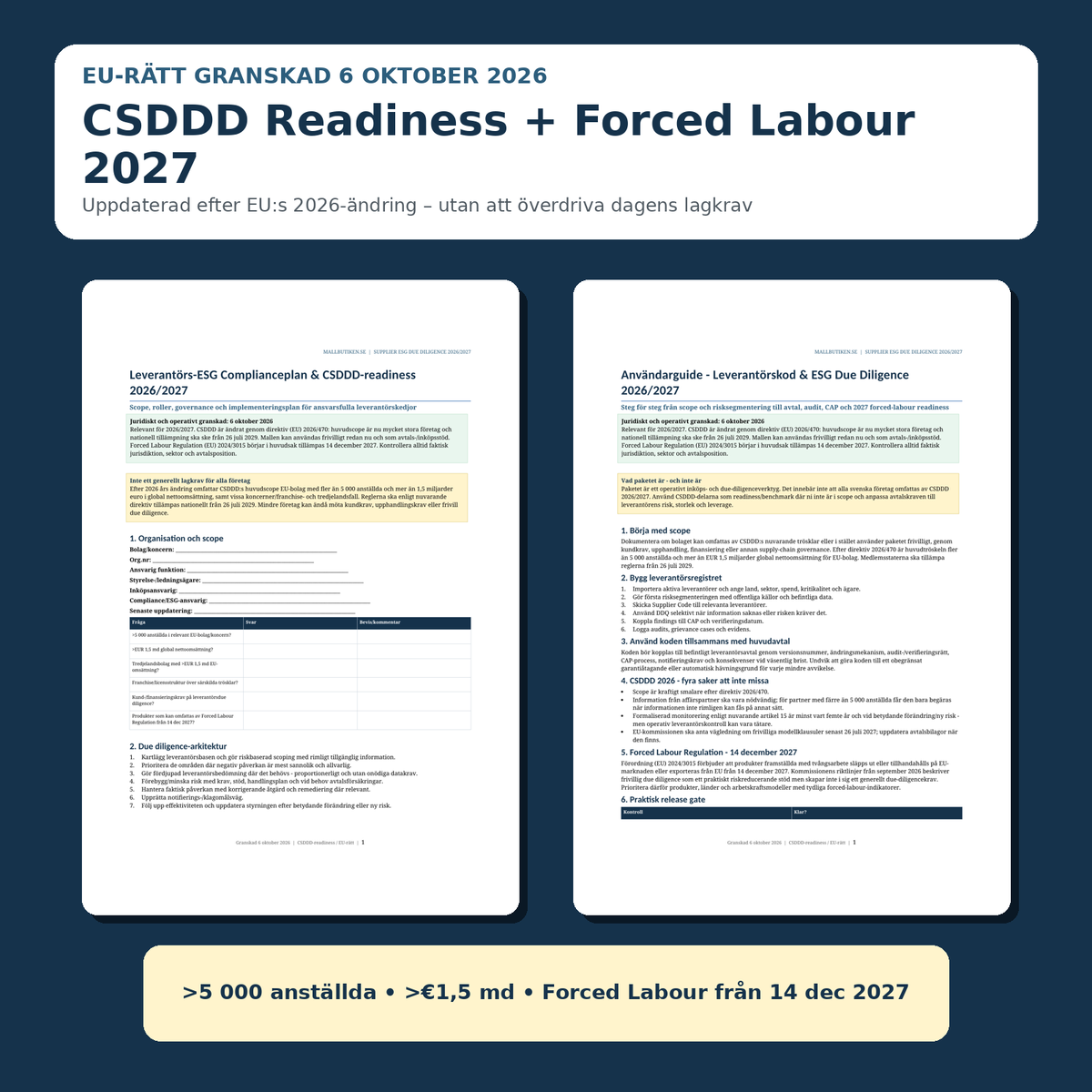
2-in-1: all seven documents are available in separate Swedish and English versions. You receive 14 document templates in Word + PDF, as well as an advanced Excel register – 29 delivery files in total.
The package has been updated according to Directive (EU) 2026/470, which amended the CSDDD's scope, data collection principles, monitoring, and application dates. It also considers Regulation (EU) 2024/3015 on products made with forced labour and the European Commission's guidelines published in September 2026. The package is relevant for 2026/2027 but should always be adapted to actual jurisdiction, sector, contractual relationship, and risk.
What is included in the package
| Document | Swedish | English | Usage |
|---|---|---|---|
| Compliance Plan & CSDDD-readiness | Yes | Yes | Scope, governance, roles, implementation, and 2027-readiness. |
| Supplier Code of Conduct | Yes | Yes | Human rights, working conditions, environment, ethics, notification, and CAP. |
| Supplier Due Diligence Questionnaire – DDQ | Yes | Yes | Risk-based supplier questionnaire with evidence fields. |
| Risk Assessment & Segmentation | Yes | Yes | Country, sector, workforce, complexity, evidence, and criticality. |
| Corrective Action Plan – CAP & remediation | Yes | Yes | Root cause, action, deadline, verification, remediation, and escalation. |
| Audit, Monitoring & Grievance Procedure | Yes | Yes | Audit program, evidence, findings, complaints, and review frequency. |
| Detailed User Guide | Yes | Yes | Step-by-step from scope to supplier register, CAP, and 2027-readiness. |
| Supplier ESG Due Diligence Register | Excel (XLSX) | Dashboard, supplier register, scoring, DDQ, CAP, audit, grievance, and forced-labour readiness. | |
The package begins with a supplier register and risk segmentation. More comprehensive DDQ, audit, and evidence requirements are used only where the risk profile warrants it. This is particularly important following the EU's 2026 amendment to the CSDDD, which explicitly limits unnecessary information requirements toward smaller business partners.
Separate from a standard supplier agreement
The template store already provides a separate supplier agreement for commercial terms such as price, delivery, warranty, SLA, liability, and ordering processes. This product serves a different function: responsible purchasing and documented supplier due diligence.
The Supplier Code can therefore be appended to an existing Supplier Agreement or accepted separately. The user guide describes how version numbers, audit/verification rights, the CAP process, notification requirements, and consequences for material breach can be linked to the main agreement without turning every minor deviation into an automatic ground for termination.
CSDDD following the EU's 2026 amendment – the right timeline and scope
CSDDD – Directive (EU) 2024/1760 – was materially amended by Directive (EU) 2026/470. For EU companies, the main threshold is now companies with more than 5,000 employees and more than 1.5 billion euros in global net turnover. Specific rules apply to groups, third-country companies, and certain franchise/license models.
According to the current text of the directive, Member States must adopt implementation rules by July 26, 2028, and apply them from July 26, 2029. The product is therefore deliberately marketed as CSDDD-readiness for 2026/2027 – not as if every Swedish company already had a statutory CSDDD requirement.
Information requirements toward smaller suppliers
Directive (EU) 2026/470 limits the trickle-down effect. In in-depth assessments, information from business partners should only be requested when necessary. For business partners with fewer than 5,000 employees, information under the new model should only be requested when it cannot reasonably be obtained in another way.
This is built into the package's approach: use public sources, existing evidence, and certifications first, and then send a targeted DDQ when risk or an information gap actually justifies it.
Monitoring
Following the 2026 amendment, Article 15 of the CSDDD specifies that formal periodic assessments should be conducted after significant changes, in the event of new risks, and at least every five years. Operational procurement work may simultaneously require more frequent review of high-risk suppliers. Therefore, the Excel register allows the user to set an individual review frequency.
Voluntary model clauses
Under the amended CSDDD, the European Commission is to adopt guidance on voluntary model clauses by July 26, 2027. The package is therefore version-controlled so that contractual appendices can be updated once this guidance is available.
Forced Labour Regulation – important already during 2027
Regulation (EU) 2024/3015 prohibits products made with forced labour from being placed or made available on the EU market or exported from the EU. The regulation primarily begins to apply on December 14, 2027.
The European Commission's guidelines from September 2026 contain practical guidance on voluntary due diligence regarding forced labour. The guidelines do not in themselves create a general due diligence requirement, but describe how companies can mitigate risk through, for example, supplier policies, risk-based screening, contractual requirements, worker voice, audits, corrective actions, and follow-up.
The Excel register therefore contains a separate sheet for Forced Labour Readiness covering, among other things, recruitment fees, migrant/staffing risk, state-imposed labour, traceability, and high-risk indicators.
Supplier Code of Conduct – ready-to-use supplier code
The Supplier Code covers, among other things:
- a prohibition on forced labour, human trafficking, and improper recruitment fees,
- child labour and protection of young workers,
- discrimination, harassment, and retaliation,
- freedom of association and collective bargaining,
- working hours, rest, wages, and overtime,
- occupational health and safety,
- environmental permits, chemicals, waste, emissions, and resource risk,
- bribery, fraud, conflicts of interest, and business ethics,
- sanctions, export control, and competition law,
- sub-suppliers and risk-based cascading,
- notification, audit, CAP, and remediation.
Supplier DDQ – questions when the risk profile requires more input
See our practical guide to ESG supplier assessment with DDQ, risk matrix, and action plan (CAP). It explains how information can be collected proportionally and followed up, and distinguishes voluntary methodology from future CSDDD requirements.
The DDQ template contains fields for company profile, production countries, ownership structure, workforce, staffing, migrant labour, recruitment fees, identification documents, working hours, wages, child labour, working environment, environmental permits, sub-suppliers, whistleblowing, anti-corruption, and risk management.
The point is not to collect the maximum amount of data. The user guide shows how the DDQ is used selectively for medium/high-risk suppliers or when public and existing sources are insufficient.
Risk assessment with a practical 1–5 model
The separate risk template and Excel file assess six main factors:
- country/region,
- sector/commodity,
- workforce model,
- supply chain complexity,
- evidence quality,
- criticality and leverage.
Excel automatically calculates the total score and risk class Low / Medium / High / Critical, while professional assessments are still documented in free text.
CAP, remediation, audit, and grievance
The Corrective Action Plan includes root cause, action, responsible party, deadline, verification method, residual risk, and remediation assessment. There is also support for decisions regarding continued relationships, order stops, suspension, or controlled termination.
The audit/monitoring template includes desktop, remote, on-site, and independent audits, worker interviews, evidence protocols, findings, severity, and a grievance log. This makes the package useful even for companies that are not subject to CSDDD but want a robust procurement governance process.
Advanced Excel register for the entire supplier process
The Excel workbook contains:
- Dashboard – KPI for suppliers, risk, DDQ, CAP, audits, grievances, and forced-labour readiness.
- Supplier Register – country, category, spend, criticality, Code acceptance, and responsible party.
- Risk Assessment – six risk factors with automatic total score and risk class.
- DDQ Tracker – sent/received DDQ, results, evidence quality, and follow-up.
- Code Acceptance – version control and connection to the main agreement.
- Findings & CAP – deviation, root cause, action, deadline, and remediation.
- Audit Register – planned/executed audits and next review.
- Grievances – notifications, worker voice, and investigation status.
- Forced Labour Readiness – special 2027 preparation.
- Evidence Checklist and Sources.
Frequently asked questions
Does CSDDD already apply in 2026 to all Swedish companies?
No. Following the 2026 amendment, the CSDDD's main scope is much narrower and, according to the current EU directive, Member States' implementation rules are to be applied from July 26, 2029. The package is therefore clearly labeled as CSDDD-readiness for when the company does not already have other contractual or customer-driven obligations.
Can a smaller company use the package?
Yes. The package is explicitly built for proportional use. Smaller companies can use the supplier code, risk register, DDQ, and CAP based on their actual risk and resource level.
Does the Supplier Code replace a supplier agreement?
No. The Supplier Code primarily regulates conduct, due diligence, and risk. Commercial terms should be in a separate supplier agreement.
Are Swedish and English included?
Yes. All seven documents are available as separate Swedish and English versions.
Is Excel included?
Yes. A complete XLSX register with dashboard and operational follow-up is included.
Is the Forced Labour Regulation a general due diligence requirement?
The regulation prohibits products made with forced labour from the EU market/export. The Commission's 2026 guidelines on due diligence are advisory and voluntary in themselves. The package uses them as practical risk-mitigating support.
Format and delivery
- 14 document templates – 7 Swedish + 7 English.
- 14 DOCX + 14 PDF + 1 XLSX = 29 files in total.
- Word (DOCX) + PDF + Excel (XLSX).
- 30 A4 pages per Word/PDF format series across Swedish + English.
- Digital product – no physical goods are sent.
Legal basis and official sources
- CSDDD – consolidated directive text, March 18, 2026
- Directive (EU) 2026/470
- EU Council – simplification of sustainability due diligence 2026
- Regulation (EU) 2024/3015 – Forced Labour Regulation
- EU Commission Forced Labour Guidelines, September 2026
- OECD Due Diligence Guidance for Responsible Business Conduct