
Plan club events – permits, venue, safety and registration
Plan a club day, market, or activity with the right documents: event plan, participant registration, venue booking, safety plan, and emergency procedures. Includes a checklist and official sources.

To plan an organization event, you need to coordinate activities and responsibilities, check the venue and any permits, manage registrations, and assess safety risks. An event plan brings the work together. Then you choose specific documents for participants, the venue, safety, and emergency preparedness according to the actual needs of the activity.
An internal course, an organization day, and an open market have different requirements. This guide helps you choose documents before you order or carry out anything. It does not replace decisions from authorities or a site-specific safety assessment.
Which documents does the organizer need?
| Situation | Document support | Use |
|---|---|---|
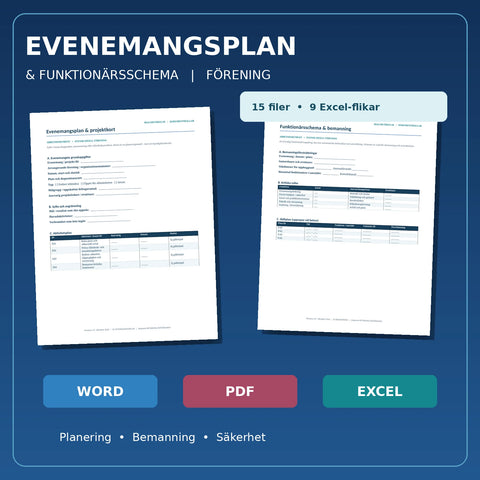
| Overall plan and volunteer schedule | Event plan and volunteer schedule | Timeline, tasks, responsibilities, staffing, and follow-up. |
| Activity with participant places and registrations | Registration and participant administration | Venue notification, waiting list, cancellation, and limited personal data processing. |
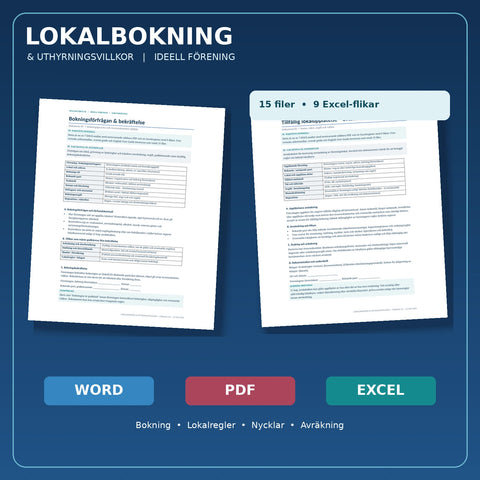
| Booking or temporary provision of a venue | Venue booking and rental terms | Confirmation, house rules, keys, and return. |
| Event with risks or authority conditions | Safety plan and incident report | Risk assessment, preparedness, incidents, and control of measures. |
| Disruptions, canceled activity, or collective communication | Crisis plan and crisis communication | Decision-making roles, communication channels, order of information, and restart. |
1. Determine purpose, decision-making mandate, and responsibility
Write down goals, target audience, date, venue, budget, estimated number of participants, and who is responsible for the event. Specify the person responsible and the time for bookings, permit checks, marketing, purchases, volunteer shifts, and conclusion.
Check the organization's bylaws and actual decision-making order before anyone signs a binding agreement. An event plan does not automatically give an external volunteer full authority. For voluntary work, the guide on volunteer agreement, volunteer schedule, and certificate can complement event planning.
2. Find out if a permit or registration is required
According to Chapter 2 of the Public Order Act (1993:1617), there are special rules for public gatherings and public events. Concerts, markets, and certain competitions may be covered, depending on the nature of the event and public access. The venue and safety conditions also play a role. There is no general exemption just because the organizer is a non-profit organization.
The police authority's service for events describes when the application or registration should be made and what information may be needed, for example, a site plan and safety information. Further rules may apply to alcohol, food, traffic, and special arrangements. Therefore, investigate the actual permit requirements of the activity before promising participants that the event can be carried out.
3. Check the venue and its conditions
Confirm who provides the venue, which areas are included, when keys are handed over, who is responsible for cleaning, technology, and damages, and what rules apply to participant numbers, accessibility, and evacuation. A booking form does not replace a check of the venue's actual suitability.
An agreement for the provision of a house or part of a house for compensation may be covered by Chapter 12 of the Land Code, even if the organization calls the agreement a "booking". In a real venue rental situation, the correct form of contract must be used.
4. Collect registrations – but no more personal data than necessary
A registration form should clarify the event, time, venue, conditions for participation, any fees, cancellation, and who is contacted. Only collect information that is needed for the specified purpose. A waiting list should not automatically give other participants access to a person's private contact details.
The organization needs a legal basis for processing, clear information, and appropriate security according to GDPR. IMY's guidance on non-profit organizations' personal data covers, among other things, purpose, membership and participant data, personal identity numbers, and sensitive data. Children's data requires special consideration. Also determine the storage period and how correction or deletion should be handled.
Cancellation and refund terms must fit the actual service and applicable consumer law. Do not generally claim that a participant always has or never has a right of withdrawal.
5. Create a site-specific risk and safety plan
Investigate risks that are truly relevant: for example, crowding, weather, evacuation, fire, electricity, falls, traffic, food service, or lack of a responsible volunteer. Describe the preventive measure, who is responsible, how the control is carried out, and how the remaining risk is managed. The risks and control points for a small internal course are not necessarily the same as for a large public event.
The Swedish Defence Research Agency's Safety Guide for Events goes through safety organization, risk analysis, communication, and preparedness. Use it for in-depth study when the size and risk situation justify it. The police can also issue special conditions that the organizer must follow.
6. Distinguish between a safety plan and a crisis plan
A safety plan is about preventing and managing risks during the event. A crisis plan helps the organization organize decisions and communication in the event of a major disruption, a serious disturbance, or a canceled activity. Specify who leads, who contacts the authorities, participants, and venue managers, and who is allowed to communicate externally.
Neither the crisis plan nor the safety plan is an authority approval. If an authority has issued special instructions or conditions, the organization must follow them.
Example: choose the right level of ambition
A membership course in the organization's venue
The organization books a venue, accepts a limited number of registrations, and appoints a course manager. Check the venue's use, any fees, personal data processing, and actual risks. Five separate template packages are not automatically needed for a small course.
A market inviting the public
The organization first needs to check permits with the police authority, book the venue, distribute responsibilities, manage registrations, and create a real safety plan. If the audience, weather, or technology poses special risks, preparedness and communication need to be strengthened. Conclude with a deviation report and actual follow-up.
What does research show about larger crowds?
Chowhan et al. (2026) compiled 13 studies on measures to reduce crowd-related risks at large public gatherings. The studies consisted mainly of observational studies, simulations, or quasi-experiments. Combined efforts for venue design, organization, security, and trained staff were associated with better flow metrics, but the authors called for stronger effect studies. This does not prove that a certain form creates safety in smaller organization events. Read the overview in Public Health Reviews.
Organizer's final checklist
- Appoint a responsible person, decision-making level, and budget.
- Check permit and registration requirements for the actual activity.
- Confirm venue, booking terms, technology, and evacuation.
- Create clear registration terms and a data protection assessment.
- Prepare work distribution, schedules, and communication channels.
- Assess risks and specify preventive measures and preparedness.
- Check any authority decisions and special conditions.
- Follow up on incidents, costs, return, and improvements.
Official sources
- Swedish Parliament: Public Order Act (1993:1617), especially Chapter 2.
- Police Authority: Permits and registration for events
- Swedish Defence Research Agency: Safety Guide for Events
- IMY: Non-profit organizations' processing of personal data
- IMY: Data protection requirements for non-profit organizations
- Swedish Parliament: Land Code (1970:994), especially Chapter 12.
Templates in this article

Explore the topic
 Business guides – contracts, HR, AI & compliance
Volunteer at a non-profit organization – agreement, schedule and certificate
How does the organization document a volunteer assignment from start to finish? Compare the agreement, official schedule, timesheet, and volunteer ...


