
Special invoice credit or BNPL in Sweden? The 14/50-day rules for 2026

Short answer: a free-of-charge invoice issued as credit by the seller may qualify as a 'special invoice credit' under Sweden's Consumer Credit Act (2026:1011). Several provisions, including the creditworthiness assessment rules in Chapter 3, Sections 13–16, then have express exceptions. An invoice issued through an independent buy-now-pay-later (BNPL) creditor does not automatically qualify. Check the actual creditor, the price of credit, repayment period and assignment of the receivable.
The adopted law starts applying on 20 November 2026; the earlier 2010 Act generally governs credit contracts concluded before that date, subject to specific transitional exceptions such as for certain open-ended contracts. This guide concerns consumer credit in Sweden, not business-to-business invoicing or payments from the customer's own funds.
1. When is an invoice a special invoice credit?
The definition is in Chapter 1, Section 3. The payment label shown by a checkout is not decisive. All applicable conditions must be met.
| Condition | Smaller seller | Seller that is not smaller, entering online distance contracts |
|---|---|---|
| Who grants the credit? | The seller itself | The seller itself |
| Interest and credit fees | None | None |
| Repayment from delivery | Within 50 days | Within 14 days |
| Sale of the receivable during the credit term | No additional restriction in this particular part of the definition; other law still applies | The receivable must not be sold during the term |
| Legal result | If conditions are met, specific statutory exceptions apply; the credit is not outside every rule | The same, but the stricter online conditions also apply |
No credit costs means no credit interest or fees such as invoice or notice fees. The actual legal creditor matters: an administration service alone does not necessarily determine the classification.
2. How is a smaller business defined?
A 'smaller business' has fewer than 250 employees AND meets at least one financial threshold: annual turnover no higher than EUR 50 million OR annual balance-sheet total no higher than EUR 43 million. Both the headcount and one of the financial tests are necessary. Document which legal entity and figures were assessed; complex group situations may need specialist review.
3. Seller invoice vs third-party BNPL vs direct payment
Seller's own invoice: the seller extends the credit. Verify the complete definition. A 30-day invoice in a large online store cannot be assumed to qualify.
Third-party BNPL or instalments: another provider extends credit or acquires the claim under the actual contract. Since special invoice credit must be granted by the seller itself, independently assess the structure, the creditor's duties and whether the store is a credit intermediary.
Direct payment: a card or other payment without a credit element should not be confused with a credit sale. Record the actual mechanics of each method.
4. When is creditworthiness assessment required?
For relevant ordinary consumer credit, Chapter 3, Sections 13–14 require thorough assessment of financial capacity with appropriate information and verification. Under Chapter 3, Section 19, Sections 13–16 do not apply to a special invoice credit. It would therefore be misleading to say all free seller invoices require exactly the same assessment. When the special classification fails, reassess the applicable rules and each actor's obligations.
The exceptions are section-specific, including Chapter 2, Section 9, Chapter 3, Section 19 and Chapter 5, Section 7; they do not cancel every consumer protection obligation, the rule on sound credit conduct or separate payment-services law. The Swedish Financial Supervisory Authority's general guidelines FFFS 2026:32 start applying on 20 November 2026, but guidelines should not be confused with binding statutory requirements.
5. No preselected credit at online checkout – an older rule
Chapter 7a, Section 1 of Sweden's Payment Services Act (2010:751) requires a non-credit payment choice to be shown first when available and prevents preselecting credit when alternatives exist. This rule was introduced in 2020, NOT by the new 2026 Act. Test the real mobile and desktop checkout and identify the payment-service provider responsible for the interface.
6. Seven steps to document checkout compliance
- Inventory the actual choices: card, Swish, seller invoice, BNPL and instalments, distinguishing credit from non-credit.
- Identify the legal creditor from contracts and terms, and document any intermediation or compensation paid by the creditor.
- Classify the seller's own invoice using credit fees, time from delivery, business-size thresholds and any sale of the receivable.
- Record information visible before agreement: costs, terms, disclosures and screenshots. Assess which credit-information duties actually apply.
- Test payment order and preselection in real mobile and desktop checkouts, including the first non-credit choice.
- Obtain written evidence from payment or credit partners of role allocation, assessments, consumer information and any licences; their statement cannot replace an independent role review.
- Record the decision, owner, date, evidence, remaining gaps, corrective action and post-deployment checks.
7. Two borderline scenarios
Scenario A: small retailer using its own invoice
Assume 20 staff and turnover below EUR 50 million. The store itself grants interest- and fee-free credit due 30 days after delivery. If the full legal terms match, this may be special invoice credit. Document the analysis and comply with the provisions that remain applicable.
Scenario B: large retailer using external BNPL
Assume 400 staff and a 30-day pay-later option provided by a third party. Calling it an 'invoice' does not turn it into the seller's special invoice credit. A large seller's own online invoice instead faces the 14-day limit and restriction on selling the receivable; a genuine external creditor requires separate role and credit-law analysis.
8. Frequently asked questions
Do all invoices require a creditworthiness check from 20 November 2026?
No. Chapter 3, Section 19 exempts special invoice credit from Sections 13–16. Other invoice or BNPL arrangements require their own legal analysis.
Is every 30-day invoice exempt?
No. The creditor must be the seller, the credit must be free of charge and size/time conditions must hold. Larger online sellers face the special 14-day and receivable conditions.
Does every Shopify store displaying BNPL need an FI licence?
Not automatically. Actual credit granting or paid intermediation matters. Permission and supervision under the separate LVBK rules require individual assessment.
Is the ban on preselected credit new in November 2026?
No. The applicable online-checkout payment-selection rule has existed in Chapter 7a of the Payment Services Act since 2020.
9. Official sources and limitations
- Swedish Consumer Credit Act (2026:1011), Chapter 1 §3, Chapter 2 §9, Chapter 3 §§13–14, 19, and transitional provisions.
- Payment Services Act (2010:751), Chapter 7a §1.
- Swedish Consumer Agency guidance.
- Swedish Financial Supervisory Authority's role guidance.
Editorial review of legal sources: 11 November 2026. Swedish/EU legal information only, not individual advice or a certification of any checkout. Verify the legal position again before publication and obtain professional assessment when credit classification or licensing is uncertain.
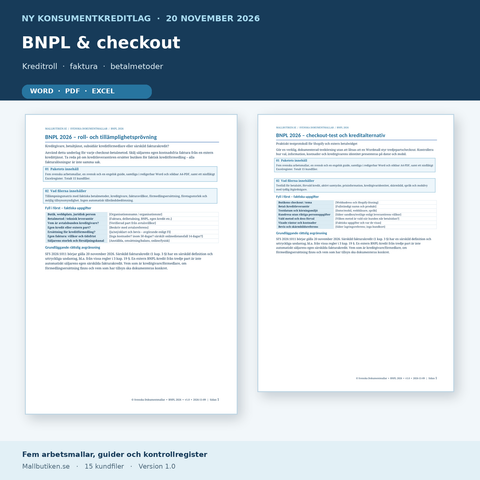
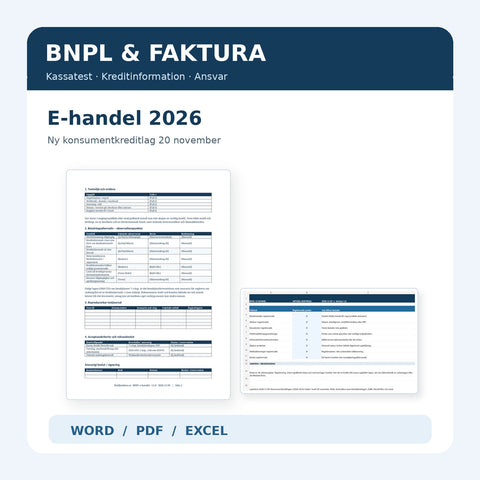
Templates in this article
Explore the topic
 Business guides – contracts, HR, AI & compliance
General Terms and Conditions for E-commerce 2026 – what must be included?
Guide to general terms and conditions for Swedish e-commerce 2026: information requirements, pricing, payment, delivery, complaints, right of withd...


