
Strengthened forced heirship protection 2026 – when a gift can be equated with a will

Can a parent give away almost all of their property and thereby reduce a child's statutory share? As a main rule, a gift is permitted even if the heirs would have received more money through a later inheritance. However, according to Chapter 7, Section 4 of the Inheritance Code, a gift can, under special circumstances, be equated with a will. If it then infringes on a forced heir's statutory share, the recipient of the gift may need to return the property or compensate for its value. This is called reinforced protection of the statutory share. It is a different rule than the standard deduction of an advance on inheritance.
Fact-checked October 19, 2026. Sources: The Inheritance Code (1958:637), particularly chapters 6 and 7, Supreme Court ruling NJA 2022 p. 277, and the case NJA 2009 p. 717. The text provides general information about Swedish law; it is not an assessment of a specific gift, estate inventory, or an ongoing statute of limitations period.
What does reinforced protection of the statutory share according to Chapter 7, Section 4 entail?
A forced heir is a descendant of the deceased, for example, a child or grandchild who has stepped into the place of their parent. According to Chapter 7, Section 1 of the Inheritance Code, the forced heir's statutory share is half of the inheritance portion provided by law. The statutory share provides protection against, among other things, wills, but in certain specific situations, also against gifts that, in their purpose, function as testamentary dispositions.
The provision in Chapter 7, Section 4 states that when the deceased, during their lifetime, has given away property under such circumstances or conditions that the gift, in terms of purpose, can be equated with a will, the corresponding protection of the statutory share shall be applied, unless special reasons speak against it. When calculating the statutory share, the value of the gifted property must then be added to the estate according to the legal rule.
There is no general limitation on the right to give gifts. That one sibling received a larger gift than another is not in itself sufficient for restitution. It requires an assessment of the gift's true purpose, conditions, and the circumstances under which it was given. An ordinary distribution of inheritance, a common monetary gift, and a will-like arrangement are therefore three separate issues.
Advance on inheritance and reinforced protection of the statutory share – two different rules
| Issue | Advance on inheritance, Chapter 6 | Reinforced protection of statutory share, Chapter 7, Section 4 |
|---|---|---|
| Main function | Deducts a previous gift from the recipient's future inheritance portion | Protects a forced heir's statutory share against certain will-like gifts |
| Prerequisite | A gift to a forced heir is presumed to be an advance unless otherwise prescribed or apparent | Special circumstances must make the gift comparable to a will |
| If something is to be returned | Normally no restitution of surplus if the advance is larger than the inheritance portion, unless otherwise agreed when the gift was given | Restitution or compensation for value can be ordered to the extent required for the statutory share |
| Process | Deduction is normally investigated when calculating inheritance portions and estate distribution | The party making a claim against the gift recipient must file an action within one year after the estate inventory is concluded |
Read our broader guide on advance on inheritance, deduction, and deeds of gift for Chapter 6 and calculation examples for two and three children. Here, we instead delve deeper into standing to sue, evidence, and gifts in anticipation of death.
When can a gift be considered to have the same purpose as a will?
In NJA 2022 p. 277, the Supreme Court describes two recurring typical situations. One is that the donor expects death within the near future. The other is that the conditions of the gift mean that the donor retains the primary benefit of the property during their lifetime, for example, a strong reservation regarding personal use of what was transferred. A gift can then, in practice, resemble a distribution of property only upon death.
However, the court also emphasizes that these situations are not exhaustive. Statements, actions, and other circumstances that show that the donor wished to disadvantage a forced heir rather than help the recipient can be significant. A comprehensive assessment is always required; a single condition or a high sum does not automatically decide the matter.
- What purpose did the donor describe at the time the gift was given?
- Did the donor retain the right to the home, right of use, yield, or practical control over the property?
- When was the gift completed in relation to illness, death, and other relevant events?
- Did the transfer affect the donor's actual ability to use their property during their lifetime?
- Are there documents or witness statements regarding the intention to reduce a certain forced heir's statutory share?
What has the Supreme Court said about gifts that infringe on the statutory share?
NJA 2022 p. 277 – gifts to one child to disadvantage another
The Supreme Court found that monetary gifts from a parent to one of two children, against the background of the special circumstances and the donor's intent to disadvantage the other child, should be equated with a will. The gifts should therefore be returned to the extent required for the other child's statutory share. The ruling shows that the overall intent of the gift can be decisive even outside the two classic typical cases. Read the Supreme Court's official summary.
NJA 2009 p. 717 – when does the statute of limitations begin to run?
The Supreme Court case NJA 2009 p. 717 deals with how the one-year deadline according to Chapter 7, Section 4 is to be applied when the registration of the estate inventory has later been cancelled. The case underlines that the conclusion of the estate inventory and the issue of registration are not necessarily the same point in time. Anyone considering an action should therefore investigate the last day of the proceedings and any special procedural events, instead of calculating the deadline from when the document happened to be registered with the Swedish Tax Agency.
Deadlines: gift according to 7:4 compared to contesting a will
| Situation | Main deadline according to the law | What is required? |
|---|---|---|
| Gift to be equated with a will according to Chapter 7, Section 4 | One year from the concluded estate inventory | The forced heir must file an action against the gift recipient within the deadline |
| Contesting an actual will according to Chapter 7, Section 3 | Six months from notification of the will according to Chapter 14 | The forced heir can present claims to the beneficiary or file an action within the deadline |
| Standard deduction of advance on inheritance according to Chapter 6 | Not the same special one-year process as in 7:4 | Normally assessed in connection with inheritance portion calculation and estate distribution |
What evidence might be needed regarding the purpose of the gift?
In a dispute, it is especially important to distinguish between what someone believes the donor wanted and what can actually be proven. A deed of gift may state formal conditions, but the purpose can also appear from contemporary letters, emails, messages, powers of attorney, bank documents, or witness statements. For gifts of real estate, a reservation of continued use may be relevant, but it is not in itself an automatic confirmation of an infringement of the statutory share.
A practical timeline can include dates for the decision to give the gift, transfer, completion, any usage conditions, illness, death, estate inventory proceedings, and correspondence regarding the transfer. The person who received the gift may correspondingly need to show that there was a true lifetime purpose, for example, financial support or a real and immediate change of ownership.
Questions regarding burden of proof and evaluation of evidence must be assessed based on the specific dispute. The guide does not provide a guarantee that a certain type of document is sufficient before a court.
Simplified calculation example: large gift before death
Assume that a person leaves 200,000 SEK after debts and has two children with the same right of inheritance. Before death, the person gave 800,000 SEK to an outsider. Without an applicable rule on will-like gifts, each child in this simplified case receives 100,000 SEK from the estate.
If – and only if – a court after examination finds that the gift should be treated according to Chapter 7, Section 4, the value of the gift may need to be included in the calculation of the statutory share. The illustrative calculation mass then becomes 1,000,000 SEK. The children's hypothetical inheritance portions become 500,000 SEK each, and the statutory shares 250,000 SEK each. If the children only receive 100,000 SEK each from the estate, there may thus be a potential shortfall of 150,000 SEK per child to be legally tested.
The example shows the principle, not an amount that can be automatically claimed. Real calculations are affected by, among other things, valuation, the heirs' position, previous gifts, matrimonial property division, wills, and the exceptions of the law. When the recipient is themselves a forced heir, Chapter 6 and the deduction against their own inheritance right may also need to be analyzed collectively.
What can the gift recipient be obliged to return?
Chapter 7, Section 4, first paragraph prescribes that when the gift needs to be reduced to protect the statutory share, the corresponding part of the gifted property must be returned or, if that cannot be done, compensation for its value must be paid. This does not happen automatically through an objection in the estate inventory and does not always mean the entire gift is returned.
The law also contains an exception when special reasons speak against the application of the provision. If the gift was not yet completed at the time of death, there are additional rules in Chapter 7, Section 4. The dispute therefore needs to be investigated following the actual gift transfer, any conditions, and all other relevant property.
Can one write in the deed of gift that the gift is not an advance on inheritance?
Yes, a donor can, in principle, prescribe that a gift to a forced heir should not be deducted as an advance on inheritance according to Chapter 6, Section 1. It can be important to document this clearly in the deed of gift. However, such a condition does not entail a guarantee against the application of Chapter 7, Section 4 if the gift, in reality, has a purpose that equates to a will and leads to an infringement of the statutory share.
It is also important to distinguish conditions regarding separate property from conditions regarding advance on inheritance and from the rules regarding statutory share. These have different legal effects. For help with formulating a clear gift condition, the Mallbutiken gift deed package on advance on inheritance can be used as document support. A template cannot determine in advance how a future court will assess the actual purpose of the gift.
Checklist for forced heirs and gift recipients
- Check that you are a forced heir and identify the relevant inheritance portions and statutory shares.
- Retrieve the estate inventory's proceeding date and clarify when the proceedings were concluded.
- Check if there is a will with a separate six-month deadline.
- Identify the gift: recipient, date, property, value, completion, and conditions.
- Distinguish standard deduction of advance according to Chapter 6 from a claim according to Chapter 7, Section 4.
- Gather contemporary communication about the donor's purpose and any right-of-use conditions.
- Prepare a preliminary statutory share calculation, including the value of the current gift where the law requires it.
- Seek individual legal advice as soon as possible if the special one-year deadline is still running.
- File any action in time; do not assume that letters or estate inventory notes are sufficient.
- If the gift is to remain: clearly document conditions, transfer, and real lifetime purpose.
Common questions about gifts and reinforced protection of the statutory share
Is a large gift to a child always illegal?
No. The size alone does not decide. However, a gift can, under special circumstances, be judged as will-like according to Chapter 7, Section 4.
Can a child demand back a gift that a sibling received?
In some cases. If the gift, after examination, is covered by reinforced protection of the statutory share and has infringed on the child's statutory share, restitution or compensation for value may come into question.
Is it enough to say that the gift should not be an advance on inheritance?
No, that formulation concerns deduction according to Chapter 6, not automatically the separate protection for will-like gifts according to Chapter 7, Section 4.
Is the deadline always one year from registration with the Swedish Tax Agency?
No. The law counts from when the estate inventory was concluded. The time of registration may not automatically be used as a starting point. See NJA 2009 p. 717.
Does the six-month deadline for a will also apply to gifts?
No, gift disputes according to Chapter 7, Section 4 have their own specific one-year deadline for action against the gift recipient. Contesting a will according to Chapter 7, Section 3 has a separate deadline.
Can a gift to a person who is not a child be reviewed?
Yes, the rule can become relevant even if the gift recipient is an outsider. The decisive factor is, among other things, a will-like purpose and infringement of a forced heir's statutory share.
Do I need a deed of gift?
It depends on what is being given away. Written conditions and documentation are often valuable; gifts of real estate and tenant-owner rights also have special formal requirements. See our guide on deeds of gift and formal requirements.
Document support for gift conditions and future estate distribution
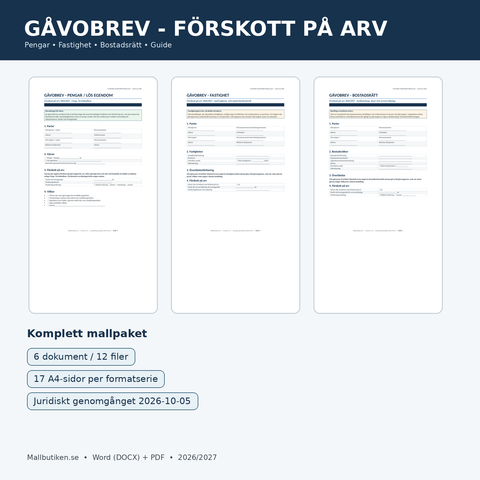
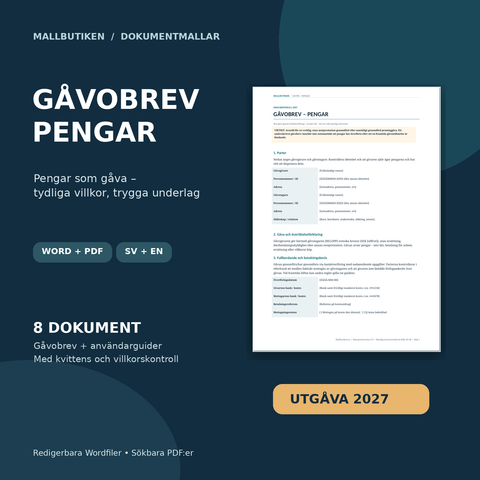
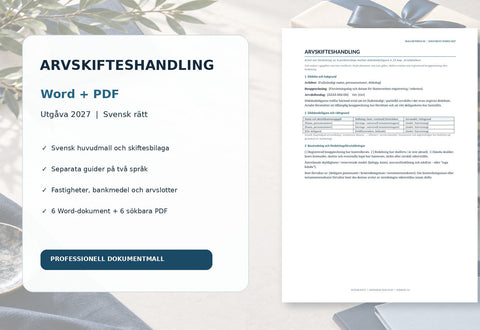
Mallbutiken offers templates for deeds of gift, advance on inheritance, monetary gifts, and estate distribution documents. They can help clarify who gave what, whether the gift should be deducted from future inheritance, and how property is distributed. No template overrides a forced heir's statutory right according to Chapter 7, Section 4 and the templates do not replace legal counsel in a dispute.
Deed of gift and advance on inheritance – Word/PDF · Deed of gift for money · Estate distribution document with distribution attachment
Related articles
- Advance on inheritance – main rules, deduction, and statutory share
- Deducting advance on inheritance for two and three children
- How gifts to children affect future inheritance
- Deed of gift – formal requirements, conditions, and tax
Official legal sources and court practice
- The Swedish Parliament: Inheritance Code (1958:637) – Chapter 6, Sections 1–6 and Chapter 7, Sections 1–4.
- Supreme Court: NJA 2022 p. 277, case T 6974-20 – will-like gifts to one child to disadvantage another.
- Supreme Court: NJA 2009 p. 717 – application of deadline for action in estate inventory.
- Google Search Central: links and anchor text – technical resource for internal linking.
Templates in this article
Explore the topic
 Deeds of gift – guides, formalities & document templates
Advancement of inheritance – deed of gift, set-off, and statutory share 2026
How inheritance advances work in 2026: the presumption for gifts to children, deduction, valuation, statutory share, and why the deed of gift shoul...
 Deeds of gift – guides, formalities & document templates
Deducting inheritance advances in 2026 – examples for two and three children
Deducting advancements of inheritance during the division of an estate in 2026. Three clear examples for two and three children, regarding excessiv...
 Deeds of gift – guides, formalities & document templates
Deed of Gift – A complete guide to formal requirements, terms, and tax 2026
Fact-checked guide on deeds of gift 2026: money, personal property, real estate, tenant-owned property, conditions, advance on inheritance, gifts b...


