
Deducting inheritance advances in 2026 – examples for two and three children

How do you calculate an advancement of inheritance when a child has already received money or other property? According to Chapter 6 of the Swedish Inheritance Code, a gift from a parent to a direct heir is, as a general rule, to be deducted from the recipient's future inheritance, unless the donor has specified otherwise or the circumstances indicate a different intent. During the estate division, a computational deduction is performed: one determines which gifts are to be deducted, their relevant values, the shares of inheritance, and what each person is to receive from the property actually remaining.
Legally reviewed October 19, 2026. The guide is based on the Inheritance Code (1958:637), particularly chapters 2, 3, 6, 7, 20, and 23, the Swedish Tax Agency's guidance on gifts in the estate inventory, and the Supreme Court's guidance on strengthened forced heirship protection. The calculation examples are fictitious and apply to simplified estates without a spouse, will, or other special rights.
- Gifts to direct heirs are presumed to be advancements; for other heirs, the opposite premise applies (Chapter 6, Section 1).
- The value of the advancement is normally the value at the time of receipt, not today’s sales value (Chapter 6, Section 3).
- If the advancement fits within the share of inheritance, the distribution is calculated essentially as if the value of the advancement were added to the net assets of the estate (Chapter 6, Section 5).
- Excess advancements normally do not need to be repaid if repayment was not agreed upon when the advancement was given (Chapter 6, Section 4).
- Forced heirship (laglott) and inheritance advancements are different assessments. Special gifts that resemble wills may be examined under Chapter 7, Section 4.
What counts as an advancement of inheritance?
Chapter 6, Section 1 of the Inheritance Code distinguishes between two situations. When the deceased has given property to their own child or other direct heir during their lifetime, the value should, as a general rule, be deducted from the recipient's inheritance. However, deduction does not occur when the donor has prescribed otherwise or the circumstances show that the gift was not intended as an advancement.
For an heir other than a direct heir, such as a sibling who inherits when there are no direct heirs, the starting point is that the gift is not deducted unless this has been prescribed or intended when the gift was given. It is therefore incorrect to treat all family gifts equally.
The article focuses on how the deduction is carried out at the subsequent estate division. If you wish to read more about the conditions of a deed of gift before the gift is made, see our broader legal guide on inheritance advancements and forced heirship.
How to calculate an advancement of inheritance in five steps
- Determine who the heirs are and their legal shares of inheritance. Children normally inherit equally, and descendants of deceased children may take their place according to Chapter 2, Section 1 of the Inheritance Code. A surviving spouse, a will, and secondary succession can change the calculation.
- Determine the net estate that can actually be divided. Consider the estate inventory, any marital property division, debts, legacies, and other rights. Do not rely solely on a bank account balance.
- Identify the gifts that are to be deducted and check deeds of gift, terms, account statements, and whether there is any express deviation from the main rule.
- Determine the relevant advancement value. According to Chapter 6, Section 3, the general rule is the value when the recipient received the gift, with the possibility of a different assessment based on the circumstances.
- Calculate the fictitious distribution mass and deduct. For ordinary advancements that fit within the inheritance share, the value is added computationally to the balance; an excessive gift requires special application of Chapter 6, Sections 4–5.
Calculation example 1: two children and a gift of 200,000 SEK
A parent passes away, leaving two children, A and B, who are the only heirs. After debts and other necessary actions, the remaining balance is 400,000 SEK. Child A has previously received a gift of 200,000 SEK that is to be counted as an advancement. The advancement fits within A's calculated share of inheritance.
| Calculation item | Amount | How is it calculated? |
|---|---|---|
| Actual net balance | 400,000 SEK | What can now be distributed |
| Deductible advancement to A | 200,000 SEK | Value added only to the calculation |
| Fictitious distribution mass | 600,000 SEK | 400,000 + 200,000 |
| Share of inheritance for each child | 300,000 SEK | 600,000 / 2 |
| A receives from the estate | 100,000 SEK | 300,000 – 200,000 |
| B receives from the estate | 300,000 SEK | No advancement to deduct |
Check: The payouts 100,000 + 300,000 = 400,000 SEK, exactly what is in the estate. A also has the previous gift worth 200,000 SEK at the relevant valuation time. This is a deduction, not a new gift from B to A.
Calculation example 2: three children and an advancement of 300,000 SEK
Three children A, B, and C are to inherit equally, and there is 900,000 SEK in distributable net assets. A has previously received a deductible advancement valued at 300,000 SEK. All amounts are educational assumptions.
| Item | Child A | Child B | Child C |
|---|---|---|---|
| Calculated share of inheritance: (900,000 + 300,000) / 3 | 400,000 SEK | 400,000 SEK | 400,000 SEK |
| Previous deductible advancement | 300,000 SEK | 0 SEK | 0 SEK |
| Payout at estate division | 100,000 SEK | 400,000 SEK | 400,000 SEK |
Check: 100,000 + 400,000 + 400,000 = 900,000 SEK. The table illustrates the simple situation where the inheritance shares are equal, everything is ready for division, and the entire value of the advancement can be deducted. In cases of different branches of heirs, wills, or a surviving spouse, a different calculation is required.
Calculation example 3: the advancement is larger than the child's share of inheritance
Assume there are 300,000 SEK remaining in the estate to be divided between two children, and that A has previously received a deductible advancement of 600,000 SEK. Under our assumptions, A receives 0 SEK from the estate and B receives the remaining 300,000 SEK.
It is not correct to mechanically add 600,000 SEK to the estate, divide 900,000 SEK by two, and then demand that A pay back 150,000 SEK just because the theoretical share is 450,000 SEK. According to Chapter 6, Section 4 of the Inheritance Code, there is normally no such obligation to repay unless it was agreed upon when the advancement was given. According to Chapter 6, Section 5, only the portion that can actually be deducted is included in the current calculation when an advancement does not fit within the share of inheritance.
If the recipient signed a valid repayment clause when the advancement was made, or if a gift can be challenged according to the special forced heirship rules, the legal situation becomes different. These issues require a separate review and should not be decided with a simple spreadsheet.
What value should be used if the house or apartment has become more expensive?
Chapter 6, Section 3 of the Inheritance Code states as a general rule the property's value at the time of receipt. If a child received a property as a gift several years ago, it is therefore not automatically worth today's market value in the advancement calculation. However, the law allows for a different assessment when circumstances justify it.
Save transfer documents, valuation certificates, account statements, and documentation of any conditions. A gift of real estate or a tenant-owned apartment may also involve special formal requirements, loan issues, and tax rules. The advancement value according to the Inheritance Code is not necessarily the same as the recipient's tax-related acquisition value.
When is a gift to a child not counted as an advancement?
It may be because the donor has explicitly stipulated that the gift is not to be deducted, or that the circumstances show the same intent. Furthermore, Chapter 6, Section 2 states that costs for a child's living and education that merely fulfill the obligation of maintenance are not to be deducted. Usual gifts whose value is not disproportionate to the donor’s circumstances should also not be deducted.
There is no universal monetary limit for a "usual gift" that applies to every family. A Christmas or birthday present must be judged against the size of the gift, the donor, and the circumstances. If the donor wants to ensure a specific intent, a clear deed of gift for money should be considered at the time the gift is given.
Gifts to siblings, grandchildren, or children from previous relationships – do the same rules apply?
No. First, one must determine whether the recipient is a direct heir, another heir, or someone who is not to inherit from the donor at all. The rules in Chapter 6, Section 1 are based on that classification. Advancements from spouses to mutual direct heirs can also affect which parental inheritance is to be burdened according to the second paragraph, which makes simplified family tables misleading.
If the donor leaves behind a surviving spouse, children from previous relationships, descendants in different branches, or beneficiaries of a will, the entire inheritance situation needs to be examined. This guide’s calculation examples are intentionally limited to children with equal inheritance shares after a single decedent.
What happens if the child who received the advancement has passed away?
According to Chapter 6, Section 6 of the Inheritance Code, an advancement that an heir received may need to be deducted from the heir's descendants' shares of inheritance when the advancement recipient died before the decedent. There is also a special rule for other heirs within the same inheritance branch if the recipient died without descendants who can take their place.
This means that a previous advancement does not always "disappear" because the recipient dies. The calculation may require an inheritance branch schedule instead of each person simply receiving an equal share. Please let a lawyer check that distribution if multiple generations are involved.
Should previous gifts be recorded in the estate inventory?
According to Chapter 20, Section 5, paragraph 3 of the Inheritance Code, certain gifts that the deceased has made shall be recorded in the estate inventory if an estate participant requests it and there are heirs entitled to a forced share. The information may concern gifts to, among others, heirs and their descendants. Usual gifts with a reasonable value in relation to the donor's circumstances are exempt.
The Swedish Tax Agency’s legal guidance distinguishes between what must be recorded and what supplementary documents may be needed. For the estate division, the participants should also compile a clear attachment: recipient, date of gift, the gift's property, relevant value, documented advancement condition, and the actual deduction.
For the entire final distribution, see estate division from inventory to payout and what an estate division document should contain.
Advancement of inheritance compared with strengthened forced heirship protection
Our calculation examples address standard deduction, not court review of will-like gifts. See strengthened forced heirship protection when a gift is equated with a will.
Chapter 6 of the Inheritance Code regulates primarily how advancements are deducted between heirs. Chapter 7, Sections 1–2 state that the forced share (laglott) is half of the direct heir's legal inheritance share and that advancements may need to be deducted also against the forced share. That is a different step in the calculation than the simplified examples above.
According to Chapter 7, Section 4, a gift whose purpose is to be equated with a will can in certain cases be covered by the strengthened forced heirship protection. The Supreme Court has, for example, examined gifts with the intent to disadvantage another direct heir. A claim according to this special provision must normally be brought within one year from the conclusion of the estate inventory, not a general deadline that always applies to all disputes over advancements. Read the court's explanation of NJA 2022 p. 277.
How should a deed of gift and a deduction attachment be designed?
The deed of gift should clarify who is giving, who is receiving, which property and when, how the gift is completed, and whether it is to be counted as an advancement of inheritance. The condition should be clear already at the time of the gift. If real estate or a tenant-owned apartment is involved, there are additional legal formal requirements that must be met; this guide does not replace a specific review of such transfers.
The deduction attachment at the estate division should show the net balance of the estate, all current heirs, deductible advancements, valuation basis, calculated shares, and exactly how much each heir receives from the estate's remaining assets. The attachment complements – but does not replace – the written estate division document that must be signed by the participants according to Chapter 23, Section 4.
Checklist for deduction at estate division
- Check the current registered estate inventory and who has the right of inheritance.
- Investigate any marital property division, debts, legacies, and wills before the estate division.
- Identify previous gifts, account statements, deeds of gift, and recipients.
- Examine whether each gift is legally an advancement of inheritance or should be exempted.
- Determine the gift's value at the time of receipt or document the basis for a differing value.
- Determine inheritance shares for all concerned heirs and inheritance branches.
- Calculate the distribution mass without confusing a fictitious contribution with actual cash.
- Check specifically for advancements exceeding the inheritance share and repayment conditions.
- Investigate separately any forced heirship objections and their deadlines.
- Include the deduction as an attachment in a correctly prepared estate division.
- Check that summed payouts do not exceed the balance.
Frequently asked questions about deduction of advancements
What amount is used for a gift of a house that later increased in value?
The main rule is the value when the recipient received the gift, according to Chapter 6, Section 3, unless the circumstances give reason for a different assessment.
Can the parent decide that the gift should not affect the inheritance?
Yes, the advancement presumption can be waived through prescription or based on circumstances. That does not always prevent a separate assessment according to forced heirship rules.
What happens if the child has already received more than their share of inheritance?
Normally, no repayment is required if this was not agreed upon when the advancement was given. Chapter 6, Sections 4–5 need to be applied specifically.
Is a Christmas present always an advancement of inheritance?
No. Usual gifts whose value is not disproportionate in relation to the donor should not be deducted, according to Chapter 6, Section 2.
Does the same deduction apply for inheritance after both parents?
Not always. Chapter 6, Section 1, paragraph 2 has special rules for advancements of marital property from spouses to mutual direct heirs.
Can one use a spreadsheet for final distribution?
Yes, as a calculation aid, but it must be based on correct legal assumptions. It does not replace the estate division document or legal assessment of forced heirship and authorization.
Document templates for gifts and final estate division
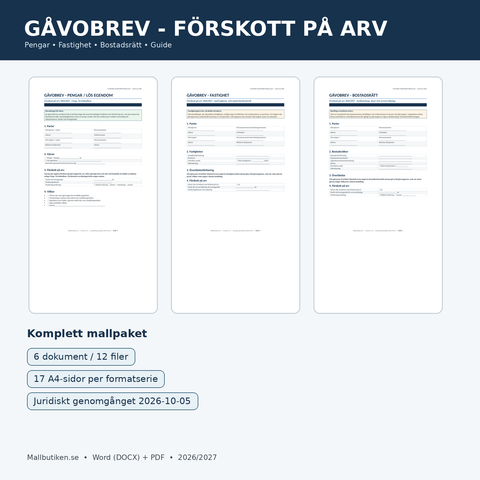
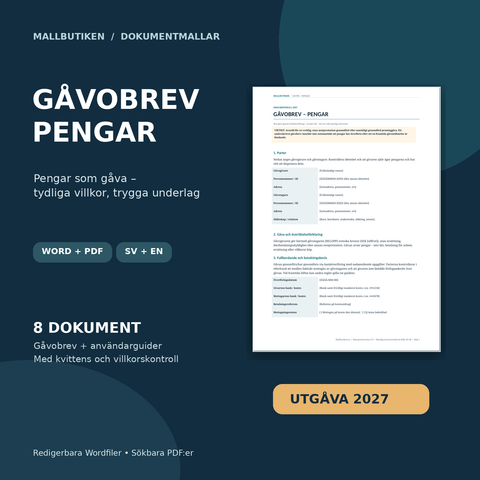
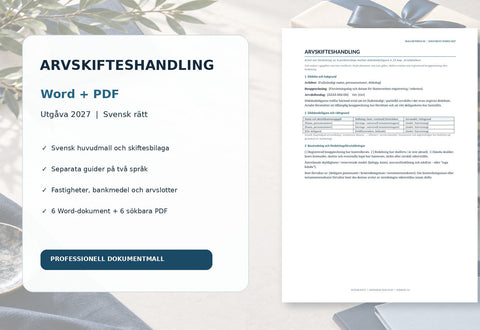
The template shop offers Deed of Gift – inheritance advancement 2026/2027 for documentation of a gift and its inheritance law conditions, as well as a separate template for an estate division document. No template guarantees a certain inheritance distribution, tax treatment, or outcome in a forced heirship dispute.
Deed of Gift – inheritance advancement, Word/PDF · Deed of Gift money – Word/PDF · Estate division document – Word/PDF
Related articles
- Advance on inheritance – deed of gift and compulsory portion
- Advance on inheritance – main rules and common situations
- Deed of gift for money – how do you document a monetary gift?
- Estate distribution step by step – from inventory to division
Official legal sources
- The Riksdag: The Inheritance Code (1958:637), specifically Chapter 2 Section 1, Chapter 6 Sections 1–7, Chapter 7 Sections 1–4, Chapter 20 Section 5, and Chapter 23 Section 4.
- Swedish Tax Agency: Information to be recorded in and attached to an estate inventory, legal guidance 2026.
- Supreme Court: NJA 2022 p. 277 – monetary gifts and strengthened protection for compulsory portions.
- Google Search Central: Creating helpful, reliable, people-first content – editorial guidance, not a legal source.
Templates in this article
Explore the topic
 Deeds of gift – guides, formalities & document templates
Advancement of inheritance – deed of gift, set-off, and statutory share 2026
How inheritance advances work in 2026: the presumption for gifts to children, deduction, valuation, statutory share, and why the deed of gift shoul...
 Deeds of gift – guides, formalities & document templates
Gift deed for money – monetary gift, advancement of inheritance, and separate property
Guide to gift deeds for money: when the monetary gift is completed, gift or loan, advancement of inheritance, separate property, spouses, tax, and ...
 Estate distribution & estate inventory – guides & templates
How do you carry out an estate distribution? Step-by-step from the estate inventory to the division of assets
How the heirs perform an estate distribution: registered inventory of assets, debts, valuation, distribution, estate distribution deed, and transfe...


