Svenska Dokumentmallar
AI in Social Services 2027 – FRIA, Financial Assistance and Human Decision-Making | Word/PDF/Excel
AI in Social Services 2027 – FRIA, Financial Assistance and Human Decision-Making | Word/PDF/Excel
- File format
- DOCX, PDF, XLSX
- Document language
- Five Swedish working documents and a Swedish guide English User Guide Swedish Excel workbook with nine tabs; 7 DOCX + 7 PDF + 1 XLSX.
- Number of files
- 7
Digital download. No physical product is shipped.
Couldn't load pickup availability
About this template
AI in financial assistance – check high-risk classification, fundamental rights, and human review. A specific document package for Swedish municipalities, social welfare boards, and other relevant organizations considering AI systems to assess eligibility for social assistance or other essential public benefits. Structure an FRIA in accordance with the EU AI Act, address parallel GDPR issues, and test whether case workers can actually stop or correct AI suggestions.
Quick facts: 7 Word (DOCX) + 7 corresponding searchable PDFs + 1 Excel (XLSX) with nine tabs = 15 delivery files in a ZIP. Five Swedish working documents, a Swedish user guide, and a separate English User Guide. The Swedish working templates are not available as full English translations. The PDF versions are searchable and printable, not interactive forms. No real client data should be entered.
01. Package contents
Five Swedish working documents: high-risk and applicability assessment, FRIA assessment of fundamental rights, GDPR/DPIA/secrecy, human oversight and decision justification, and implementation decision and FRIA follow-up. Two guides are included in Swedish and English. All seven documents are delivered in Word and PDF. One Excel workbook with nine tabs complements the documents. 15 files in total.
02. What the files contain
Practical fields for the AI system's intended function, Annex III 5(a), classification under Article 6, the organization's legal roles, FRIA Article 27.1(a–f), affected groups, rights risks, human oversight, complaint procedures, DPIA references, secrecy review, decisions, and action follow-up. No automatic classification as legal, safe, or approved. The responsible parties always make the actual assessment.
Who is the product for?
Municipal social welfare departments, assistance and financial units, AI and digitalization officers, lawyers, data protection officers, and management.
The package serves as documentation support for preliminary assessment or pilot planning, not as a system that decides on eligibility for assistance.
Example 1: A social welfare department is considering an AI system that sorts applications for social assistance and provides individual decision recommendations. Investigate whether its use falls under Annex III 5(a). Example 2: A municipality wants to document which groups may receive incorrect rejections, which rights are at risk, and whether a case worker can correct an AI result. Example 3: Before deployment, those responsible need to distinguish an FRIA from a GDPR DPIA and document any blocking risks.
When is the product not suitable? If you need a general social welfare service system, an algorithm that calculates assistance, an individual assessment of eligibility for financial support, a completed regulatory filing, or formal AI certification. Not all administrative AI use in the municipality is high-risk.
File by file: 15 actual customer files
| No. | File | Practical function | Language | Format |
|---|---|---|---|---|
| 01 | High-risk and applicability assessment | Annex III 5(a), Article 6, purpose, system role, and transitional rules | Swedish | DOCX + PDF |
| 02 | FRIA – fundamental rights | Article 27.1 a–f: process, groups, risks, human oversight, and complaints | Swedish | DOCX + PDF |
| 03 | GDPR, DPIA, and secrecy | Separate assessment of legal basis, DPIA, Article 22, and social welfare secrecy | Swedish | DOCX + PDF |
| 04 | Human oversight and decision justification | Fictitious tests of incorrect data, equal treatment, and urgent assistance needs | Swedish | DOCX + PDF |
| 05 | Implementation decision and FRIA follow-up | Stop-gap, Article 27.3 notice where applicable, and update log | Swedish | DOCX + PDF |
| 06 | Swedish User Guide | Workflow, legal boundaries, data handling, and control questions | Swedish | DOCX + PDF |
| 07 | English User Guide | English instructions for the Swedish operational templates | English | DOCX + PDF |
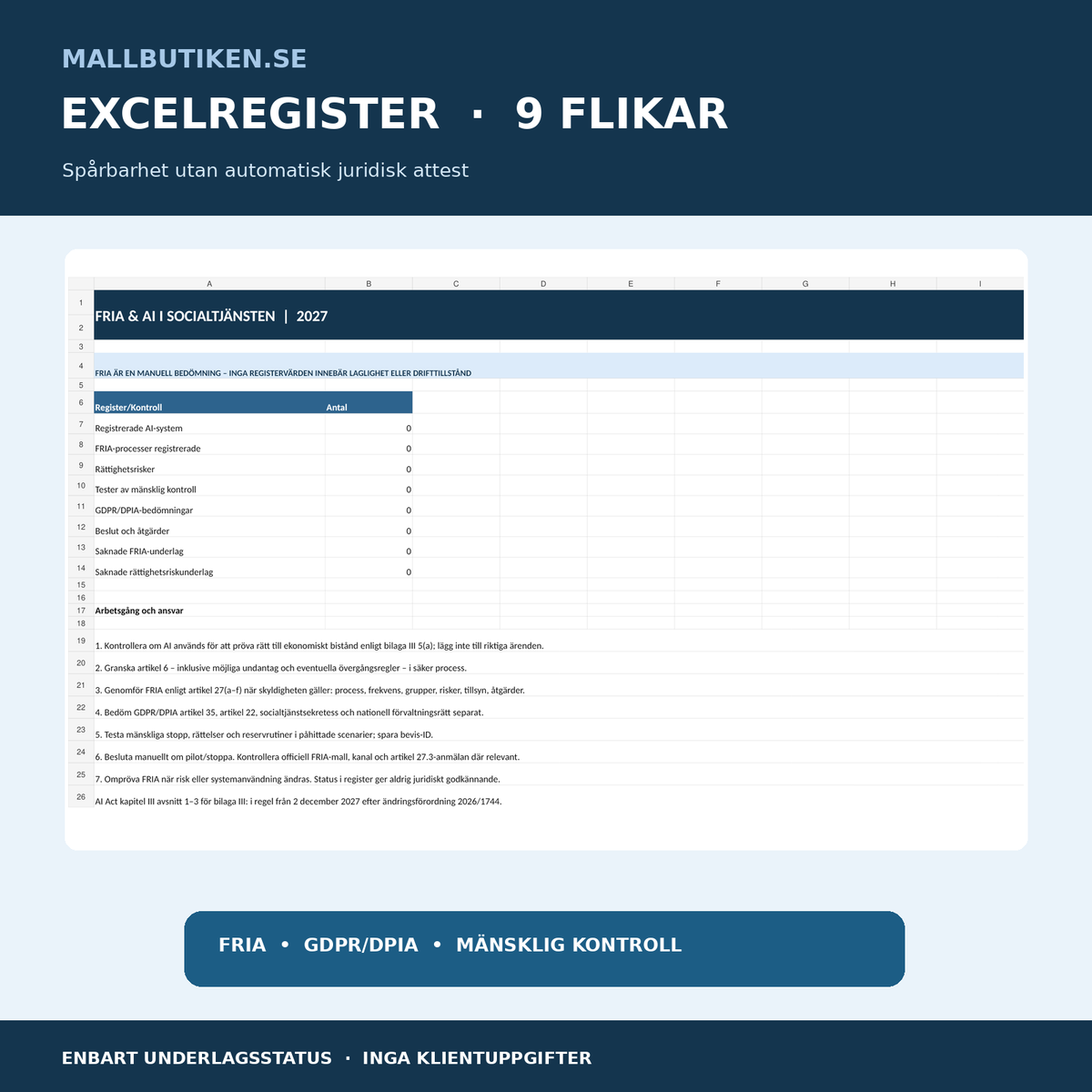
| 08 | FRIA risk register | Nine Swedish Excel tabs with status formulas and traceable process IDs | Swedish | XLSX |
Excel with nine tabs
Start provides an overview. System records the system/version and purpose. FRIA process follows Article 27(a–f). Affected groups maps impact without personal names. Rights risks documents consequences and measures. Human oversight follows up on real test cases. GDPR DPIA records separate assessments. Decision actions provides action and decision tracking. Sources collects official legal sources.
The register formulas have been tested with fictitious data for three situations: missing documentation, all control fields registered, and removed risk field. They only show the status Missing documentation or Documentation registered – manual review; never “legally approved”. The customer workbook is empty at the start, with only examples of field names and instructions.
Which rules apply?
EU AI Act (EU) 2024/1689: Annex III point 5(a) covers AI systems intended to be used by or for authorities in assessing eligibility for certain essential public support and benefits, including granting, reducing, revoking, or demanding them. The actual function and Article 6 must be assessed; not every AI tool in social welfare is automatically high-risk.
FRIA Article 27: For certain users of high-risk AI, a fundamental rights impact assessment is required before deployment. It covers the process, period/frequency of use, affected groups, harmful effects, human oversight, as well as safeguards and complaint procedures. The information must be updated if changes occur. Article 27.4 allows reference to relevant parts of a GDPR DPIA, but it does not automatically make an incomplete FRIA complete.
Actual application date: For high-risk systems under Article 6.2 and Annex III, the relevant requirements in Chapter III, Sections 1–3 of the AI Act under Regulation (EU) 2026/1744 apply from 2 December 2027. Transitional rules, including Article 111, must be assessed for older systems. It is incorrect to claim that every Swedish municipality must already report an FRIA in 2026.
FRIA results and notification: When Article 27.3 applies, the results must in some cases be reported to the competent market surveillance authority via an official form, with prescribed exceptions. This package contains an internal decision and preparation template, not the official EU notification. Verify the current EU template, competent authority, and channel in the actual case.
Swedish law already in effect: the Social Services Act (2025:400), especially Chapter 12 on financial assistance, as well as the Administrative Procedure Act (2017:900) on legality, decision documentation, and justification, must be assessed separately. The Administrative Procedure Act's provision for automated decisions does not override the protections of the GDPR or other laws. The GDPR legal basis, Article 22, and the obligation to conduct a DPIA under Article 35 where applicable must be assessed independently. Social welfare secrecy under the Public Access to Information and Secrecy Act must also be addressed.
How to use the document package
- Describe the system, version, organization, and the AI system's actual impact on individual applicants.
- Conduct a legal high-risk assessment under Article 6 and Annex III 5(a), and check transitional rules.
- Establish an FRIA under Article 27(a–f) for applicable systems, including affected groups and concrete fundamental rights risks.
- Conduct separate GDPR/DPIA, secrecy, and administrative law assessments; link to evidence in secure systems.
- Test human oversight: incorrect data, equal treatment risk, and urgent assistance needs, using entirely fictitious cases.
- Make a real human decision to stop, supplement, or pilot after addressing blockers.
- Check the official FRIA questionnaire and regulatory notification where the obligation applies, and update the assessment if changes occur.
Frequently asked questions
Are all AI systems in social welfare high-risk?
No. Classification depends on the intended purpose, actual use, Article 6, and Annex III. Certain systems for assessing eligibility for essential public support are covered, but a purely administrative tool does not need to be.
What is an FRIA?
A fundamental rights impact assessment under Article 27 of the AI Act. It helps those responsible identify affected groups, actual risks, human oversight, and appropriate safeguards before the affected high-risk AI is used.
Are the FRIA and DPIA the same document?
No. A GDPR DPIA under Article 35 and an FRIA under AI Act Article 27 have different legal bases. Relevant parts may be cross-referenced, but each obligation must be met.
Does the municipality have to report an FRIA now?
Not as a general requirement in 2026 for all systems. Assess when Article 27.3 applies, transitional rules, possible exceptions, and the current official notification channel.
Can AI make decisions on social assistance without a case worker?
The Administrative Procedure Act may allow automated decisions, but the GDPR, secrecy, the Social Services Act, and relevant AI requirements must be applied separately. The package contains no general pre-approvals for fully automated assistance decisions.
Can real social welfare cases be stored in Excel?
No. The package's Excel is intended for pseudonymous system and process references, not personal identity numbers, sensitive individual data, or client records. Use secure and access-controlled handling for actual cases.
Can Excel determine whether an AI system is legal?
No. The status formulas only show whether selected register fields are filled in. They do not assess legal basis, discrimination, the quality of the FRIA, or deployment.
Are the documents in English, or is the PDF fillable?
The working templates and Excel are in Swedish. There is a separate English guide. The PDF is searchable and printable but is not a digitally fillable form; use the editable Word originals.
Related templates
For organization-wide AI governance, see the AI Governance Package 2026. For an independent, complete GDPR impact assessment, see DPIA / GDPR Impact Assessment. This product complements them with an organization-specific FRIA and controls for financial assistance.
Official sources and transparency
EU AI Act in consolidated version, 2026/1744, EU Commission AI Act Service Desk – Article 27, the Social Services Act (2025:400), the Administrative Procedure Act (2017:900), and GDPR (EU) 2016/679.
Version 1.0, AI-assisted source review November 12, 2026. No independent legal review, regulatory approval, certification, or individual legal opinion. The product is delivered as a digital ZIP upon separate activation; it is not published automatically.