

Svenska Dokumentmallar
Influencer Agreement Template 2026 – Word/PDF | Swedish Law
Influencer Agreement Template 2026 – Word/PDF | Swedish Law
 Downloading the template is available immediately after purchase. Our document templates are always delivered in customizable formats.
 If you are unsure which template is appropriate or how you should complete it, please see the relevant information under the 'Legal Information' tab in our main menu.
 Our templates are designed in accordance with current legislation and practice in each area to ensure that the documents you create are legally correct.


Couldn't load pickup availability
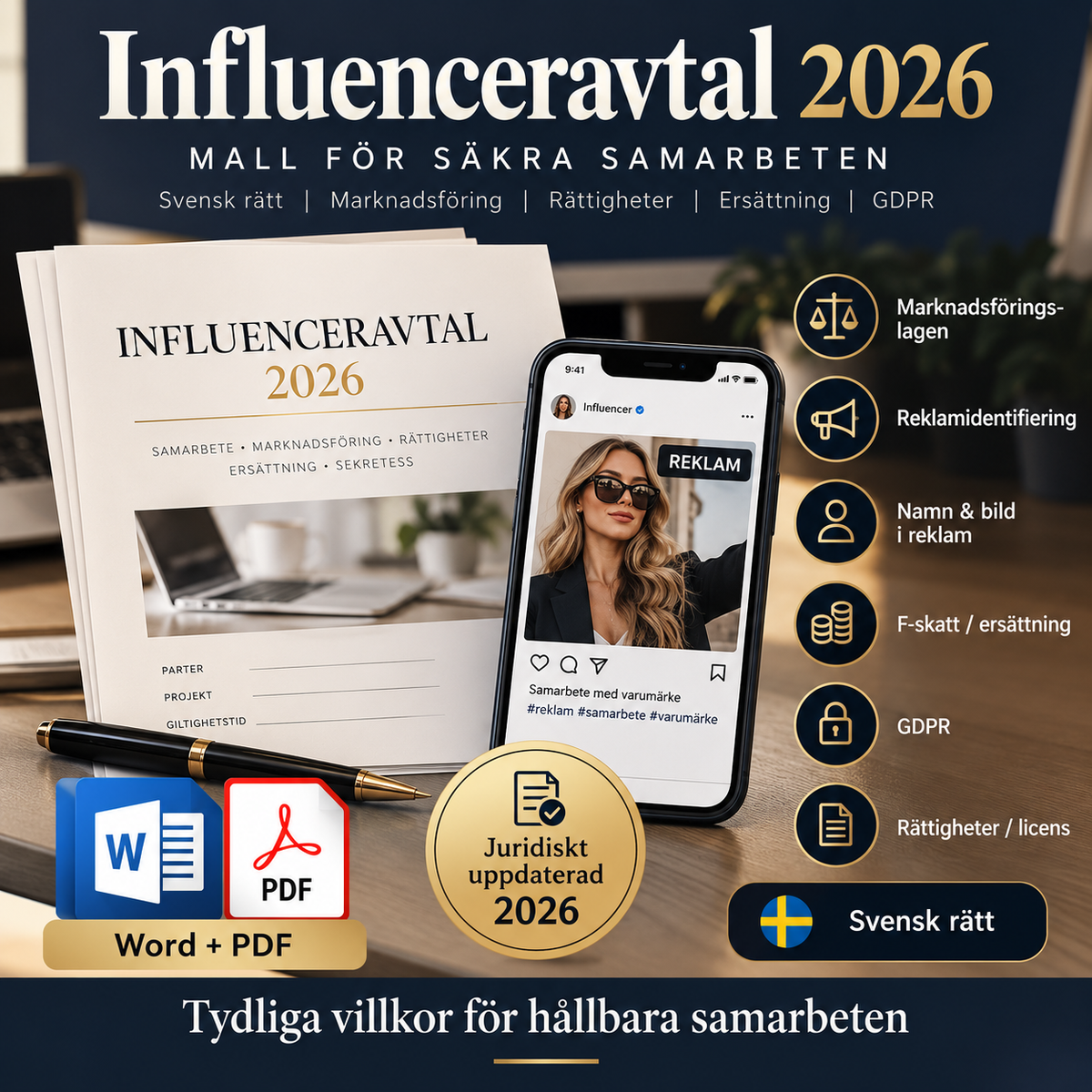
Influencer Agreement 2026 – professional template for influencer collaborations
A clear influencer agreement is essential when a company hires an influencer, content creator, or public figure to promote products and services on social media. This professional contract template is developed for Swedish companies and influencers who wish to regulate the collaboration in writing and reduce the risk of misunderstandings regarding deliverables, compensation, ad disclosure, content rights, exclusivity, and liability.
The template is delivered in both editable Word format (DOCX) and as a ready-to-use PDF. The document comprises 9 professionally designed A4 pages, 27 areas of agreement, and four practical appendices that make the contract useful for both individual campaigns and longer ambassador collaborations.
What does the influencer agreement regulate?
Influencer marketing combines marketing law, contract law, intellectual property law, tax regulations, and in some cases data protection. Therefore, it is rarely sufficient to only write down what compensation should be paid and how many posts should be published. A professional agreement should also clarify who is responsible for ad disclosure, which product claims may be used, how the material may be reused, and what happens if a post needs to be corrected or removed.
The main agreement includes, among other things, rules on:
- parties, contact persons, and the purpose of the campaign,
- scope of assignment and deliverables,
- creative freedom and brand guidelines,
- pre-review and approval before publication,
- ad identification and clear advertiser disclosure,
- product claims and requirements that information must be accurate and verifiable,
- children, young people, and other particularly vulnerable target groups,
- regulated product categories and platform rules,
- publication time, removal, and corrections,
- compensation, products, services, and commission,
- Swedish F-tax, A-tax, and responsibility for taxes and employer contributions,
- statistics, KPIs, and reporting,
- discount codes and affiliate links,
- copyright and license to influencer content,
- use of name, image, and voice,
- editing, subtitling, and versioning,
- paid media, whitelisting, Partnership Ads, Spark Ads, and creator licensing,
- exclusivity and competing collaborations,
- confidentiality and embargo,
- personal data and GDPR,
- liability, cancellation, termination, Swedish law, and dispute resolution.
Appendix 1 – Campaign brief and delivery schedule
A large portion of conflicts in influencer collaborations arises when it is not clear exactly what is to be delivered. Therefore, the template contains a separate campaign brief where the parties can fill in the campaign, product, business goals, target group, campaign period, embargo, mandatory CTA, discount code or affiliate link, approved product facts, prohibited or unapproved claims, and the pre-review process.
There is also a delivery table for different channels and formats, such as Instagram Reels, Stories, regular posts, TikTok, YouTube, and other platforms. The number of publications, dates, minimum publication time, and mandatory elements can be documented separately.
The appendix also contains a practical KPI section for visibility, engagement, traffic, and results. There, the parties can specify what is to be followed up and what statistics the influencer should provide after the campaign.
Appendix 2 – Compensation, products, and affiliate
Compensation in influencer marketing can consist of more than a standard fee. It can, for example, consist of money, products, services, discount codes, commission, or a combination of several forms of compensation. Appendix 2 makes it possible to clearly document:
- fixed fee,
- payment terms,
- products or services as compensation,
- products that are only borrowed during the campaign,
- commission and affiliate model,
- attribution period,
- returns and cancellations,
- bonus and KPI-based compensation,
- travel and other expenses,
- F-tax, A-tax, or self-employment company status.
The Swedish Tax Agency (Skatteverket) emphasizes that compensation to influencers can consist of both money, products, and services. What obligations the principal has depends, among other things, on whether the influencer is approved for F-tax. The template therefore contains special checkpoints for this.
Appendix 3 – Rights and license matrix
One of the most important parts of a modern influencer agreement is the question of who may use the material after publication. The fact that a company has paid for a post does not automatically mean that the company is free to use the image or video in all media and for all time.
The rights matrix allows the parties to separately choose if the content may be used for:
- the influencer's own publishing,
- organic reposting on the company's social media,
- the company's website and e-commerce,
- newsletters and CRM,
- retail stores, POS material, and events,
- paid advertising on social media,
- whitelisting, Partnership Ads, and Spark Ads,
- third-party retailers,
- raw material.
For each area of use, there is space for the license period, territory, or channel, and any separate compensation. The template also regulates cropping, format adaptation, subtitling, translation, and shorter versions.
Appendix 4 – Advertising and publishing checklist
Marketing on social media is covered by the Marketing Act. When a company has hired an influencer, it must be clear to the recipient that the content is advertising and which company is behind the marketing. A company cannot contractually transfer away its own legal responsibility regarding marketing, while at the same time the influencer may have parallel responsibility.
To make the agreement practical, the document therefore contains a checklist that can be used before each publication. It covers, among other things, ad disclosure, the advertiser's identity, verification of product claims, target group, regulated products, music and image rights, discount codes, platform rules, and final approval.
Ad identification – particularly important in 2026
The Swedish Consumer Agency (Konsumentverket) has continued to prioritize the oversight of influencer marketing in 2026 and noted that shortcomings still occur. The agency's current guidance emphasizes that advertising must be identifiable immediately, even at a fleeting glance. Therefore, the ad disclosure may not be hidden far down in a text, among hashtags, or in a way that requires the recipient to first interpret the content.
The template is therefore based on the assumption that advertising posts should normally have a clear and conspicuous ad disclosure, for example, the word "Ad" (or "Reklam"), and that the advertiser's identity must be evident.
Name, image, and content rights
An influencer is not only a content producer but also the person exposed in the advertising. According to the Act on Name and Image in Advertising, consent is required to use another person's name or image in marketing. The agreement therefore contains a special section where the scope of this consent is linked to the license that the parties have actually agreed upon.
This means that a company could, for example, gain the right to repost material organically for three months, but does not automatically gain the right to use the same material in paid advertising for several years. Such usage is regulated separately.
Paid media and whitelisting
The template contains special terms for modern ad formats where the company uses the influencer's account, identity, or content in paid advertising. This applies to, among other things, creator licensing, whitelisting, Meta Partnership Ads, and TikTok Spark Ads. These rights can have a significantly higher commercial value than a standard organic repost and should therefore be expressly regulated.
Exclusivity without unnecessarily broad restrictions
Companies often want to prevent an influencer from working with competitors during the campaign. The template is not based on an unlimited non-compete clause but allows the parties to define categories, named competitors, and time periods. This makes the condition clearer and easier to adapt to the actual scope and value of the campaign.
Legally updated 2026
Version 1.0 was legally reviewed on September 27, 2026. The template has been designed taking into account, among other things:
- The Marketing Act (2008:486), especially the rules on ad identification and misleading marketing,
- The Act (1978:800) on Name and Image in Advertising,
- The Copyright Act (1960:729),
- The General Data Protection Regulation (EU) 2016/679 (GDPR),
- The Swedish Consumer Agency's current guidance on influencer marketing and hidden advertising,
- The Swedish Tax Agency's guidance on compensation and payments to influencers.
Who is the template for?
The influencer agreement is particularly suitable for e-commerce companies, brands, marketing departments, advertising agencies, influencer agencies, startups, consulting firms, influencers, and creators who carry out commercial collaborations on social media.
It can be used both for a single campaign and as a basis for a longer collaboration, such as ambassador agreements, product launches, affiliate collaborations, or recurring campaigns.
You receive
- Influencer_Agreement_2026.docx – fully editable Word template
- Influencer_Agreement_2026.pdf – ready-to-use PDF version
- 9 professionally designed A4 pages
- 27 areas of agreement
- 4 practical appendices
- campaign brief and delivery schedule
- compensation and affiliate appendix
- rights and license matrix
- advertising and publishing checklist
- signature section
- legal checklist and sources of law
Important regarding customization
Influencer collaborations vary greatly depending on the product, channel, target group, compensation, and which rights the company wants to purchase. The template must therefore be customized for the specific campaign. Special rules may apply to, for example, alcohol, tobacco and nicotine, pharmaceuticals, gambling, financial products, health claims, environmental claims, and campaigns aimed at children.
The template is a professional contractual foundation but does not replace individual legal advice in particularly complex or high-risk campaigns.
Digital delivery
The product is delivered digitally in Word and PDF format. No physical product is sent.
Frequently asked questions
Can the agreement be used by both companies and influencers?
Yes. The template is designed as a balanced commercial contract foundation where both parties' core obligations are stated.
Are rules about ad disclosure included?
Yes. Ad identification, the advertiser's identity, product claims, and publication control are central parts of the agreement.
Can the company use the influencer's video in ads after the campaign?
Only if the parties have granted that right in the license matrix. Paid advertising and whitelisting are regulated separately.
Can I use the agreement for affiliate collaborations?
Yes. The template contains terms for discount codes, affiliate links, commission, attribution, and reporting.
Can the agreement be used for UGC?
Certain parts are relevant, but a pure UGC collaboration often has a different rights model since the creator does not always publish the material on their own channels. Therefore, there is a separate UGC Creator agreement in the product plan.