
APT, safety representative or safety committee? Choose the right workplace environment document
Which document is required for workplace environment cooperation? Compare APT, the appointment of a safety representative, the safety committee, the allocation of workplace environment duties, and a 6:6a request. A practical decision-making guide according to Swedish regulations.

The election of safety representatives, safety committees, workplace meetings (APT) and the allocation of occupational health and safety tasks are different parts of occupational health and safety work. The election protocol documents who represents the employees, the committee protocol deals with occupational health and safety issues in a special collaborative body, the APT protocol follows everyday dialogue and the allocation of tasks clarifies who is to perform occupational health and safety tasks. A 6:6a request is used by safety representatives when concrete measures or investigations need to be requested from the employer.
There is no universal template that replaces all these functions. Start by identifying which decision, which participation or which measure needs to be documented. Then check the size of the workplace, the risks of the business and any collective or collaborative agreements.
Quick guide: which document is right for the situation?
| Situation | Choose primarily | What the document helps with |
|---|---|---|
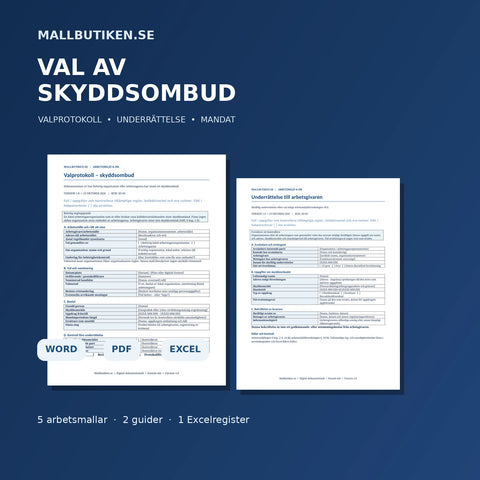
| A safety representative role is to be appointed or changed. | Election of safety representative and notification | Election protocol, area of protection, notification and mandate administration. |
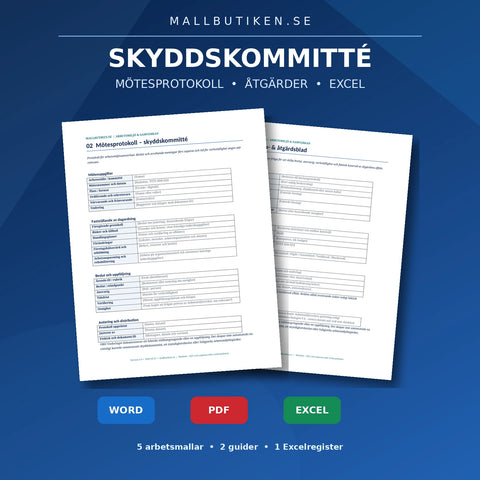
| A safety committee is to be organized or convene. | Safety committee and occupational health and safety collaboration | Constitution, agenda, minutes, decisions and follow-up on measures. |
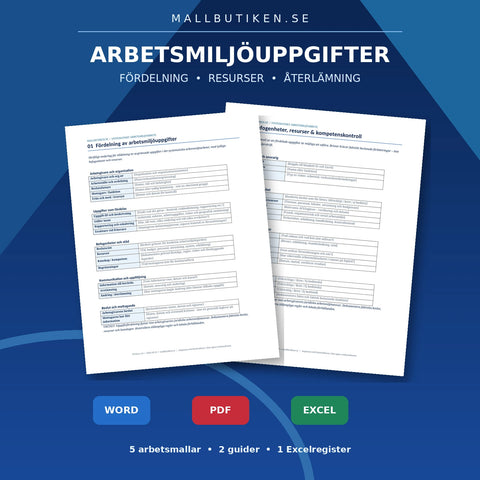
| Occupational health and safety tasks are to be assigned to a manager or other employee. | Allocation of occupational health and safety tasks | Tasks, authorities, resources, competence, change and return. |
| Manager and employees need regular dialogue and follow-up. | APT – agenda and minutes | Meeting planning, documented dialogue, responsible parties and follow-up of local issues. |
| A safety representative requests a concrete occupational health and safety measure or investigation. | 6:6a request and employer response | Request, confirmation of receipt, employer response and follow-up on measures. |
What is required for five, ten and fifty employees?
Several common thresholds refer to different rules and should not be confused:
- Five employees at a workplace: where at least five are regularly employed, one or more safety representatives shall be appointed. Safety representatives shall also be appointed at other workplaces if working conditions require it. A competent local employee organization appoints the representative; otherwise, the employees do it. See the occupational health and safety act, chapter 6, section 2.
- Ten employees in the business: occupational health and safety policy, procedures for SAM and allocation of tasks shall be in writing when the business has ten or more employees. The requirement to work systematically also applies to smaller businesses. See AFS 2023:1, sections 7–9.
- Fifty employees at a workplace: a safety committee shall exist where at least fifty are regularly employed. Even at smaller workplaces, a committee shall be appointed if the employees request it. See the occupational health and safety act chapter 6, sections 8–9.
Safety representatives, managers and safety committees have different roles
Safety representative – the employees' representative
The safety representative represents the employees in occupational health and safety issues. It is not the employer who can freely appoint the employees' representative. Document the correct appointment procedure, area of protection and notification without presenting the document template itself as a decision.
Employers and managers – responsibility and tasks
The employer retains their occupational health and safety responsibility even when occupational health and safety tasks are allocated. The person who receives a task must have appropriate authorities, resources, knowledge and competence. If the conditions are lacking, this needs to be addressed; someone having signed a form is not enough. See AFS 2023:1, section 9.
Safety committee – organized handling and follow-up
The safety committee shall participate in the planning of occupational health and safety work and monitor how the work is carried out. The committee deals with, among other things, action plans, changes in the work organization, occupational health services and workplace adjustments. Collective agreements can, according to the occupational health and safety act, chapter 6, section 9 a, specify a collaborative body with a different name and broader mandate. A protocol is not automatically proof that the committee's tasks have been performed.
When is a workplace meeting enough – and when is another forum needed?
APT can be a practical way to involve employees in ongoing occupational health and safety work. AFS 2023:1 requires participation, but does not prescribe a general APT frequency that applies to all employers. It can instead follow local procedures and collective or collaborative agreements.
A workplace meeting does not automatically replace a safety committee, a special risk assessment, a negotiation under the co-determination act or other formal processes. Therefore, note which forum actually has decision-making authority and which issues should be passed on. Avoid sensitive personal data and individual personnel matters in generally distributed meeting minutes.
Two examples showing the document choice
Example 1: A company with twelve employees at a workplace
The business needs safety representatives according to the five-person rule and written allocation of tasks according to the ten-person rule. APT can be used for recurring participation and follow-up. There is no general fifty-person requirement for a safety committee, but a committee shall be appointed even at a smaller workplace if the employees request it. Check the actual conditions and agreements of the workplace.
Example 2: A workplace with fifty-five employees
Here a safety committee shall exist according to the occupational health and safety act, chapter 6, section 8. The employer still needs to allocate tasks and conduct SAM. Workplace meetings can complement, but not automatically replace, the committee's legally regulated mandate. Document decisions, responsible parties and actually carried out follow-up in the right forum.
When does a 6:6a request become relevant?
When a safety representative believes that the employer needs to take occupational health and safety measures or investigate conditions within the area of protection, the representative can request this according to the occupational health and safety act, chapter 6, section 6 a. The employer shall immediately confirm receipt in writing upon request and provide a response without delay. If the request is not handled in the manner specified by law, the safety representative can request the authority's review.
A 6:6a request is not the same as a safety representative stop according to chapter 6, section 7. In case of immediate and serious danger to life or health, other and more urgent protective measures may be needed. Never use a normal meeting protocol as a substitute for necessary immediate safety measures.
For overall procedures, we also refer to the guide on systematic occupational health and safety work according to AFS 2023:1.
Checklist before you decide on a template and workflow
- Decide whether the issue concerns representation, allocation of tasks, ongoing dialogue, safety committee work or a concrete request for measures.
- Check the number of employees at the right workplace or in the right business for the relevant rule.
- Review collective agreements, collaborative agreements and local decision-making procedures.
- Identify the function that is actually to appoint, decide, carry out or follow up.
- Specify what needs to be documented: appointment, risk, measure, responsibility, deadline or effect.
- Limit personal data and plan who may access the documents.
- Follow up whether the measure worked – a completed form is not the same as a removed risk.
What does research say about participation?
A systematic review by Leso et al. (2024) compiled 43 studies on the broader Total Worker Health approach. Employee participation, management commitment and ongoing evaluation emerged as important elements in implementation. The authors also emphasized the need for better long-term studies. Research therefore does not show that a certain meeting form, a certain number of APT meetings or a specific commercial template package in itself improves the occupational environment. Read the research review.
Official sources and further reading
- Occupational Health and Safety Act (1977:1160), especially chapter 3 and chapter 6, sections 1–9 a – Swedish Parliament.
- AFS 2023:1, especially sections 5–9 – Swedish Work Environment Authority.
- Occupational Health and Safety Ordinance (1977:1166) – Swedish Parliament.
- The employer's handling of a safety representative's request – Swedish Work Environment Authority.
Templates in this article
Explore the topic
 Business guides – contracts, HR, AI & compliance
Systematic work environment management 2026 – SAM according to AFS 2023:1 step by step
Guide to systematic work environment management according to AFS 2023:1: policy, risk assessment, action plan, division of tasks, incidents, and an...


