
Partial distribution of estate 2026 – partial distribution, partial payment and debts

Is it possible to pay out part of an inheritance before the entire estate has been settled? A partial division of the estate means that a specific portion of the assets is distributed while other property remains in the estate for a later division. This can be practical when, for example, cash can be distributed but a property has not yet been sold. However, a partial division assumes that the relevant rights and the estate's debts are managed correctly. If property is distributed too early, all or part of the division may have to be reversed according to Chapter 21, Section 4 of the Inheritance Code.
Legally fact-checked October 19, 2026. Primary sources: The Inheritance Code (1958:637), particularly chapters 18, 20–23, The Swedish Tax Agency’s current guidance on estate debts and reversal, The Swedish Tax Agency’s legal guidance on inheritance division and division payment, and The National Courts Administration on estate administration and inheritance division.
- Multiple estate beneficiaries can agree to divide certain property and leave the rest undivided, but there is no automatic right to demand early payment.
- Chapter 23, Section 4 of the Inheritance Code requires an inheritance division document signed by the beneficiaries. Also, document a partial division in writing.
- Before division, relevant debts and legacies must be paid, secured, or managed according to the law's specific terms. Chapter 21, Section 4 contains rules for the reversal of prematurely distributed property.
- A residual estate refers to the property and obligations remaining to be managed after the partial division.
- A final division of the estate must deduct what has already been distributed so that the heirs' rights are not satisfied twice.
- This must be distinguished from advance on inheritance, which typically refers to gifts made during the testator's lifetime.
What is a partial division?
A partial division means that the estate beneficiaries perform a limited division of, for example, cash holdings, securities, or certain other assets, while remaining property is managed in the undivided estate. Chapter 23 of the Inheritance Code contains rules on the division of estates but no special regulatory procedure where a partial division is approved or registered with the Swedish Tax Agency.
In a typical estate with multiple beneficiaries, a written, signed partial division document is therefore an important basis for demonstrating what has actually been distributed, to whom, when, and under what conditions. A partial division must not be confused with the entire estate being settled: there may still be a home, bank funds, additional assets, payment obligations, and tax filing matters.
Compare with the general guide to inheritance division from inventory to final distribution. This article deals specifically with multiple distribution instances and the risks associated with early payments.
When can the heirs carry out a partial division?
Chapter 23, Section 1 of the Inheritance Code specifies who performs the division: heirs and universal legatees. If the deceased was married, a marital division according to the Marriage Code must be done before the inheritance division. If a surviving cohabitant requests a division according to the Cohabitation Act, that must also precede the division.
Chapter 23, Section 2 states that the division may not be carried out against the objection of any beneficiary before the estate inventory has been prepared and all known debts paid, funds set aside under special care, or an agreement reached such that the beneficiary is not responsible for the debts. Furthermore, there are special rules regarding as-yet unfulfilled legacies, purpose provisions, and estates under the management of an estate administrator or executor.
The fact that all beneficiaries agree is not sufficient in itself to remove the protection of creditors. Debts can still lead to a reversal according to Chapter 21, Section 4. A safe partial division is therefore preceded by an up-to-date list of assets, already paid debts, reserved amounts, and remaining risks.
What happens if the estate's debts are not paid?
According to Chapter 21, Section 4 of the Inheritance Code, a marital division or inheritance division that occurs before the deceased's and the estate's other debts have been paid, or funds for payment have been placed under special care, must be reversed. When the legal requirements for limited reversal are met, the entire division does not need to be undone; the reversal is then limited to what is required to pay the debts and the estate's administrative costs. Beneficiaries may be required to return property or compensate for its value.
This also applies if the estate has only distributed part of the assets. An internal statement that the heirs "approve the payment" is not protection against the estate later needing to cover unpaid debts. The Swedish Tax Agency describes how a division that took place too early may need to be reversed and that an estate administrator may be needed when the beneficiaries do not resolve the matter voluntarily.
For correct bank and debt reconciliation, the Mallbutiken final settlement template for estates can be an administrative tool, but it cannot make a legally uncertain payment permissible.
How does a will or a legacy affect things?
If the will prescribes a legacy – for example, a specific item or a sum of money to a certain person – it must be checked before property is distributed. According to Chapter 23, Section 2, a division cannot, under certain conditions, take place against a beneficiary's objection before such provisions have been fulfilled or protected in the manner the law specifies. Chapter 22, Section 1 also contains rules regarding liability when an inheritance division is carried out before a legacy has been delivered.
Therefore, do not distribute money needed for an already known testamentary provision without the legal situation and all affected rights having been investigated. Special inheritance law issues concerning children from previous relationships, statutory shares, and deferred inheritance can also affect the distribution.
Partial payment from the estate – what should be documented?
A transfer from the estate's bank account may concern an actual partial division, the payment of a legacy, the reimbursement of an out-of-pocket expense, or another legal disposition. The designation and payment basis should show which one it is. Calling the payment an "advance on inheritance" after the death can create unnecessary ambiguity, as the term in Chapter 6 of the Inheritance Code mainly refers to advances through gifts from a person while they were still alive.
For an agreed-upon partial division, it is appropriate to document the payment date, recipient, amount, what basis was used, how previous payments should be deducted, and how much of the estate remains. If only part of the balance is divided, the beneficiaries must be able to see that the rest has not been finally distributed.
The documentation should not state that the estate is debt-free or that a balance is final until the check has actually been performed. In the case of preliminary figures, the appendix can explicitly state which account statement period, valuation date, or other information is still missing.
What should be in a partial division document?
The statutory basic requirement in Chapter 23, Section 4 of the Inheritance Code is that an inheritance division be documented in a document signed by the beneficiaries. A partial division should also clearly show that it is partial and not a final division of the entire estate.
| Information | Function | Legal status |
|---|---|---|
| The deceased's identity and date of death | Identifies the estate | Practical identification |
| All relevant beneficiaries, representatives, and signatures | Shows participation and involvement | Inheritance Code Ch. 23, Sec. 1 & 4; authorization checked separately |
| Which property and what value is divided | Defines this particular agreement | Central to the agreement's clarity |
| Amount and recipient per beneficiary | Guides bank transfer and future reconciliation | Practical accounting |
| Debts, reserves, legacies, and administrative costs | Highlights risks and what is being held back | Material limitations according to IC Ch. 21 and 23 |
| What remains undivided (residual estate) | Avoids the partial division being misinterpreted as final | Recommended clarity |
| How previous partial divisions should be deducted later | Prevents double or unfair distribution | Contractually important |
There is no general government form that automatically replaces the division document. See also our broader checklist on what an inheritance division document should contain.
Residual estate: which property and obligations are left behind?
If the residual estate is to remain for a longer time, thoughtful joint management is required with regard to Chapters 18 and 24 of the Inheritance Code. Read undivided estate – management, agreement, and termination.
Residual estate is a practical term for the estate's remaining property and tasks after the partial division. It can include bank funds, real estate, claims, unsold securities, debts, administrative costs, and tax filings that remain. Write down exactly which assets have been distributed and which are still managed by the estate.
Update a statement after every transaction: incoming assets, payment made, remaining balance, and what amount is actually available after relevant debts and reservations have been handled. When the final inheritance division is performed, previous divisions are deducted from the respective recipient's right to inheritance. Correct reconciliation requires that previous decisions and account statements are available.
Calculation example: two heirs receive a first payment
Assume an estate has a net worth of SEK 400,000 after all known debts have been paid or secured in the correct way, and that there are no legacies or other special rights. Two heirs have equal inheritance shares. They write an agreement to distribute SEK 100,000 to each now and let SEK 200,000 remain as a residual estate. In the example, this is a matter of truly agreed partial divisions, not loans or repayment of expenses.
| Illustrative entry | Heir A | Heir B | Residual estate |
|---|---|---|---|
| First partial division | SEK 100,000 | SEK 100,000 | SEK 200,000 |
| If the rest is later finally divided equally | +SEK 100,000 | +SEK 100,000 | SEK 0 |
| Total received in example | SEK 200,000 | SEK 200,000 | SEK 0 |
What does the bank require for a partial division and partial payment?
A bank may request a registered estate inventory, division document, powers of attorney, and their own information about the estate beneficiaries. Exact routines differ between banks and may vary depending on whether the money is transferred to individual recipients or if the entire estate's accounts are to be closed. The bank's execution of a transfer is not the same as a legal guarantee that the partial division was correct.
Ask the bank which originals, signatures, and account numbers are required for a partial inheritance division. Retain relevant accounts and documentation for remaining management. A bank statement regarding current balance does not automatically show which taxes or debts have not yet been paid.
Can a property or tenant-owner right be included in the partial division?
Yes, a partial division can concern specific property, but then other legal requirements for that property must also be fulfilled. When dividing real estate, registration of title according to the Land Code may be required for the person receiving the property. A partial division of a tenant-owner right needs instead to be reviewed against the housing association's membership rules. The fact that other property remains in the estate does not override the rules for the transfer.
If a property is to be taken over and other heirs compensated with a balancing payment, the buyout and its financing need to be assessed separately. See inheritance division of property – title registration and buyout of siblings.
Is a partial division taxed as a sale?
The Swedish Tax Agency’s legal guidance for 2026 states that a beneficiary who, in connection with a true inheritance division, including a partial division, buys out another beneficiary with a balancing payment is normally not considered to be carrying out a disposal for that reason alone. The balancing payment in this context does not automatically become a new tax-related acquisition value. A separate purchase from the estate may have other consequences.
It is also important not to say that all property or all income in an estate is tax-free. The estate may have obligations to declare and pay tax on income or sales that occur during management. When the ownership and timing of a transaction change, the tax assessment may change. Therefore, save documentation and request individual tax advice if the estate contains companies, foreign property, large stock holdings, or real estate.
What do you do if a beneficiary opposes the partial division?
The Inheritance Code's Chapter 23, Section 2 protects a beneficiary who opposes a division before the conditions in the provision are met. In the event of disagreement about management or division, the beneficiaries may need the help of an estate administrator or division executor, who is appointed by the district court according to applicable conditions. A division executor can ultimately carry out a forced division, but that does not mean that another beneficiary can force an arbitrary early bank payout.
The Swedish Courts describe the difference between an estate administrator and a division executor and how an application is made. If there is a dispute regarding the validity of the will, debts, or any heir's right, the investigation should normally be clarified before a partial division is started.
Checklist – partial inheritance division step by step
- Determine the estate beneficiaries and who has the right to perform the division according to IC Ch. 23.
- Check the estate inventory and if marital division is needed before inheritance division.
- Investigate all known debts, tax, legacies, and remaining administrative costs.
- Pay or secure obligations according to law; do not assume that a standard internal reserve is always enough.
- Determine which property is to be included in the first partial division and how it has been valued.
- Document all affected beneficiaries' stances and authorization.
- Draw up a clear partial division document with signatures and reconciliation terms.
- Make bank transfers or other transfers only when the documentation is ready.
- Register in the residual estate accounting what has been paid out, when, and to whom.
- Follow up on remaining assets, debts, tax returns, and any new circumstances.
- Deduct previous partial divisions at the final inheritance division.
- Keep original documents, account statements, and any bank or authority confirmations.
Common questions about partial inheritance division
Can an inheritance division be done in several stages?
Yes, a limited partial division can be done and other property remain in the estate. Both the rules regarding the beneficiaries' participation and the protection of creditors must be followed.
Must all estate beneficiaries sign the partial division document?
According to Chapter 23, Section 4 of the Inheritance Code, an inheritance division document must be signed by the beneficiaries. Authorized representatives can in certain situations sign, but then valid authorization is required.
Are you allowed to pay out inheritance even if there is an unpaid tax debt?
Debts must be handled according to the rules of the Swedish Inheritance Code before distribution. A payment made too early can be clawed back under Chapter 21, Section 4. Do not assume a preliminary tax debt has lapsed without verification.
Must a partial estate distribution be registered with the Swedish Tax Agency?
No, a standard partial distribution agreement does not need to be registered as a separate decision with the Swedish Tax Agency. The estate inventory and any special transfers have their own rules.
Is a partial payment the same thing as an advancement of inheritance?
Not necessarily. A partial distribution after the death must be distinguished from gifts made during the testator's lifetime, which may be an advancement of inheritance under Chapter 6 of the Inheritance Code.
What happens if a new debt is discovered after the first partial distribution?
Investigate the debt and assess whether the estate's remaining assets can cover it. The Inheritance Code's rules on restitution may become applicable if assets have been distributed too early.
Can the bank make the partial payment without a distribution agreement?
Bank procedures vary, but a transfer does not replace the requirement for a properly documented estate distribution agreement. Ask the bank to specify which documents are required.
Document templates for partial distribution, partial payment, and final settlement
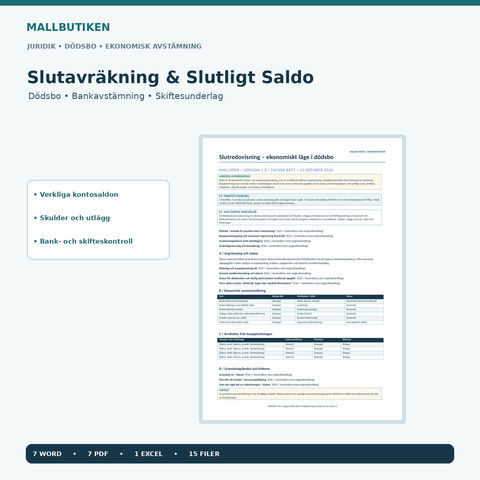
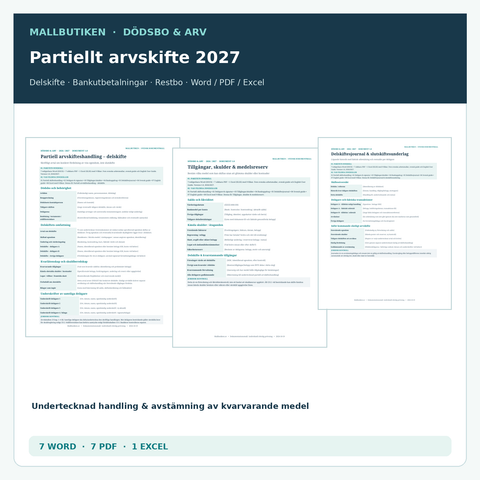
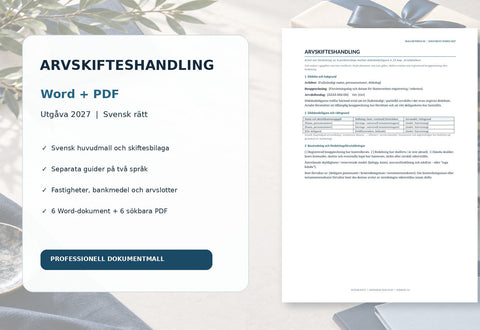
The template store's Partial Estate Distribution 2026/2027 includes Word, PDF, and Excel templates for a limited distribution agreement, allocation, partial payments, and final estate accounting. The templates are aids that need to be adapted to an actual estate and do not provide an automatic bank payout or a guarantee that all debts are legally secured.
See Partial estate distribution – partial distribution and partial payment · See final settlement and final balance for an estate · See general estate distribution agreement
Related reading
- How do you distribute an estate? Estate inventory, debts, and allocation
- What must an estate distribution agreement contain?
- Estate inventory 2026 – summons and current deadlines
- Division of matrimonial property upon death and the surviving spouse's rights
- Estate distribution of property, title registration, and sibling buyouts
Official legal sources and review
- The Inheritance Code (1958:637), The Swedish Parliament – specifically Chapter 18, Section 1; Chapter 20; Chapter 21, Sections 4–6; Chapter 22, Section 1; and Chapter 23, Sections 1–5.
- Swedish Tax Agency – Application for an estate administrator and reversal of estate distribution – reversal and debts.
- Swedish Tax Agency – Capital gains taxation, legal guidance 2026 – distribution payment even for partial distributions and separate purchases.
- The Swedish Courts – Death and inheritance – estate administration, estate distributor, and disputes.
- Google Search Central – linking – editorial and technical reference for the article's internal link structure.
Templates in this article
Explore the topic
 Estate distribution & estate inventory – guides & templates
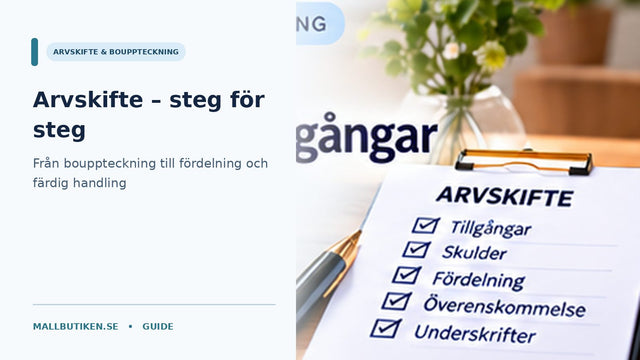
How do you carry out an estate distribution? Step-by-step from the estate inventory to the division of assets
How the heirs perform an estate distribution: registered inventory of assets, debts, valuation, distribution, estate distribution deed, and transfe...
 Estate distribution & estate inventory – guides & templates
What should a deed of estate distribution include? Checklist 2026
Checklist for the estate distribution document: estate of the deceased, beneficiaries, assets, valuations, distribution, will, signatures, and prac...
 Estate distribution & estate inventory – guides & templates
Undistributed estate 2026 – agreements, joint administration and termination
Undistributed estate 2026: joint administration pursuant to Chapter 18 of the Swedish Inheritance Code, agreements pursuant to Chapter 24, power of...


