
Estate inventory 2026 – deadlines, summons and new regulations
Complete guide to estate inventory 2026: three-month procedure, filing, summons, assets and liabilities, and the amendments effective July 1, 2026.

An inventory of estate (bouppteckning) is both a compilation of the estate’s financial circumstances and a document verifying the authority of the estate. During 2026, the rules have also changed in several practical aspects, making older checklists unreliable to use without verification.
Quick Overview
- The inventory of estate should normally be held within three months of the date of death.
- It must be submitted to the Swedish Tax Agency (Skatteverket) within one month of being drawn up.
- From July 1, 2026, a certified copy no longer needs to be attached; the original must be submitted.
- All individuals summoned to the proceedings must be listed with the identification details required by the new regulations.
- Assets and liabilities must be reported based on the circumstances on the date of death.
| Proceedings | Determine the time, place, and who should be summoned. |
| Summons | Ensure that all relevant parties have been summoned in good time. |
| Assets | Bank accounts, securities, real estate, cooperative apartments, vehicles, insurance policies, and receivables. |
| Liabilities | Loans, invoices, taxes, and other debts existing on the date of death. |
| Attachments | Will, proof of summons, powers of attorney, and other relevant documents. |
Three months for the proceedings
Chapter 20, Section 1 of the Inheritance Code states that the inventory of estate must be held no later than three months after the death, unless the Swedish Tax Agency grants an extension. Once the inventory of estate has been drawn up, the general rule is that it must be submitted within one month.
Summons and inventory proceedings
Everyone who must be summoned according to the regulations must be summoned in good time. The Swedish Tax Agency’s legal guidance emphasizes that if multiple meeting days are held, all relevant parties must have been summoned to or present at the concluding proceedings.
Important changes from July 1, 2026
The Swedish Tax Agency has informed about new data requirements for individuals summoned to the proceedings. The inventory of estate must still be submitted in original format, but a certified copy no longer needs to be attached. Digital submission is not yet possible according to the Swedish Tax Agency's information from 2026.
The inventory of estate’s new requirements in 2026 – practical checklist
For those inheriting real estate, updated identification requirements apply to applications for title registration (lagfart) from July 2026. Read inheritance of real estate – title registration, personal identity number (personnummer), and coordination number (samordningsnummer).
Following the legislative changes on July 1, 2026, the inventory of estate must specify the name, personal identity number or coordination number, and domicile of those who should have been summoned. If a personal identity number or coordination number is missing, the date of birth must be provided. Please use the Swedish Tax Agency’s form SKV 4600 as a starting point, but follow the authority’s current instructions, as some older designations may remain in the form.
- Relevant parties: identify heirs, secondary heirs, and surviving spouse or cohabitant who must be summoned; document how and when the summons occurred.
- Witnesses to the inventory: appoint two knowledgeable and credible individuals. They must be independent of the financial interests of the estate according to applicable rules.
- Deadlines: the inventory of estate should normally be held within three months from the death and submitted within one month after being drawn up. Request an extension in time if necessary.
- Submission: since July 1, 2026, no extra certified copy needs to be attached. For paper-based inventories, submit the original document. The rules open for future electronic submission to a receiving point designated by the Swedish Tax Agency, but verify the current availability of e-services; a standard emailed PDF is not the same as an approved electronic application.
Inventory of estate, supplementary inventory, and final accounting – what is the difference?
A registered inventory of estate does not close an estate that still holds undistributed property. See undistributed estate – responsibility and tax return after the inventory.
The inventory of estate reports, among other things, who has the right of inheritance as well as assets and liabilities based on the date of death. A supplementary inventory (tilläggsbouppteckning) may be needed if a previously unknown asset or debt or another error in the inventory is discovered, according to Chapter 20, Section 10 of the Inheritance Code. The final accounting, by contrast, is a practical working document that can show the current bank balance, transactions after the date of death, paid expenses, and what remains for the distribution of the estate.
Example: if a bank account had 120,000 SEK on the date of death but the estate later pays invoices and receives a tax refund, a later account balance may differ from the inventory without that in itself meaning the inventory is incorrect. Document the changes with account statements and assess separately whether an actual previously unknown asset or debt requires a supplementary inventory.
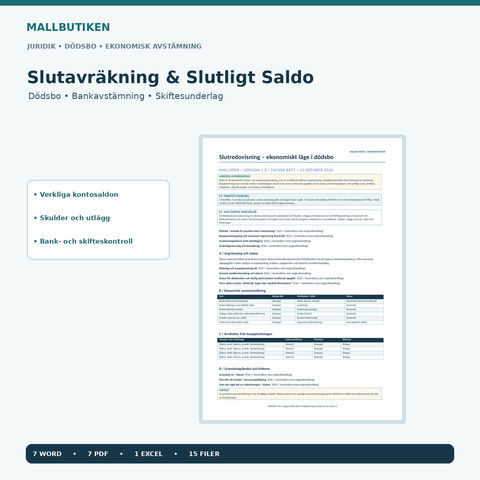
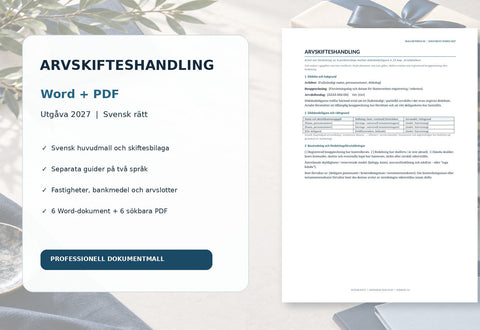
Before the proceedings, you can use the inventory of estate package for summons and supporting documents. When the estate's finances are to be reconciled afterwards, there is a separate template for final accounting and final balance. The actual distribution between multiple heirs is normally documented in an estate distribution instrument (arvskifteshandling). Also read inheritance distribution step by step.
Sources: Swedish Tax Agency on the inventory's tasks, witnesses to the inventory, and submission and registration.
Assets, liabilities, and attachments
A registered inventory of estate is not the same as approval of a partial payment from the estate. Read partial distribution and partial payment – debts, liability, and practical checklist.
When the deceased was married, the surviving spouse's request to retain their marital property (giftorättsgods) may need to be documented as early as the inventory proceedings. See the guide on Chapter 12, Section 2 of the Marriage Code, timing, and documentation.
The work should be based on the date of death and documented systematically. Bank funds, securities, real estate, cooperative apartments, receivables, and other assets should be handled together with liabilities and relevant attachments. Information regarding a surviving spouse or cohabitant may also need to be reported depending on the situation.
Common mistakes to avoid
- Missing the three-month deadline or applying for an extension too late.
- Failing to summon everyone who should be summoned.
- Using an old checklist that requires a certified copy after July 1, 2026.
- Confusing transactions after the date of death with assets and liabilities on the date of death.
- Forgetting the will, power of attorney, or proof of summons as a relevant attachment.
Frequently asked questions
When should the inventory of estate be completed?
The proceedings should normally be held within three months from the date of death. Thereafter, the inventory of estate must be submitted within one month after being drawn up.
Can one get an extension?
Yes, the Swedish Tax Agency can, upon application within the three-month period, extend the time if the nature of the estate or other special reasons justify it.
Must a certified copy be submitted in 2026?
No, from July 1, 2026, a certified copy no longer needs to be attached. The original must still be submitted.
Can the inventory of estate be submitted digitally?
The Swedish Tax Agency states that digital submission is not currently possible.
What are the inventory proceedings?
It is the meeting where assets, liabilities, and other details are reviewed and where it is ensured that the persons who should be summoned have been summoned.
Inventory of Estate Package 2026/2027
The package contains a summons, working documents for assets and liabilities, an attachment checklist, and a practical guide.
Read also
Sources and further reading
- Swedish Tax Agency – changes regarding inventory of estates 2026
- Inheritance Code (1958:637), Chapter 20 – The Riksdag
Last updated: October 15, 2026. This article provides general information and does not replace individual legal, tax-related, or pension-related advice.
Templates in this article

Explore the topic
 Estate distribution & estate inventory – guides & templates
Estate distribution of real property 2026 – title deed, buyout of siblings, and documents
Real estate in the estate distribution? Checklist for title registration, estate distribution deed, buying out siblings, settlement payment, and th...
 Estate distribution & estate inventory – guides & templates
Undistributed estate 2026 – agreements, joint administration and termination
Undistributed estate 2026: joint administration pursuant to Chapter 18 of the Swedish Inheritance Code, agreements pursuant to Chapter 24, power of...
 Estate distribution & estate inventory – guides & templates
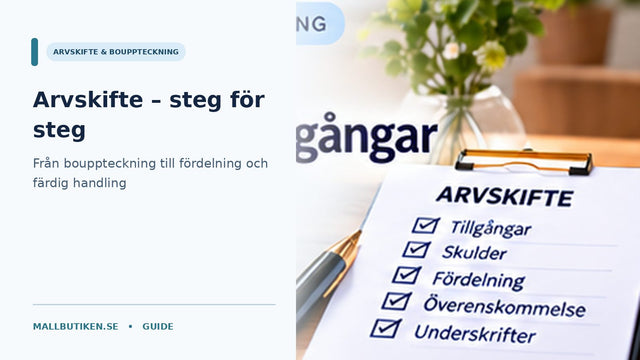
How do you carry out an estate distribution? Step-by-step from the estate inventory to the division of assets
How the heirs perform an estate distribution: registered inventory of assets, debts, valuation, distribution, estate distribution deed, and transfe...


