Svenska Dokumentmallar
Estate Inventory Package 2026/2027 – Summons, Assets & Liabilities, Attachments & Guide Word/PDF
Estate Inventory Package 2026/2027 – Summons, Assets & Liabilities, Attachments & Guide Word/PDF
- File format
- DOCX, PDF
- Document language
- Swedish
- Number of files
- 6
Digital download. No physical product is shipped.
Couldn't load pickup availability
About this template
Estate Inventory Package 2026/2027 – Summons, Assets & Liabilities, Attachments & Guide
This is a complete support package for those preparing an estate inventory who want to ensure order regarding summons, relevant parties, assets, liabilities, attachments, the meeting, and filing.
The package is designed to be used in conjunction with the Swedish Tax Agency's official estate inventory form SKV 4600. It does not replace the registrable estate inventory itself, but helps you gather and verify all supporting documentation surrounding it.
The template package was legally reviewed on October 5, 2026 and accounts for the changes to Chapter 20 of the Inheritance Code that apply as of July 1, 2026.
This includes
- Summons to the estate inventory meeting – 2 pages.
- Proof of summons & attendance list – 2 pages.
- Worksheet – assets & liabilities – 2 pages.
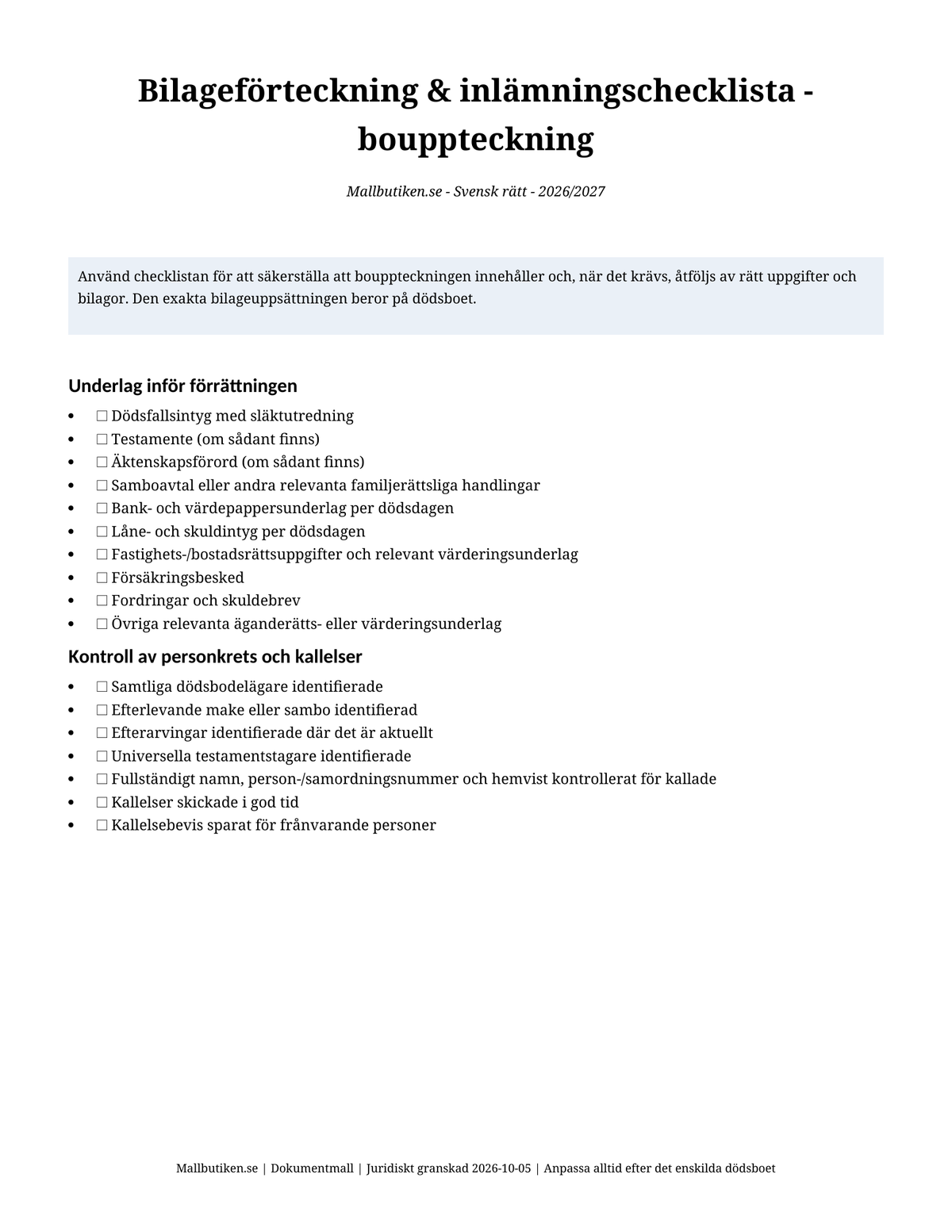
- List of attachments & valuation documentation – 2 pages.
- Meeting checklist – estate representative & meeting officials – 2 pages.
- Detailed user guide – 2 pages.
All six documents are provided in both Word (DOCX) and PDF – a total of 12 files.
Guidance before and after the estate inventory
Read our updated guide on estate inventory deadlines and the new 2026 regulations before summoning to the meeting. It explains, among other things, what information must be recorded and how the estate inventory differs from financial changes following the death.
When the estate inventory is complete: if necessary, use a separate template for final accounting and final balance for bank transactions, expenses, and debts, as well as an estate distribution agreement when multiple heirs are to divide assets. The estate inventory package does not replace these documents.
What does the package help you with?
The estate inventory must describe the estate's legal and financial situation. The package helps you, step by step, to:
- identify who must be summoned to the meeting,
- document attendance and absence,
- save proof that absent persons were summoned in due time,
- collect assets and liabilities as of the date of death,
- separate the finances of the deceased and the surviving spouse where required,
- identify separate property,
- check which attachments may need to be included,
- follow up on missing documentation before filing.
Summons to the estate inventory meeting
All persons who must be summoned according to the regulations need to be summoned in good time. The summons template includes fields for:
- the deceased's information,
- the date, time, and location of the meeting,
- the name and personal identity number/coordination number of the summoned party,
- place of residence,
- position in the estate,
- date and method of distribution.
If a person who was meant to be summoned does not attend, proof that the person was summoned in due time should normally be attached.
New personal data requirements from July 1, 2026
From July 1, 2026, the estate inventory must contain the name, personal identity number or coordination number, and place of residence for those who were required to be summoned to the meeting. If a personal identity number or coordination number is missing, the date of birth must be stated.
The package's summons and attendance documentation are adapted to these requirements.
Meeting officials – new term in 2026
As of July 1, 2026, legislation uses the term meeting officials (förrättningspersoner) instead of the previous term 'meeting men' (förrättningsmän). According to the Swedish Tax Agency, their form SKV 4600 can still be used even if certain words in the form have not yet been updated.
Assets and liabilities on the date of death
The worksheet helps you collect financial information with the correct valuation date: the date of death.
There are separate tables for, among other things:
- bank accounts and cash,
- stocks, funds, and securities,
- real estate and tenant-owned apartments,
- vehicles and boats,
- receivables and promissory notes,
- loans, credits, and other debts,
- other financial rights.
Surviving spouse
When the deceased leaves a spouse, the surviving spouse's assets and liabilities must normally also be recorded, but kept separate from the deceased's. Separate property must be listed independently.
The worksheet therefore includes a specific section for the surviving spouse's finances.
Attachments and document control
The required attachments vary between estates. The checklist helps you verify, for example:
- proof of summons,
- will,
- prenuptial agreement,
- powers of attorney or other authorization documents,
- supporting documentation for assets, liabilities, and valuations.
Deadlines
An estate inventory should normally be conducted within three months from the date of death. Thereafter, it must be submitted to the Swedish Tax Agency within one month after it has been drawn up.
If more time is needed, an extension may in some cases need to be applied for before the standard deadline expires.
Filing after July 1, 2026
The legislative change effective July 1, 2026, opens up for electronic filing to a reception point designated by the Swedish Tax Agency. At the same time, the Tax Agency notes that electronic filing is not yet possible in practice until their technical solution is in place.
For paper filing, the original estate inventory is sent. No extra copy needs to be included.
When might an estate notification be relevant?
In some smaller estates, an estate notification can replace an estate inventory, for example, when assets do not exceed funeral costs and other expenses related to the death, and there is no real estate or site leasehold. Estate notifications are handled by the social services committee.
When should legal help be used?
Expert help is particularly appropriate in cases such as:
- unclear order of succession or unknown heirs,
- children from previous relationships, secondary inheritance, or complicated wills,
- international connections,
- businesses or complicated company shares,
- disputes regarding ownership, gifts, debts, or valuations,
- uncertainty about which persons should be summoned.
Legally reviewed for 2026/2027
The package was reviewed on October 5, 2026, based on:
- Chapter 20 of the Inheritance Code (1958:637), including amendments via SFS 2026:251.
- The Swedish Tax Agency's current legal guidance on estate inventories.
- The Swedish Tax Agency's current information regarding form SKV 4600.
Format and delivery
- 6 documents.
- 12 files total.
- Word (DOCX) + PDF.
- 12 A4 pages per format series.
- Digital product – no physical goods are shipped.
Frequently asked questions
Does the package replace SKV 4600?
No. The package is support for preparation, the meeting, and verification. The actual estate inventory is drawn up using SKV 4600 or another correct registration document.
When must the estate inventory be ready?
The meeting should normally take place within three months of the date of death, and the estate inventory must be submitted within one month after it is drawn up.
Must everyone who is summoned attend?
No. However, the persons who must be summoned must have been summoned in good time. If someone does not attend, proof of summons normally needs to be attached.
Is the package updated for the 2026 legislative change?
Yes. It accounts for the personal data requirements, terminology, and filing changes from July 1, 2026.
Important
These are general document templates and practical worksheets. Estates with complicated inheritance law, international connections, disputes, significant business holdings, or other special circumstances may require individual legal advice.