Svenska Dokumentmallar
EHDS journal system 2029–2031 – interoperability, access logging and requirements gap | Word/PDF/Excel
EHDS journal system 2029–2031 – interoperability, access logging and requirements gap | Word/PDF/Excel
- File format
- DOCX, PDF, XLSX
- Document language
- Five Swedish work templates Swedish user guide English User Guide translated into Swedish for the templates; Swedish Excel register
- Number of files
- 7
Digital download. No physical product is shipped.
Couldn't load pickup availability
About this template
Do you develop or manage a health record system that may be affected by the European Health Data Space (EHDS)? This Swedish document package helps you map the system's use, monitor interoperability and access logging, request evidence from suppliers, and document open requirements gaps ahead of upcoming implementation steps. The package is preparatory and does not constitute EHDS certification, an EU declaration, or CE marking.
Quick facts: 15 customer files, including 7 editable Word documents (DOCX), 7 corresponding searchable PDF files, and one editable Excel workbook (XLSX) with nine tabs. Five Swedish work templates, a Swedish guide, and an English User Guide for the Swedish templates. Intended use: Sweden, in accordance with relevant EU law. The PDF files are not interactive fillable forms; no patient data should be entered.
Package contents
Five independent work documents: 01 System classification and applicability, 02 Interoperability and requirements gaps, 03 Access logging and testing, 04 Supplier request, 05 Technical documentation plan and decision. In addition, a Swedish user guide and English User Guide. All seven documents are available in both DOCX and searchable PDF formats, plus one XLSX file. 7 + 7 + 1 = 15 files.
What the files contain
Assessment of the system's intended purpose and EHDS data categories, preliminary applicability timeline, check against Annex II requirements for import/export and access logging, request for version-controlled supplier evidence, test results, action ownership, technical documentation overview, and internal readiness decisions.
Who should choose the package – and when is it not suitable?
Suitable, for example, for a supplier developing health record systems for patient overviews and electronic prescriptions, or a healthcare organisation that needs to document the supplier's plan for interoperability and logging functions. Not suitable on its own if you need actual CE marking, a legal assessment of all system classifications, processing of real patient data, review under the Medical Devices Regulation, or full operational safety certification.
All files and their function
| File/document | What does the customer do? | Language | Format and editing |
|---|---|---|---|
| 01 System classification | Assess intended purpose, EHR definition, data category, and phased implementation. | Swedish | Editable DOCX + searchable, printable PDF |
| 02 Interoperability | Perform preliminary requirements analysis for EEHRxF and Annex II points 2.1–2.6. | Swedish | DOCX + PDF |
| 03 Logging and testing | Document synthetic tests of identity, access logs, and review. | Swedish | DOCX + PDF |
| 04 Supplier request | Request technical source material, audit versions, and test results. | Swedish | DOCX + PDF |
| 05 Technical file and decision | Collect action requirements and internal decisions without issuing a CE certificate. | Swedish | DOCX + PDF |
| 06 Swedish user guide | Provides workflow, sources, and completion checklist. | Swedish | DOCX + PDF |
| 07 English User Guide | Explains the Swedish documents in English. | English | DOCX + PDF; work templates remain in Swedish |
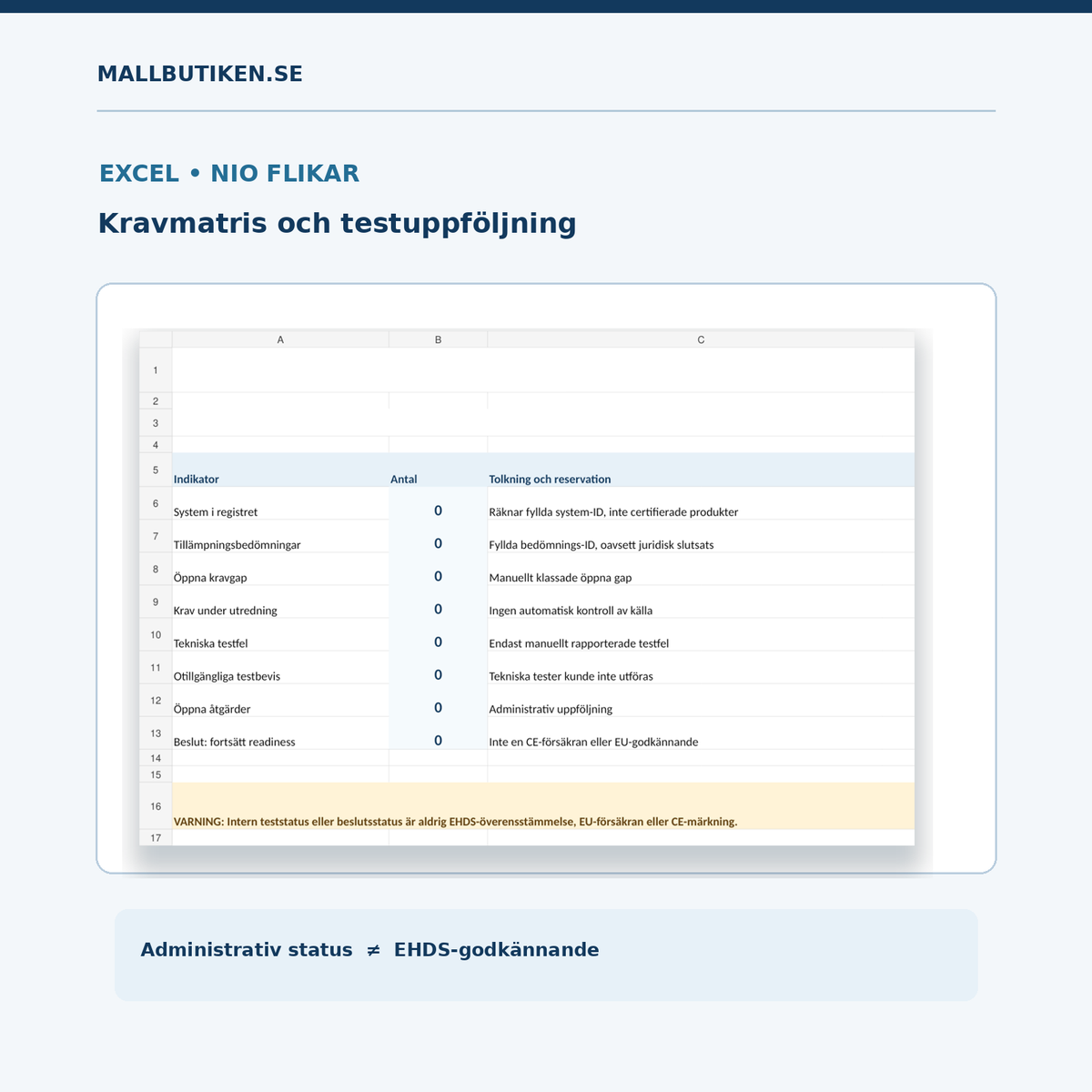
| 08 EHDS Excel register | Record systems, applicability, requirements gaps, tests, suppliers, actions, and decisions. | Swedish | Editable XLSX |
How the Excel register works
Nine tabs: Overview, System Register, Applicability, Requirements Matrix, Test Register, Suppliers, Actions, Decisions, and Read Me. The overview summarises, among other things, the number of registered systems, open requirements gaps, failed tests, and internal readiness decisions using tested COUNTA/COUNTIF formulas. In the event of a test case with an open gap and a failed test, both are reported separately. Excel does not determine whether a health record system is covered by the EHDS or approved. Test data have been removed from the customer file.
Step-by-step workflow
- Identify the system, intended purpose, supplier, and priority data categories.
- Determine whether the current solution is an EHR system or general software and document the basis for the decision.
- Assess relevant implementation dates and requirements against currently applicable regulations and specifications.
- Document interoperability gaps and test logging with synthetic identities.
- Request missing supplier evidence and record action ownership.
- Make a separate human readiness decision, archive the supporting documentation, and return to the new source version if regulations change.
Legal prerequisites and important dates
Regulation (EU) 2025/327 (EHDS) entered into force on 26 March 2025. According to Article 105, the provisions apply in stages. The first core EHR/priority data requirements apply to relevant categories from 26 March 2029, and additional categories from 26 March 31 2031. Other provisions have different application dates. Therefore, classify each system and applicability separately; do not refer to 2029 as the general start date for the entire regulation.
Article 25 concerns the harmonised interoperability and logging components. General software in a healthcare environment is not automatically covered by this chapter. Annex II describes the basic technical requirements; Article 36 addresses common specifications. Actual compliance requires the relevant specification, real testing, technical documentation, and the correct process for the relevant actor. The Commission's EHR guidance describes the structure. See also Articles 27, 30, and 37–41, as well as Annex III, where applicable.
An EHR adaptation does not replace separate obligations under GDPR, medical device regulations, IVDR, or the AI Act. No template here constitutes evidence of regulatory compliance. Professional review may be required before actual market access and deployment.
Difference from other documents
The EHDS package focuses on EHR system functions, technical gaps, and evidence. A GDPR personal data breach package, in contrast, deals with handling a privacy incident that has occurred. An AI Governance package addresses specific AI governance issues. These areas may need to be reviewed in parallel, but the document types are not interchangeable.
Frequently asked questions
Does the EHDS apply to all health record systems already in 2027?
No. The EHDS has several application dates, and the system's intended purpose and data category determine which rules are relevant. Article 105 needs to be checked for the actual product.
What does interoperability mean in this package?
It involves mapping and documenting support for import, export, and the relevant electronic exchange format (EEHRxF). The template does not test any technical integration itself.
Can we use real patient records in Excel?
No. Use only synthetic test identities and administrative references. Handle real patient data in approved systems and in accordance with your data protection and security processes.
Does a passed test prove that our system complies with the EHDS?
No. An individual technical test only proves its documented outcome. Applicability, common specifications, the technical file, and the relevant assessment procedure must be assessed separately.
Are the Swedish work documents translated into English?
No. The English User Guide provides instructions in English; five work templates and the Excel workbook are in Swedish.
Are the PDF files digitally fillable?
No. The PDFs are searchable and printable static versions. Edit the Word files to fill them in digitally.
Sources, version, and transparency
Official sources: EUR-Lex, Regulation (EU) 2025/327, the European Commission's EHDS timeline, and the Swedish Medical Products Agency's EHDS information.
Product version: 1.0, 11 November 2026. Legal source review: AI-assisted review of legal sources and final documents 11 November 2026; technical file review separately. No independent external legal review, regulatory review, or certification. Delivery format after activation: digital ZIP via the store's download function.