Svenska Dokumentmallar
Digital Product Passport for Toys 2030 – Data Sheet, Supplier Declaration & QR Verification | Word/PDF/Excel
Digital Product Passport for Toys 2030 – Data Sheet, Supplier Declaration & QR Verification | Word/PDF/Excel
- File format
- DOCX, PDF, XLSX
- Document language
- Five Swedish work templates one Swedish guide and a separate English User Guide. Excel in Swedish.
- Number of files
- 7
Digital download. No physical product is shipped.
Couldn't load pickup availability
About this template
Do you manufacture or import toys and need to prepare digital product passports ahead of 2030? This specialist package helps Swedish toy companies collect the future DPP data required by the model, request evidence of testing from suppliers, check data carriers, and document remaining non-conformities. The package does not create a completed or registered digital product passport, CE certificate, or regulatory approval.
Important regarding timing: The EU's new toy regulation (EU) 2025/2509 entered into force on 1 January 2026. Its main rules, including the general requirement for a digital product passport, begin to apply on 1 August 2030. Certain specified provisions apply as early as 2026, and Articles 57 and 59 contain transitional and time-related provisions. The Swedish Consumer Agency explains the timeline.
Quick facts: For toy manufacturers, importers, and relevant distributors • Sweden/EU • 7 editable Word documents (DOCX) • 7 searchable and printable PDF documents • 1 Excel workbook (XLSX) • 15 files in total • five Swedish specialist templates, a Swedish guide, and an English User Guide • PDFs lack interactive fillable fields • future digital ZIP delivery upon manual activation.
01 · Package contents
Five independent Swedish work templates, a Swedish user guide, and a separate English User Guide. Each document is available in Word and as a corresponding searchable PDF, making 7 DOCX and 7 PDF files in total. A Swedish Excel register with nine tabs is included. 15 customer files in total in a ZIP, not 15 separate download links.
02 · What the files contain
Role and rule assessment, DPP data card according to Annex VI, supplier material and test evidence according to Annex V, testing of physical data carriers and visibility in distance selling, and a manual decision gate ahead of future launch. Excel compiles the status of work and missing evidence but never issues a declaration of conformity.
Who should choose this template?
Suitable for: Swedish toy manufacturers who need to prepare product identifiers and documentation for a specific model; importers who want to inventory supplier DPP and test evidence ahead of a new range; product, purchasing, quality, and compliance functions who want to document a clear action plan.
Not suitable for: a company looking to purchase a completed registered EU product passport, a QR code system, a CE declaration, or a regulatory-approved safety analysis. Those who only sell older products or other product categories may have completely different regulatory and transitional conditions.
All documents and formats
| Document | Function | Language | Format |
|---|---|---|---|
| 01 Applicability and roles | Assess toy model, manufacturer, importer, date, and transitional rule | SV | DOCX + PDF |
| 02 DPP data card Annex VI | Collect actual product, economic operator, standard, and data carrier information | SV | DOCX + PDF |
| 03 Supplier certificates and test evidence | Request material, testing, and documentation evidence according to Annex V | SV | DOCX + PDF |
| 04 Data carrier and e-commerce test | Check model ID, physical data carrier, purchase flow, and access | SV | DOCX + PDF |
| 05 Pre-launch decision 2030 | Separate manual decision gate, conditions, and non-conformity list | SV | DOCX + PDF |
| 06 Swedish user guide | Legal timeline and workflow for Swedish main files | SV | DOCX + PDF |
| 07 English User Guide | Instructions for five Swedish templates, not a translation of them | EN | DOCX + PDF |
| 08 Excel – nine tabs | Register for model ID, sources, evidence, tests, non-conformities, and decisions | SV | XLSX |
Excel: nine meaningful tabs
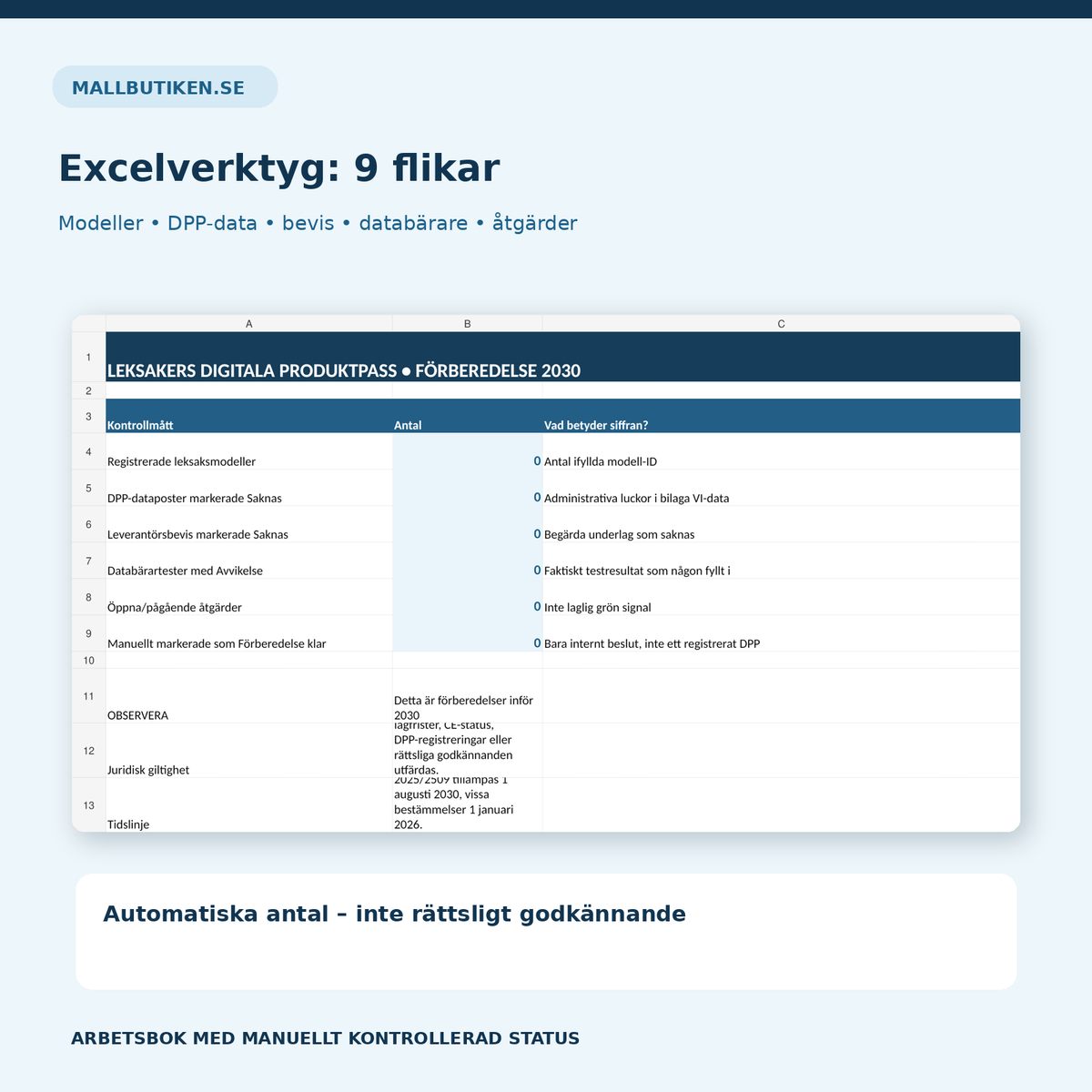
The workbook consists of Overview, Toy Models, DPP Data, Supplier Evidence, QR & E-commerce, Actions, Decisions, Sources, and Read Me. Register model ID, actual document references, manual reviews, supplier responses, and non-conformities. The overview uses controlled summary formulas to show the number of registered models, items marked “Missing”, tests with “Non-conformity”, open actions, and manually decided preparation steps.
An empty customer workbook starts with 0 models, 0 non-conformities, and 0 decisions. No personal data, made-up CE numbers, real product passport IDs, or test cases have been left in. There are no macros or automatic external links.
How to use the template package
- Determine product and role: document whether the item is a toy, who is the manufacturer and importer, and when the product was actually placed on the market.
- Create model-specific data card: collect the data points covered by Annex VI to (EU) 2025/2590. Use an actual evidence reference in each field.
- Request supplier documentation: collect technical documentation, material information, safety assessments, and test results according to relevant parts of Annex V.
- Plan the data carrier: check the readability, physical placement, and visibility before purchase of the intended solution. A QR code is one possible example of a data carrier, not evidence of compliance in itself.
- Follow up on non-conformities: register incomplete data, who is responsible, and when new actual testing is needed.
- Perform separate 2030 check: ahead of actual market launch, the applicable technical rules, safety requirements, and registration procedures must be checked again.
Legal conditions and limitations
Article 19 and Annex VI: the future manufacturer obligation refers to a model-specific digital product passport with identifiable information. An internal Word/Excel data card is not equivalent to public registration and must not be described as an actual passport.
Articles 20 and 21: technical interoperability, availability, and identifiers must be handled in a real DPP solution. Companies should not lock themselves into a made-up identifier system or incorrect QR requirements during the preparation stage.
Articles 25–27 and Annex V: a correct safety and conformity assessment, as well as technical documentation, requires actual evidence. Templates, markings, and Excel formulas cannot replace testing, certification where applicable, or competent documentation.
Articles 57 and 59: the product's market date and transitional provisions are central. According to the Swedish Chemicals Agency's guidance, companies should prepare for 2030 rather than treating most of the requirements as already applicable in 2026.
Difference from a regular DPP package
The existing broad ESPR package deals with ecodesign and product passports more generally. This product is specific to toy Annex VI data and EU 2025/2509, with a special preparation track for supplier evidence and expected visibility in distance selling. For the current safety information on the product page, there is also GPSR Article 19 – product listing; it does not replace the toy regulation's special future passport requirements.
Frequently asked questions
Must my toy have a digital product passport already in 2026?
No, the main requirement in the new toy regulation begins to apply on 1 August 2030. Other, earlier applicable product safety requirements may still be relevant now.
Does Excel create a valid DPP identifier or QR code?
No. Excel is a manual preparation register. Technical identifiers, actual data carrier, and product passport registration require a separate correct system and check.
Is it always the importer who must issue the product passport?
No. Article 19 is based on the manufacturer's obligations. The actual roles, document checks, and responsibilities of the importer and distributor must be assessed separately.
Are all the files in English?
No. The five main documents and Excel are in Swedish. A Swedish guide and a separate English User Guide are included, explaining how the Swedish templates are used.
Does the package guarantee legal compliance in 2030?
No. The regulation may be supplemented by technical rules. The actually used version of the law, standards, product data, and test evidence must be reviewed ahead of future launch.
Sources, document version, and transparency
Version 1.0 • AI-assisted legal source check 10 November 2026 • Sweden/EU. Official sources: Regulation (EU) 2025/2509 – especially Articles 19–21, 25–27, 57, 59, and Annexes V and VI, The Swedish Consumer Agency's questions and answers, and the Swedish Chemicals Agency's information. No external legal review, regulatory review, DPP registration, or actual toy certification is included. The future customer ZIP file has not been linked to Digital Products during this DRAFT round.
Related guide: Read about digital product passports (DPP) and EU rules. The guide explains the regulatory framework and varying application dates; the template pack provides practical preparation.