
GPSR or DSA for marketplaces? Rules and checklist 2026

Short answer: The GPSR (EU) 2023/988 regulates product safety and specific obligations for online marketplaces, while the DSA (EU) 2022/2065 regulates liability and due diligence obligations for digital intermediary services and platforms. A marketplace where external traders offer consumer products may need to comply with both. The requirements for seller identification, visible product information, handling of dangerous listings, and information to buyers must be assessed in conjunction – however, legal scopes and exemptions are not identical.
Fact-checked: October 19, 2026 · Primary legal sources: GPSR, consolidated May 29, 2026 and the Digital Services Act. This article provides general information and primarily concerns marketplaces with third-party sellers offering consumer products to EU customers.
What is the difference between the GPSR and the DSA?
The DSA's general rules on reporting suspected illegal content are described in the guide to Article 16 and Notice and Action. Distinguish these from the GPSR's specific product safety measures.
The GPSR is the general product safety regulation. It became applicable on December 13, 2024, and sets requirements for relevant consumer products and for relevant actors in the supply chain. Article 22 prescribes specific obligations for providers of online marketplaces regarding product safety. Article 19 also regulates information in distance offers from economic operators.
The DSA generally became applicable on February 17, 2024, and addresses, among other things, the reporting of illegal content, platform processes, seller traceability, and the design of marketplace interfaces. The DSA's Articles 16, 29–32 are particularly relevant here, but obligations depend on the platform type and certain size exemptions.
GPSR vs. DSA – overview of requirements
| Area | GPSR | DSA |
|---|---|---|
| Main purpose | Product safety, traceability, measures against dangerous consumer products. | Due diligence and processes for digital intermediary services, including handling of illegal listings. |
| Marketplace contact channels | Article 22.1–2: contact point for market surveillance authorities and for consumers, registration in the Safety Gate portal. | Articles 11–12 contain specific contact point requirements for providers of intermediary services. |
| Identify traders (KYBC) | Article 22.10: mechanism enabling the seller's product safety information and self-declaration. | Article 30: verification and collection of specific trader data for relevant marketplaces; with Article 29 exemptions. |
| Product listing | Article 22.9: interface for manufacturers, EU responsible person when relevant, product image, and necessary warnings. | Article 31: compliance by design for relevant marketplaces, with Article 29 exemptions. |
| Reporting illegal or dangerous listings | Article 22.8: product safety notifications via the DSA Article 16 mechanism are processed within three working days. | Article 16: mechanism for notification and action against alleged illegal content, with requirements for reasoned, prompt, and non-arbitrary processing. |
| Authority order regarding dangerous product | Article 22.4: necessary measures without undue delay, no later than two working days from receiving a valid order. | Article 9: general frameworks for orders to act against illegal content. |
| Information to customers after purchase | Article 22.12 and 35: relevant contact and information regarding product safety recalls or safety warnings. | Article 32: information on detected illegal product or service, normally only purchases in the last six months and with Article 29 exemptions. |
Important distinction: The exemption for micro and small enterprises in DSA Article 29 concerns the specific section containing Articles 30–32. It does not automatically remove the GPSR's specific obligations under Article 22 or the general DSA obligations that are otherwise applicable.
Is a regular web shop, a marketplace, or both covered?
Web shop selling only its own products
The company assesses its obligations based on whether it is a manufacturer, importer, or distributor of goods within the scope of the GPSR. However, it is generally not an online marketplace with third-party sellers just because products are sold via a website. The DSA's general rules on intermediary services and its specific marketplace sections should therefore not be applied indiscriminately.
Marketplace where independent sellers offer consumer products
The platform provider must assess GPSR Article 22 when it facilitates offers of relevant consumer products, and the DSA according to the service's function and size. The trader's separate responsibility for safe products, labeling, and documentation does not disappear because the marketplace offers a reporting or seller form.
Company that both sells its own products and operates a marketplace
The company may have multiple roles simultaneously. Routines and risk liabilities then need to be documented per product and business flow. If the company sells under its own name or brand, the manufacturer's obligations may also apply according to relevant product rules.
What must be displayed in product listings?
The specific duty of design for relevant marketplaces is described in more detail in DSA Article 31 – how product fields, labeling, and controls are to be enabled.
GPSR Article 22.9 explicitly links to DSA Article 31. The online marketplace must design the interface so that the seller can provide and the consumer can see or easily access the details specified in Article 22.9 a–d:
- Manufacturer: name, registered trade name or trademark, postal address, and electronic contact address.
- EU responsible actor: when the manufacturer is not established in the Union, the relevant responsible person's name, postal address, and electronic address must be stated.
- Product identity: relevant product image, product type, and other identifying information.
- Warnings and safety: the safety information required by the GPSR or applicable special legislation, in the correct language version.
Under GPSR Article 22.10, the interface must also enable the seller's self-declaration that they only offer products compliant with relevant Union rules. Simultaneously, DSA Article 30 may require verification of the seller's identity, contact details, registration data, and payment account details for platforms that are covered.
For a detailed checklist of the actual four GPSR listing requirements, see GPSR Article 19 – checklist for e-commerce and product information. Article 19 applies to the offers of relevant economic operators; Article 22.9 describes the marketplace's interface obligations.
Dangerous product detected – what time limits apply?
A dangerous product on a marketplace can trigger multiple processes. These should not be confused:
- DSA Article 16: a notification and action system for illegal content. The platform must process notifications within the framework of the DSA and provide relevant decisions and justifications in accordance with applicable provisions.
- GPSR Article 22.8: when such a notification concerns a safety issue for a product offered on the platform, the marketplace must process it without undue delay and no later than three working days from receipt.
- GPSR Article 22.4: after a valid authority order regarding a dangerous offer, necessary measures must be taken without undue delay and no later than two working days. The order may concern removing the offer, blocking access, or displaying a clear warning.
- GPSR Article 22.12: the platform must cooperate on risk-reduction measures and, when it has actual knowledge of a recall or safety warning, inform identifiable consumers who purchased via the platform.
A notification, an authority order, and a recall are thus different events. The two- and three-day deadlines should not be marketed as a general deadline for all DSA complaints or for all product safety incidents. Read the deep dive into GPSR recalls, customer information, and compensation according to Articles 35–37 regarding actual safety measures.
Do DSA KYBC rules also apply to small marketplaces?
The specific conditions for platform providers and seller identification are explained further in the guide on DSA Article 30 and KYBC for marketplaces.
DSA Article 29 generally exempts micro and small enterprises according to the EU definition from the specific section containing Articles 30–32, with a time-limited subsequent exemption when the company loses its size status and an express exception from the exemption for designated very large online platforms (VLOPs). Assess the size based on relevant EU definitions, even when partner or affiliated companies need to be included.
What does DSA Article 32 require after the sale of an illegal product?
Also see our separate practical guide to DSA Article 32 and information on illegal products with the six-month rule, buyer notifications, and the boundary against the GPSR recall requirements.
When a platform covered by Article 32 becomes aware that a trader has offered an illegal product or service via the platform, it must, according to the provision, inform the affected consumers, to the extent contact details exist, about the illegality, the seller's identity, and relevant remedies. The six-month limit applies to purchases within six months prior to the time the platform became aware of the illegality. If contact details are missing, equivalent information must be made public and easily accessible on the platform's interface.
The provision has a different scope than the GPSR's specific product recall and safety warning rules. A platform may not use the DSA's six-month rule as a general cap for which consumers should be contacted in the event of a product safety recall according to the GPSR.
Practical checklist for the marketplace
- Determine if the service is an online marketplace and which products, countries, and seller roles are covered.
- Assess whether the DSA Article 29 exemption applies to Articles 30–32, without ignoring other obligations.
- Establish contact points for market surveillance authorities and consumers according to the GPSR and register relevant information in Safety Gate.
- Create interfaces for the seller's contact information and self-declaration, as well as product identity, manufacturer, EU responsible person, and warnings.
- Implement relevant routines for DSA notice-and-action and the GPSR's specific handling of product safety notifications and authority orders.
- Document how dangerous goods are identified and handled, including relevant data from Safety Gate.
- Establish a plan for direct customer contact and published warnings upon knowledge of product safety recalls.
- Ensure that product information and seller data can be linked to decisions and that data is processed lawfully, also from a data protection perspective.
Which documentation package fits the work?
DSA – platform routines and seller traceability
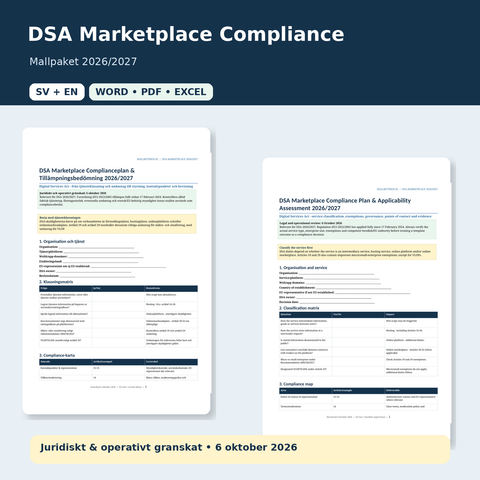
For the process surrounding KYBC, notice-and-action, compliance by design, and Article 32, see Mallbutiken's DSA Marketplace Compliance 2026/2027 – Swedish/English Word, PDF, and Excel. Also read the main guide on the DSA and marketplaces.
GPSR – product safety and recalls
For product, supplier, risk, and recall documentation, see GPSR Product Safety & Recall Compliance 2026/2027 – Word/PDF/Excel. Complement this with the guide on the GPSR, Safety Gate, and risk assessment.
Limitation: Document templates can facilitate the work but do not replace actual verification of seller roles, safety risks, applicable exemptions, or authority decisions. Check the current product description and which digital files are included with the purchase.
Frequently asked questions about GPSR and DSA for marketplaces
Does my Shopify store need to follow the DSA rules for marketplaces?
Not just because it uses Shopify. It depends on whether the company actually provides such an intermediary or marketplace service that the DSA regulates. A store that only sells its own goods should primarily assess its relevant product and consumer protection obligations.
Are the GPSR and DSA the same thing?
No. The GPSR primarily regulates product safety and associated responsibilities for relevant actors. The DSA regulates the obligations of digital intermediary services and platforms, including the handling of illegal listings and certain marketplace requirements.
Does three working days apply to every DSA notification?
No. GPSR Article 22.8 specifies a final deadline of three working days for notifications concerning product safety issues received according to DSA Article 16. The DSA's general notification system has its own principles for processing.
Can a small marketplace ignore the GPSR because DSA Article 29 applies?
No. The DSA's size exemption applies to its specific section on certain marketplace requirements. It does not mean that GPSR Article 22 automatically ceases to apply.
Must every platform check every seller detail and every product's safety itself?
The DSA and GPSR contain specified obligations regarding information, checks, and handling of notifications. Neither regulation entails a general, unlimited obligation to monitor all third-party listings in advance. At the same time, the platform must fulfill the concrete control and action obligations that are applicable.
Is the six-month rule in the DSA also a time limit for a GPSR recall?
No. The six-month limit in DSA Article 32 applies to its specific information obligation regarding detected illegal products or services. The GPSR's rules on recalls and safety warnings have their own scope.
Legal sources and fact-checking
- EUR-Lex: Regulation (EU) 2023/988, GPSR, consolidated May 29, 2026 – Articles 19, 22, and 35.
- EUR-Lex: Regulation (EU) 2022/2065, Digital Services Act – Articles 9, 11, 12, 16, 29, 30, 31, and 32.
- European Commission guidance 2025/C 6233 – specific requirements for online marketplaces under the GPSR.
- European Commission: product safety and Safety Gate.
Legal limitation: This is fact-checked general guidance, not a legal authority decision or a certification of a specific platform. Assess service classification, company size, product category, the economic operator's role, and any special regulation for every concrete business.
Templates in this article

GPSR Product Safety & Recall Compliance 2026/2027 – Swedish + English | Risk Assessment, Safety Gate & Guide Word/PDF/Excel
Word (DOCX) + PDF + Excel (XLSX)
79 SEK
View template: GPSR Product Safety & Recall Compliance 2026/2027 – Swedish + English | Risk Assessment, Safety Gate & Guide Word/PDF/Excel

Explore the topic
 Business guides – contracts, HR, AI & compliance
DSA Article 16 – Notice and Action: report illegal content 2026
Guide to DSA Article 16 and Notice and Action: how hosting services receive notifications, require correct information, send confirmations and deci...
 Business guides – contracts, HR, AI & compliance
DSA Article 31 – compliance by design for marketplaces 2026
Practical guide to DSA Article 31: compliance by design, product fields, prior and safety information, pre-publication checks, and reasonable rando...
 Business guides – contracts, HR, AI & compliance
GPSR Article 19 – requirements for product information in e-commerce 2026
GPSR Article 19: which information regarding manufacturers, responsible persons in the EU, product identification, and warnings must be displayed i...


