
DSA for marketplaces 2026 – KYBC, notice-and-action, and illegal products

Short answer: The Digital Services Act (DSA) imposes specific requirements on online platforms and marketplaces. For marketplaces, Articles 30–32 are particularly important: they relate to trader traceability (KYBC), interfaces that enable legal product information, and obligations when an illegal product or service is discovered.
Which DSA requirements are central to a marketplace?
| Area | What it means |
|---|---|
| Article 30 – trader traceability | The platform must obtain and, to a relevant extent, verify information about traders before they are allowed to offer goods or services to EU consumers. |
| Article 31 – compliance by design | The interface must allow traders to provide necessary pre-contractual, compliance, and product safety information. |
| Article 32 – information | When the platform becomes aware of an illegal product or service, affected consumers must in certain cases be informed about the illegality, the trader, and potential remedies. |
| Notice-and-action | There must be mechanisms for notifying illegal content and a documented handling process. |
What does KYBC mean?
Do you want to implement seller identification in practice? Read the in-depth article DSA Article 30 – KYBC, seller information, verification, storage, and checklist. It explains what must be published and what must remain internal.
KYBC – Know Your Business Customer – is often used as a practical term for the DSA's requirements on trader traceability. Information may include, among other things, name, address, phone number, email, identification data, payment account details, registration data, and a self-declaration that the offered products or services comply with EU law.
Practical workflow
Relevant online platforms must also be able to provide information about the possibility of using certified bodies. See DSA Article 21 – out-of-court dispute settlement, bodies, fees, and deadlines.
Supplement the handling of notifications with an objective review process. See our guide on DSA Article 20 and free internal complaint handling.
A complete DSA process must also be able to justify actual restriction decisions. Read DSA Article 17 – what a statement of reasons must contain.
For a specific workflow for the notification mechanism under Article 16, read Notice and Action – notification, processing, and decisions under the DSA.
When an illegal good or service has already been offered, consumer information must also be assessed. Read DSA Article 32 – when and how marketplaces inform buyers.
For a specific product and interface perspective, see our practical guide to DSA Article 31 and compliance by design.
- Classify the service and determine which DSA rules apply.
- Build an onboarding flow for trader information and verification.
- Define rules for blocking when information is missing or cannot be verified.
- Ensure that the product interface has fields for mandatory safety and compliance information.
- Implement notice-and-action, statement of reasons, and internal traceability.
- Document the process for illegal products, consumer information, and evidence.
DSA and GPSR must be read together
For marketplaces that facilitate physical consumer products, the DSA often needs to be combined with product safety regulations, particularly the GPSR. The DSA focuses, among other things, on platform responsibility and trader traceability, while the GPSR contains more product-specific safety and recall requirements.
Frequently asked questions
Does a marketplace have to check every product manually?
The DSA does not imply a general requirement to monitor all content. However, there are concrete requirements for processes, trader information, and reasonable checks within regulated areas.
Does the DSA only apply to large platforms?
No. The DSA contains obligations for several types of intermediary services, but the scope varies, and certain exemptions apply to smaller players.
What should be documented?
At a minimum: trader onboarding, verification steps, notice-and-action, statements of reasons, complaints, information flows, and responsibilities between functions.
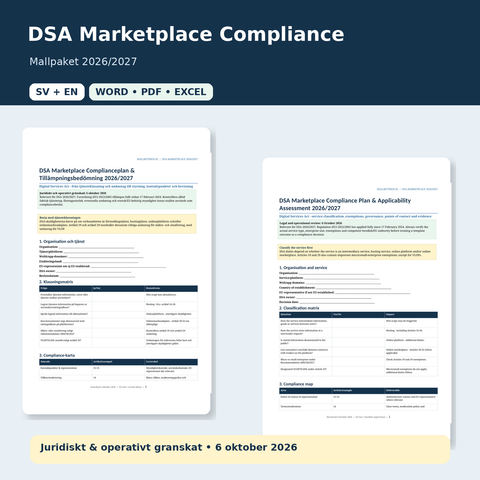
See DSA Marketplace Compliance 2026/2027.
Related guides
- EU compliance for companies 2026/2027
- Battery producers on marketplaces: Where a marketplace subject to DSA Article 30 enables direct sales by battery producers to consumers, Article 62(6) of the EU Batteries Regulation specifies the producer-registration details and EPR self-certification to collect under DSA Article 30(1)(d–e). This differs from a distributor's waste-battery take-back duties. guide to battery producer registers and EPR checks.
- Controller or processor?
- Which companies are covered by NIS2?
More working templates: See more templates for EU compliance and product regulations.
Sources
The guide provides general information and is not legal advice.
Templates in this article
Explore the topic
 Business guides – contracts, HR, AI & compliance
DSA Article 30 – KYBC and trader identification for marketplaces 2026
In-depth guide on DSA Article 30 and KYBC: which trader information must be collected, verified, and displayed on marketplaces, six-month deletion ...
 Business guides – contracts, HR, AI & compliance
DSA Article 21 – out-of-court dispute settlement for content moderation decisions 2026
DSA Article 21 – guide to certified out-of-court dispute settlement bodies, the 90/180-day deadline, fees, eligibility, cooperation, and the differ...
 Business guides – contracts, HR, AI & compliance
DSA Article 20 – Internal complaint-handling system and appeal 2026
Practical guide on the internal complaint-handling system under DSA Article 20: which moderation decisions can be appealed, the six-month deadline,...


