
Batteries on online marketplaces – producer registers, EPR declarations and seller access

Do battery producers sell directly to EU consumers through your online marketplace? Article 62(6) of Regulation (EU) 2023/1542 may require the platform to obtain producer-register details, registration numbers and a separate declaration about extended producer responsibility (EPR). The rule is linked to the Digital Services Act (DSA) trader-traceability provisions. It does not automatically cover every ordinary web shop or every reseller of someone else's batteries.
Who is covered by Article 62(6)?
The provision addresses providers of online platforms covered by Chapter III, Section 4 of the DSA that enable consumers to conclude distance contracts directly with producers offering batteries. Batteries built into appliances, light means of transport and other vehicles are expressly included. Establish the platform's role, the producer's role and the consumer's actual contracting party before applying the requirement. DSA Article 29 generally excludes qualifying micro and small platform providers from that section, subject to limitations, notably for very large online platforms. A small seller does not automatically exempt a larger platform. A Shopify shop selling only its own products is not necessarily a marketplace.
What information must a marketplace obtain?
Article 62(6) calls for two distinct sets of information from qualifying battery producers: (1) the producer register referred to in Article 55 and the producer's registration number, and (2) a self-certification undertaking to offer only batteries for which the listed EPR requirements are met. A self-certification is not an official certificate or a substitute for registration. Offers across several Member States require country-specific assessment. The Swedish Environmental Protection Agency explains Swedish registration but does not confirm registrations in every other EU country.
Onboarding decision matrix
| Situation | Check | Next action |
|---|---|---|
| Producer sells directly through a marketplace | Check DSA Articles 29–30, Member States, register/number and EPR declaration | Collect and assess the applicable evidence before enabling offers |
| Battery is built into an appliance | Identify the battery and producer even when another item is the main product | Do not omit embedded batteries |
| Independent distributor resells someone else's batteries | Identify seller, contracting party and actual producer | Assess the DSA obligations separately; do not assume identical Article 62(6) treatment |
| Platform is a micro or small enterprise | Examine DSA Article 29 and any very-large-platform status | Record reasons why Section 4 applies or not |
| Required information is missing | Identify the precise missing information and legal basis | Request completion and record a proportionate access decision |
Seven practical checks
- Classify the service: confirm whether consumers contract with independent traders and assess any DSA Article 29 exemption.
- Map the supply chain: distinguish direct producer sales from resale by a distributor.
- Map battery products and destination countries, including batteries built into other products.
- Request producer-register details: record country, number, source and verification date.
- Obtain the producer's EPR self-certification and identify its scope and commitments.
- Review quality: DSA Article 30 requires best efforts to assess relevant trader information; receiving a file is not the same as verifying it.
- Record decisions and follow-up: owner, missing information, technical access test, and renewed review after material changes; restrictions must follow applicable law.
Two cases illustrating the distinction
Power-bank marketplace. Independent producers sell directly to Swedish and Danish consumers. The onboarding team determines the relevant producer registers, countries and declarations, records sources and checks completeness. An Excel tracker alone does not prove registration.
Reseller of earphones with built-in batteries. The trader buys earphones from another manufacturer and resells them. Embedded batteries remain relevant, but Article 62(6) presupposes a particular relationship between platform and producer. Establish the contractual chain rather than applying the same EPR form to every reseller.
Common mistakes
- Confusing general DSA seller identification with the special batteries producer data.
- Describing an unverified self-declaration as an official certificate.
- Assuming a Swedish producer number automatically covers all EU Member States.
- Overlooking batteries built into appliances, bicycles or vehicles.
- Treating every Shopify store as a marketplace or overlooking DSA Article 29.
Frequently asked questions
Must every battery seller submit an EPR certificate?
Not necessarily under the same provision. Article 62(6) targets certain platforms facilitating direct producer-to-consumer sales; other sellers and DSA rules need separate assessment.
Does self-certification establish producer registration?
No. The rule lists both producer-register details and a separate undertaking. Keep them distinct.
Does the rule include batteries inside products?
Yes, it expressly mentions batteries in appliances, light means of transport and other vehicles, provided the platform and producer conditions are met.
Do you sell batteries as a distributor rather than operate a marketplace? Our guide to free battery take-back in online retail covers collection points, delivery returns and ordering information under Article 62(1–5), separate from the marketplace producer checks in Article 62(6).
Further reading and official sources
Read our DSA Article 30 / KYBC guide on general trader traceability and battery passport guide on a separate requirement. No purchase link is provided without verification of actual digital delivery.
- EU: Regulation (EU) 2023/1542, Articles 55, 56, 62(6), 96
- Digital Services Act (EU) 2022/2065, Articles 29–30
- Swedish Environmental Protection Agency: battery producer responsibility
Editorial source check: 16 November 2026. General information about EU requirements and Swedish registration where indicated, not individual legal advice, official registration, a guarantee of compliance or a claim of external lawyer review.
Explore the topic
 Business guides – contracts, HR, AI & compliance
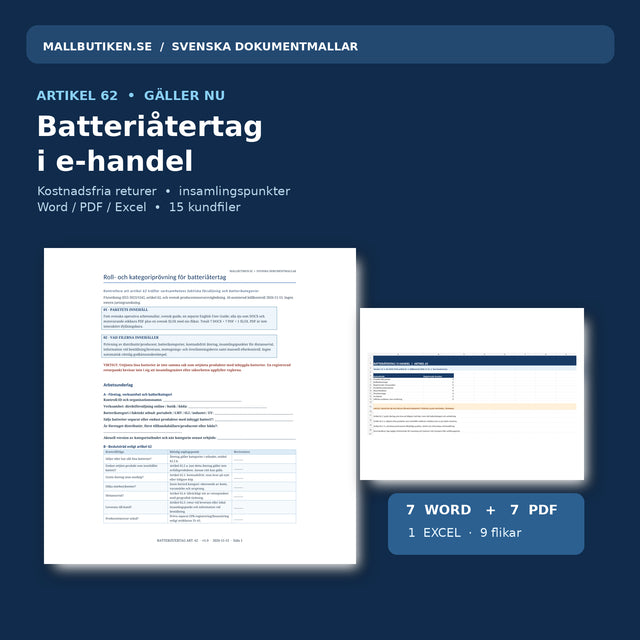
Battery take-back in online retail – free returns, collection points and Article 62
How online battery retailers must organise free take-back, accessible collection points and pre-order information under Article 62 of the EU Batter...
 Business guides – contracts, HR, AI & compliance
DSA Article 30 – KYBC and trader identification for marketplaces 2026
In-depth guide on DSA Article 30 and KYBC: which trader information must be collected, verified, and displayed on marketplaces, six-month deletion ...
 Business guides – contracts, HR, AI & compliance
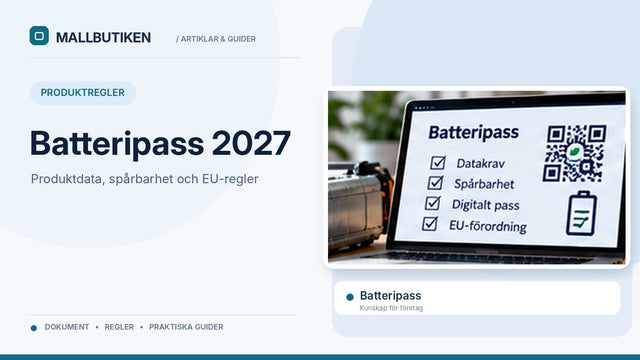
Battery Passport 2027 – which batteries are covered and what information is required?
Battery passports become mandatory on February 18, 2027, for LMT batteries, EV batteries, and industrial batteries over 2 kWh. A guide to data, QR,...


